
The Bible forbids charging interest to a poor fellow Israelite who borrows to survive (Exodus 22:25; Leviticus 25:35-37; Deuteronomy 23:19-20). It does not forbid every interest-bearing loan. Jesus tells a parable in which a master expects his money to earn interest at the bank (Matthew 25:27), and Deuteronomy 23:20 permits interest on loans to foreigners. The dividing line is who the borrower is and why the loan exists.
Christians have argued about this for centuries. The medieval church condemned lending at interest outright, and many reformers later argued that Scripture targets exploitation and not the commercial loan. Today the question lands in ordinary life: Can I charge interest when a relative asks to borrow? Is a savings account that pays interest acceptable? What about credit cards, car loans, a mortgage? This article reads the key passages in context, shows where the traditions differ and gives a practical way to decide.
Put it into practice
See what interest costs you or earns for you with the Compound Interest Calculator, and plan a payoff with the Debt Snowball Calculator.
The Old Testament laws on interest
Three law passages address the subject directly. Each one speaks about lending to a person in need.
Exodus 22:25. “If you lend money to any of my people with you who is poor, you shall not be to him as a moneylender, and you shall not exact interest from him” (ESV). Two conditions apply: the borrower belongs to God's people, and he is poor.
Leviticus 25:35-37. “If your brother becomes poor and cannot maintain himself with you, you shall support him as though he were a stranger and a sojourner, and he shall live with you. Take no interest from him or profit, but fear your God, that your brother may live beside you. You shall not lend him your money at interest, nor give him your food for profit” (ESV). The reason given is survival, and the instruction is to treat him as a member of the household.
Deuteronomy 23:19-20. “You shall not charge interest on loans to your brother, interest on money, interest on food, interest on anything that is lent for interest. You may charge a foreigner interest, but you may not charge your brother interest, that the LORD your God may bless you in all that you undertake in the land that you are entering to take possession of it” (ESV).
Two points follow from these texts. First, the ban protects the brother in distress. The loan in view is a lifeline: a farmer who lost a harvest and needs grain. Second, the law itself draws a distinction. Deuteronomy 23:20 allows interest on loans to a foreigner, which most commentators read as a commercial transaction with a traveling trader and not a rescue of a struggling neighbor.
Psalms, Proverbs and the prophets
The wisdom books share the same concern. “who does not put out his money at interest and does not take a bribe against the innocent. He who does these things shall never be moved” (Psalm 15:5, ESV). The psalm lists lending without interest among the marks of a person who may dwell in God's presence, in the same breath as refusing bribes against the innocent.
Proverbs 28:8 gives the flip side: “Whoever multiplies his wealth by interest and profit gathers it for him who is generous to the poor” (ESV). Wealth built by squeezing borrowers does not last in the hands that took it. The ethics are about oppression, and the proverb warns the oppressor that his gains will pass to someone kinder.
Nehemiah 5: what the law looked like in a crisis
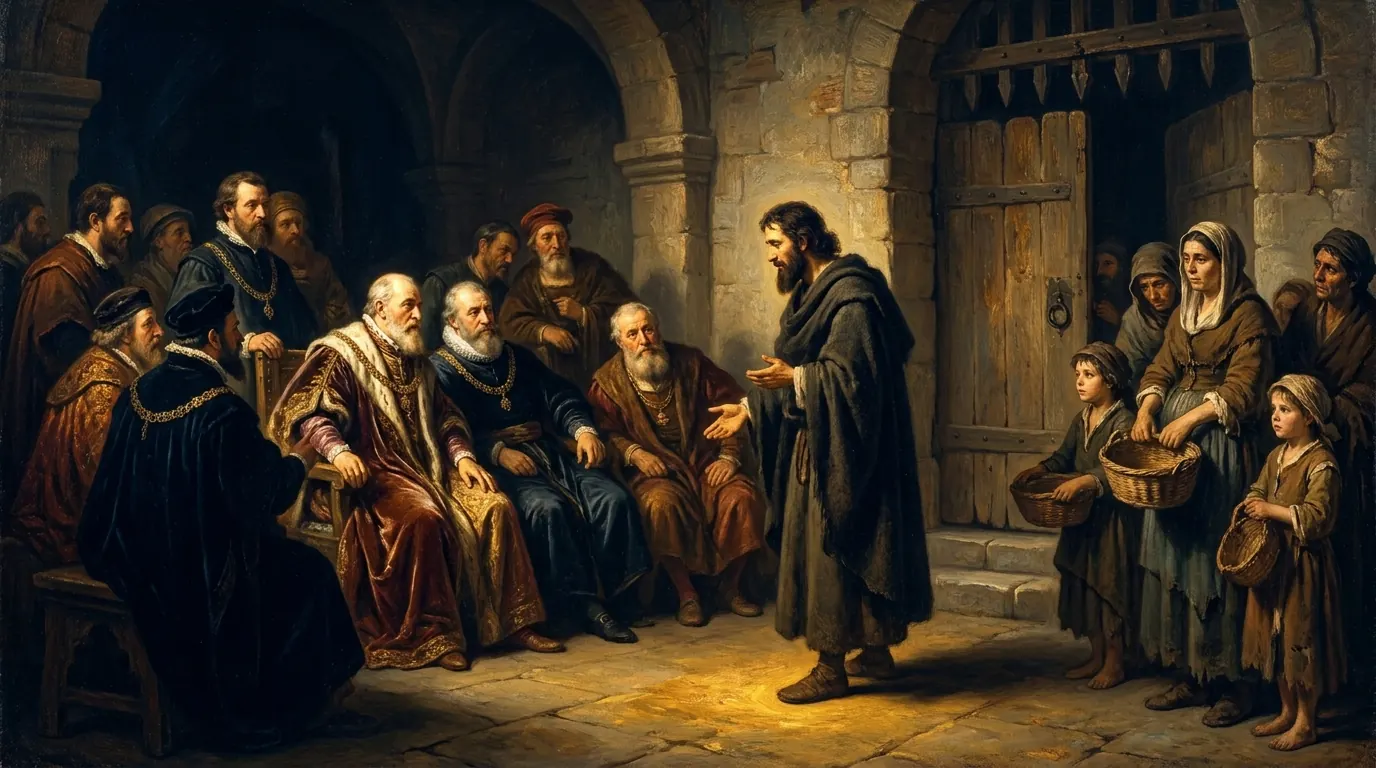
Nehemiah 5 shows these laws in action. A famine hit Jerusalem while the walls were being built. Families mortgaged fields and vineyards for grain, and some sold their children into servitude to pay debts. The nobles and officials who held the loans were Jewish brothers of the borrowers, and Nehemiah was furious.
He confesses that he and his own circle have been lending too, and then says: “Let us abandon this exacting of interest” (Nehemiah 5:10, ESV). He then orders the lenders to return the fields, vineyards, olive orchards and houses, along with the percentage they had been charging (5:11). The lenders agree and swear an oath.
This scene shows how the prohibition operated, since its target was lending that profits from a neighbor's emergency. Nehemiah himself had been lending, and his solution kept the help flowing and removed the squeeze. This is a model for a Christian with spare money and a struggling friend: help, and skip the profit.
What Jesus says
In the parable of the talents, a master rebukes the servant who buried his money: “Then you ought to have invested my money with the bankers, and at my coming I should have received what was my own with interest” (Matthew 25:27, ESV). Jesus does not condemn banking in the story. He uses it as the example of the minimum the master expected. A parable teaches about the kingdom, and its background still assumes that placing money with bankers to earn a return was normal and acceptable. Our study of the parable of the talents covers the full meaning.
Luke 6:34-35 pushes the other direction: “And if you lend to those from whom you expect to receive, what credit is that to you? Even sinners lend to sinners, to get back the same amount. But love your enemies, and do good, and lend, expecting nothing in return, and your reward will be great, and you will be sons of the Most High, for he is kind to the ungrateful and the evil” (ESV). Jesus raises the standard for lending that comes from love. When a neighbor is in need, the Christian goal is mercy, and the reward comes from God.
Taken together, the texts describe two kinds of lending. Mercy lending helps someone in trouble and asks for no profit. Commercial lending puts capital to work and may bear a return. The Bible commands the first and tolerates the second.
Two kinds of loans, in a table
| Situation | What Scripture points to | Passage |
|---|---|---|
| A brother or sister is poor and needs help to survive | Lend without interest or profit | Exodus 22:25; Leviticus 25:35-37 |
| Loan to a foreigner, a commercial dealing | Interest was permitted | Deuteronomy 23:20 |
| Funds placed with bankers to earn a return | Presented as the expected minimum in the parable | Matthew 25:27 |
| Profiting from a neighbor's crisis | Rebuked and reversed | Nehemiah 5:10-11 |
| Lending only to those who can repay you | Offers no special credit; lend in mercy as well | Luke 6:34-35 |
Applying it today
Lending to family and friends. When a relative or church member is in real need, the Old Testament pattern is clear: help without interest. Many Christians go further and make it a gift, since a loan to a person in crisis can strain the relationship. Our article on what the Bible says about loaning money goes through the wisdom side, including the warning about co-signing in surety.
Credit cards and consumer loans. The lender here is a company, and the borrower is often a household under strain. Many Christians draw on the spirit of the law and the warning in Proverbs 22:7, “The rich rules over the poor, and the borrower is the slave of the lender” (ESV), and treat high-interest consumer debt as a trap to leave. Read our pieces on Proverbs 22:7, credit cards and whether debt is a sin. The sin to avoid on your side is borrowing beyond your ability to repay and then withholding what you owe. Paul's standard in Romans 13:8 is to “Owe no one anything, except to love each other” (ESV), which many read as an aim and a direction of travel.
Savings accounts, bonds and investing. When you deposit money in a bank, you are in effect lending to the bank, and the interest you receive is the return. Matthew 25:27 supports using banks, and most Christian traditions today treat ordinary savings interest and commercial investing as acceptable. Our guide to compound interest in the Bible covers how to think about growth and greed together.
Business loans and mortgages. A loan to build a business or buy a home is commercial in purpose. The practical questions concern wisdom. Can you repay, is the rate fair, and what happens if income falls? Luke 14:28 asks you to count the cost first.
Being a lender. If you run a lending business or hold a rental, the biblical test is treatment of the weak. Charge a fair rate, disclose it plainly, show mercy to the borrower who hits real hardship, and refuse to profit from desperation. Nehemiah did not abolish lending. He ended the abuse.
A worked example: the same $5,000 loan
Suppose a church member asks to borrow $5,000 for a transmission and rent after a layoff. Under the law of Exodus 22:25 and Leviticus 25, you would lend the $5,000 and ask for $5,000 back, with a gracious repayment plan. If you charged 8 percent for a year, you would be asking $5,400, which means $400 of profit from a neighbor's bad season. The arithmetic is simple, and the point it makes is moral: the profit comes out of the borrower's hardship.
Compare a different scenario. You lend $5,000 to a friend who is opening a second shop and has a business plan, and you both agree to a fair rate in writing. The Bible does not label that transaction as the oppression the laws condemn. Put terms in writing in both cases and talk through what happens if repayment slips.
A framework for your decisions
1. Ask who the borrower is (Exodus 22:25). A neighbor in distress calls for mercy lending without profit.
2. Ask what the loan is for (Leviticus 25:35-36). Survival needs sit in a different category from capital for a business.
3. Put terms in writing (Luke 14:28). Amount, date and plan prevent hurt feelings later.
4. Never profit from desperation (Nehemiah 5:10). If the borrower is trapped, lower the cost or forgive.
5. Do not guarantee other people's debts casually (Proverbs 22:26-27). Count the exposure first.
6. Aim to owe little (Romans 13:8). Pay down high-interest balances first, and see our debt freedom hub for a plan.
7. Give where lending cannot help (Luke 6:35). Some needs call for a gift.
Internal study path
Continue with Proverbs 22:7 on the borrower and the lender, is debt a sin?, compound interest in the Bible, verses about the borrower and the lender, loaning money, can Christians be landlords, and our debt freedom hub.