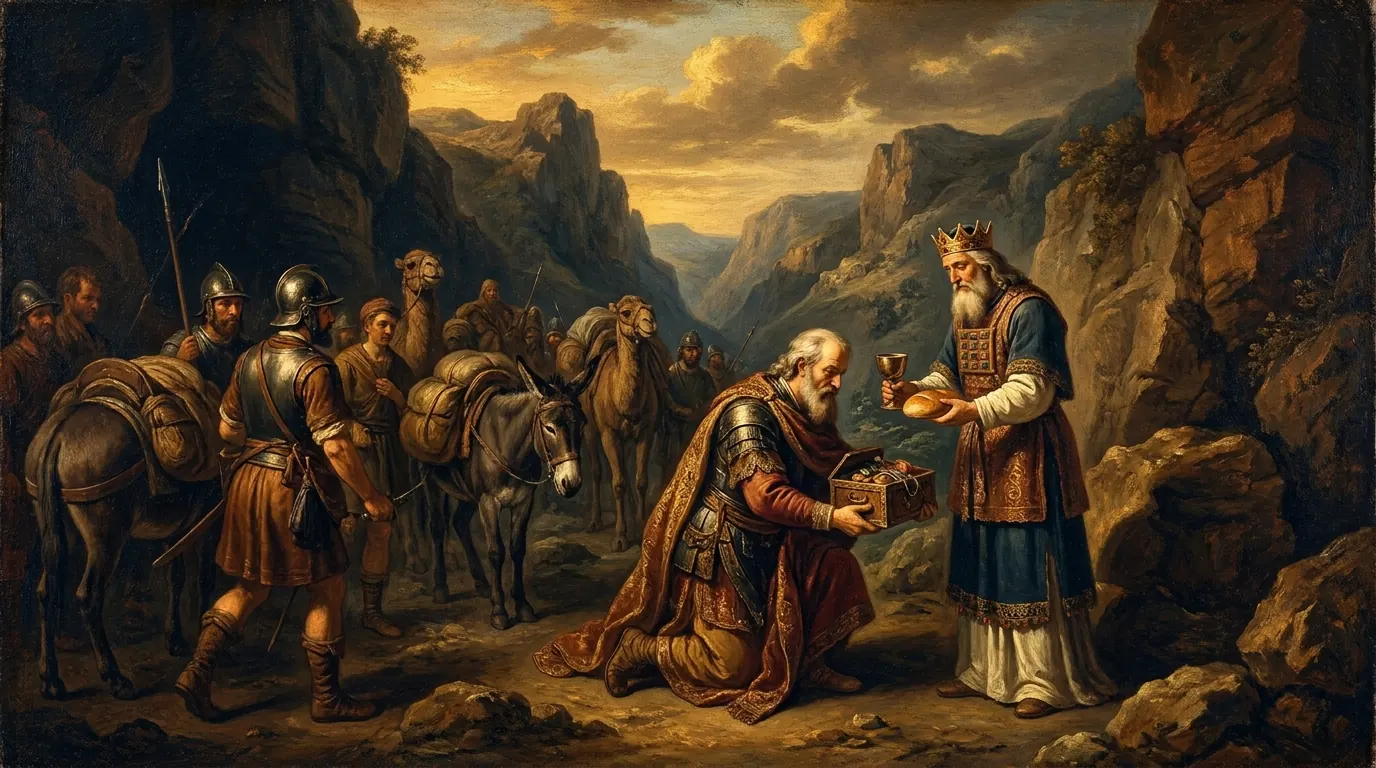
A biblical tithe is one tenth of your increase. The Old Testament has four tithing practices: Abraham’s gift to Melchizedek, the Levitical tithe, the festival tithe and the tithe for the poor. Jesus affirmed tithing in Matthew 23:23, and the New Testament never repeats the command. Christians hold three main positions today, and this guide states each one fairly so you can decide.
Put it into practice
Run our Tithe Calculator to see the weekly, monthly and annual tithe on gross or net income. Then find your situation among the practical pages at the end of this guide. Open it now →
In this guide
- The Hebrew and Greek words
- Tithes in the Old Testament (table)
- Malachi 3 and the storehouse
- Jesus and Paul on giving
- Three Christian positions
- How to decide
- Practical guides for your situation
The Hebrew and Greek words
Hebrew ma’aser means “a tenth.” The verb asar means to give a tenth. The Greek Old Testament (the Septuagint) uses dekatē, also “a tenth,” and the New Testament keeps that word in Luke 18:12 and Hebrews 7. Both languages carry a precise number, so a tithe is a tenth. Whatever you decide about how the tithe applies today, this is the measure the Bible names.
Tithes in the Old Testament
The Old Testament shows tithing before the law of Moses and then in three forms inside it.
| Tithe | Passage | What it was | Who received it |
|---|---|---|---|
| Abraham and Melchizedek | Genesis 14:18-20; Hebrews 7:1-10 | A tenth of the spoils of battle, given once | Melchizedek, priest of God Most High and king of Salem |
| Jacob’s vow | Genesis 28:20-22 | A promised tenth of all God gives him | God, at Bethel |
| Levitical tithe | Leviticus 27:30-32; Numbers 18:21-24 | A tenth of the crops and herds | The Levites, who held no land; they gave a tenth of it to the priests (Numbers 18:26) |
| Festival tithe | Deuteronomy 14:22-27 | A tenth eaten before the LORD at the place he chose | The family itself, with the Levite invited to the meal |
| Tithe for the poor | Deuteronomy 14:28-29; 26:12 | A tenth stored in the towns every third year | The Levite, the foreigner, the fatherless and the widow |
Abraham’s tithe comes centuries before Sinai, since Galatians 3:17 counts 430 years from the promise to the law. That timing is the main reason many Christians see tithing as older than Moses. Others point out that Abraham gave once, from spoils, and that Genesis records no command.
Some scholars add the three Mosaic tithes and reach about 23 percent of income a year. Others read the festival tithe and the tithe for the poor as one tithe used in two ways. The debate does not change the main lesson. Faithful Israelites gave a tenth or more, and the tenth supported worship, the priesthood and the poor.
Malachi 3 and the storehouse
Malachi 3:8-10 is the best-known tithing passage: “Will man rob God? Yet you are robbing me. But you say, ‘How have we robbed you?’ In your tithes and contributions… Bring the full tithe into the storehouse, that there may be food in my house.” The storehouse (beit ha’otsar) was the room in the temple where tithes were kept and distributed to the Levites.
Christians who see the tithe as binding usually read the local church as today’s storehouse. Those who see it as an Old Testament practice note that the passage speaks to Israel under the covenant and that its promise of blessing is not a guarantee of wealth. Either way, Malachi shows God caring about how his people handle their first and best.
Jesus and Paul on giving
Jesus. In Matthew 23:23 and Luke 11:42 he tells the scribes and Pharisees that they tithe mint, dill and cumin yet have neglected justice, mercy and faithfulness. Then he adds that they ought to have done the latter without neglecting the former. Jesus affirms the practice while rebuking those who use it as a substitute for righteousness. In Luke 18:9-14 the Pharisee lists his tithing proudly, and Jesus condemns the pride.
Paul. Paul never commands a 10 percent tithe to churches. He asks for planned, proportional giving (1 Corinthians 16:2) and for cheerful, freely chosen giving (2 Corinthians 9:7). He praises the Macedonians who gave “beyond their means” (2 Corinthians 8:3). Our page on tithing in the New Testament goes through each passage.
Hebrews. Hebrews 7 cites Abraham’s tithe to argue that Christ’s priesthood is greater than Levi’s. The author uses the tithe as evidence about the priesthood. He does not add a rule for churches.
Three Christian positions on tithing today
Serious Christians read the same passages and land in three places. Each has strong support in church history.
| Position | Main argument | Practice |
|---|---|---|
| The tithe still applies | Abraham tithed before the law, Jesus affirmed it, and Hebrews 7 keeps the pattern. | Give 10 percent to your local church, often from gross income, and give offerings above it. |
| The tithe is a starting benchmark | The command belonged to Israel, and grace giving should equal or exceed it. | Use 10 percent as a floor, and grow past it as income and faith grow. |
| No fixed percentage in the New Testament | Paul asks for proportional, willing and generous giving and names no percent. | Decide a percent prayerfully with your household, and give sacrificially to the church and the poor. |
Denominations differ as well. See how Baptist, Catholic and Latter-day Saint teaching handle the question. Our page Is tithing required in the New Testament? tests the argument behind each position.
All three agree on four things. Giving is part of discipleship (2 Corinthians 9:7). The heart matters more than the sum (Mark 12:41-44). The poor belong in the picture (Deuteronomy 14:29; Galatians 2:10). Giving flows from gratitude, since Scripture treats what we have as God’s.
What the tenth teaches, whatever your position
Tithing has a purpose that outlasts the argument over the rule. Psalm 24:1 says the earth and everything in it belong to the LORD. Deuteronomy 8:18 says he gives the power to get wealth. A tenth handed back each month puts those two verses into practice, because it trains the hand to open before the budget closes.
The tenth also builds community. In the Old Testament it fed the Levites and the widow. In a healthy church it pays for the pastor, the building, the food pantry and the missionary. A household that gives regularly joins a body that carries needs together, and that is a good reason to give whichever of the three positions you hold. Our first fruits study follows the idea through the rest of the Bible.
How to decide
- Read the passages yourself. Start with Genesis 14, Malachi 3, Matthew 23:23 and 2 Corinthians 8–9.
- Ask your pastor. Your church has a position, and the conversation is worth having in person.
- Choose a percentage together. A married couple should settle it side by side so neither one gives under pressure. A starting point of 10 percent is common. On $4,000 of monthly income, 10 percent is $400.
- Choose the base. Firstfruits (Proverbs 3:9) suggests giving before other allocations, which many teachers read as gross income. Others use net. Both views have defenders. See tithe on gross or net.
- Choose the recipient. Many Christians give the tithe to the local church and add offerings to missions and the poor. See the difference between tithe and offering.
- Automate and review yearly. Recurring gifts remove the monthly decision. Revisit the number each year, and consider raising it a little.
If you are behind on bills or in debt, start with the amount you can give with a clear conscience and grow into it. See tithing while in debt.
A worked example: what gross and net look like
Take a household with $4,000 a month before taxes and about $3,300 a month after taxes and payroll deductions. The take-home figure is an illustration, since taxes vary by state and situation. Check with a tax professional about your own numbers.
| Base | Monthly income | 10% tithe per month | Per year |
|---|---|---|---|
| Gross | $4,000 | $400 | $4,800 |
| Net (illustrative) | $3,300 | $330 | $3,960 |
The gap is $70 a month, or $840 a year. Either base gives an honest answer once you choose it and hold to it. A household that cannot settle the question can start with net and raise the percentage over time, which brings the two numbers together.
Common questions
Do I tithe on a bonus or an inheritance? Many teachers treat both as increase, and some treat an inheritance as capital. See our pages on bonuses and inheritances.
What about stocks, crypto or Social Security? The same principle of firstfruits applies, and the details differ by asset. We cover stocks and crypto and Social Security separately.
Can I give the tithe to the poor or a missionary? Many churches teach the tithe for the local church and offerings for other causes. Others let members direct the whole amount. Talk with your pastor, and give offerings to missions and the poor in addition to the tithe when you can.
What if my church misuses funds? Raise the concern through the church’s governance first. If it cannot be fixed, find a faithful church and give there. Scripture asks for honest stewardship from those who receive gifts as well as those who give them.
Practical guides for your situation
- How much should I tithe by salary? Tables at common income levels.
- Tithe on gross or net? The two views compared with dollar examples.
- Tithe per paycheck for weekly, biweekly and monthly pay.
- Tithe on rental income for landlords.
- Tithing as a self-employed person or business owner.
- How to start tithing when you are broke.
- Tithe or pay off debt first?
- The Tithe Calculator for your own numbers.
A short tithing prayer
Father, all I have is yours. Give me a heart that gives gladly, a mind that gives wisely, and a household that gives together. Bless the church where this gift lands, and use it to feed the hungry, equip the leaders and reach the lost. Amen.
Internal study path
Continue with tithing in the Old Testament, the Melchizedek tithe, Malachi 3:10, Bible verses about tithing, first fruits, and our tithing hub.
Set the number now
Calculate your tithe in 30 seconds.
Enter income, choose gross or net, and get weekly, monthly and annual amounts ready to automate.
Open the Tithe Calculator →