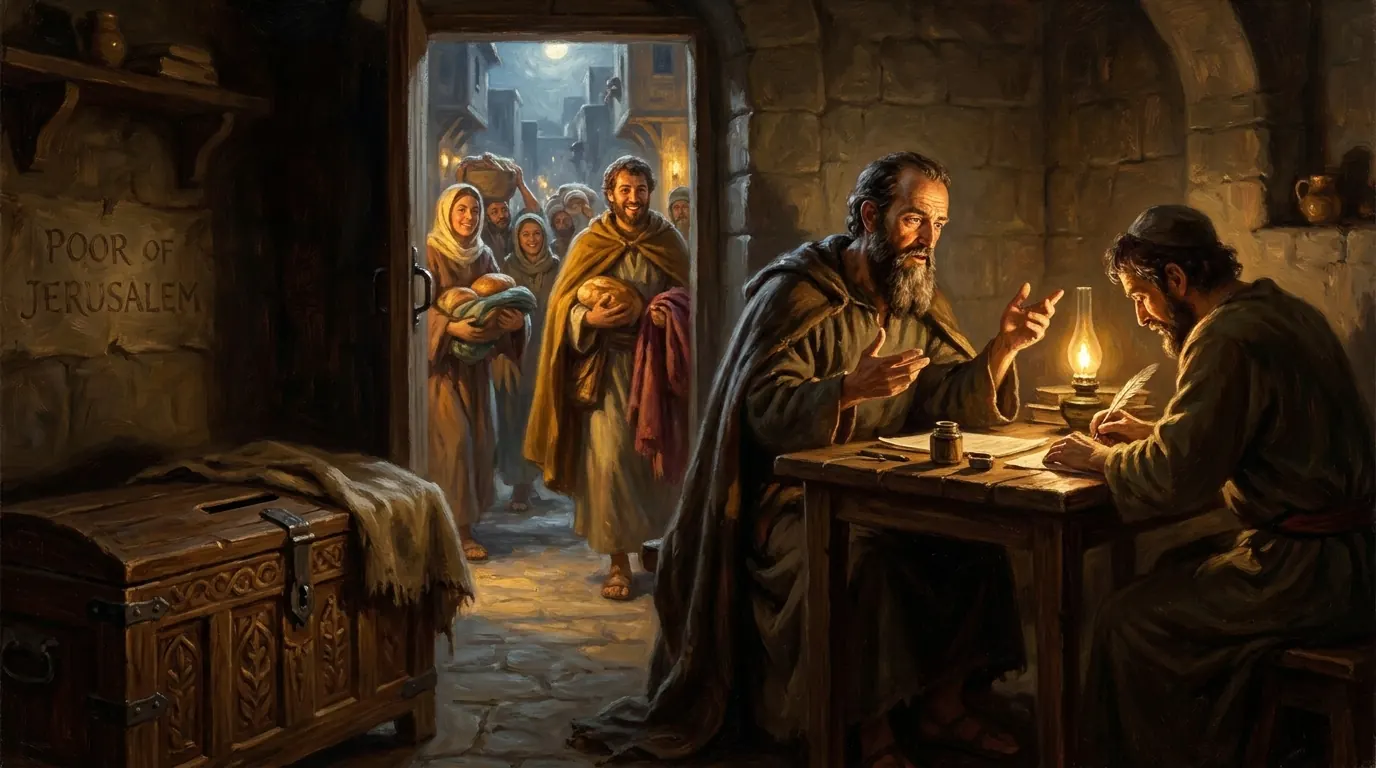
2 Corinthians 9:7 says each Christian should give what he has decided in his heart, without reluctance or pressure, because God loves a cheerful giver. The Greek word behind “cheerful” is hilaron, and the verse gives three instructions plus one promise of God’s love. Paul wrote it while raising money for the poor believers in Jerusalem.
Put it into practice
Paul says to decide in advance. Set your giving number with our Tithe Calculator and place it in your budget with the Budget Calculator. Open the Tithe Calculator →
The context: a collection for Jerusalem (2 Corinthians 8–9)
Paul was collecting money from Gentile churches for the Christians in Jerusalem, who were suffering from poverty. He mentions the project in Romans 15:26, gives the Corinthians instructions in 1 Corinthians 16:1-4, and spends two full chapters on it in 2 Corinthians 8 and 9. Most scholars date the letter to about AD 55–56.
The Corinthians had promised to give a year earlier and had not finished (8:10-11). Paul points to the churches of Macedonia, who gave out of “extreme poverty” and “beyond their means” (8:2-3). Then he sends Titus and two brothers to help complete the offering (8:16-24) so no one is embarrassed on his arrival (9:3-4).
Paul refuses to give an amount. In 8:8 he says he speaks without a command. He gives reasons, examples and a promise, and he leaves the decision with each person. Verse 7 is the center of that appeal.
The Greek word: hilaron
Hilaron (ἱλαρόν) means cheerful, glad, ready. English “hilarious” comes from the same root. It describes a giver whose heart is in the gift.
God loves (agapa, present tense) this kind of giver. The love is ongoing, and it attaches to the giver’s spirit as well as the gift.
Translations agree on the word and differ on how they phrase the two things Paul rules out.
| Translation | Rendering of hilaron | Rendering of “not reluctantly or under compulsion” |
|---|---|---|
| KJV | “God loveth a cheerful giver” | “not grudgingly, or of necessity” |
| ESV | “God loves a cheerful giver” | “not reluctantly or under compulsion” |
| NLT | “God loves a person who gives cheerfully” | “reluctance” or “pressure” |
| Latin Vulgate | hilarem datorem | non ex tristitia aut ex necessitate |
The Greek behind the second column is ek lupēs (from grief or sorrow) and ex anagkēs (from necessity). Paul names two things that spoil a gift: sorrow in the giver and force from outside.
The three instructions in verse 7
- “As he has decided in his heart” (kathōs proēirētai tē kardia). The verb proaireomai means to choose beforehand. Giving is planned before the offering plate comes by.
- “Not reluctantly” (mē ek lupēs). A gift given with regret in the heart misses what Paul asks for.
- “Not under compulsion” (mē ex anagkēs). A gift extracted by manipulation, shame or pressure falls outside what Paul describes.
The passage around it: verses 6–15
- v.6 — sow sparingly and you reap sparingly; sow bountifully and you reap bountifully.
- v.7 — the cheerful giver.
- v.8 — God is able to make all grace abound to you.
- v.9 — Paul quotes Psalm 112:9 about the righteous man’s giving.
- v.10-11 — God supplies seed and multiplies it, so you can be generous in every way.
- v.12-15 — the gift overflows in thanksgiving to God, and Paul ends with thanks for God’s indescribable gift.
Verse 7 is one line in a passage about giving as worship. Read it with the verses on either side and it sounds warmer than a rule about donation etiquette.
What the verse means and what it leaves alone
- Giving is a decision of the heart, made ahead of time.
- Joy is the mark of the gift Paul wants.
- Giving should be free of coercion, guilt and manipulation.
- God loves the giver who gives gladly.
The verse does not settle the tithe question. Jesus affirmed tithing in Matthew 23:23, and Paul asks for planned, regular giving in 1 Corinthians 16:2, but Christians differ on whether the tithe binds believers under the new covenant. Our biblical tithing guide lays out the main positions. What everyone can agree on is that 2 Corinthians 9:7 does not excuse giving nothing. Paul’s whole appeal assumes the Corinthians will give.
Three common misreadings
“I will give when I feel like it.” Paul asks the Corinthians to finish what they promised (8:11). A feeling comes and goes, and a decision made in advance carries you through the days when the feeling is missing.
“Verse 6 means every gift returns with interest.” Verse 6 says the sower reaps according to how he sows, and verse 8 speaks of grace abounding so that you have “all sufficiency in all things.” Paul does not promise a payout in dollars. His stated purpose for the abundance is more good works (9:8) and more thanksgiving to God (9:11-12). Our page on the prosperity gospel takes the reading apart in more detail.
“This verse is only about the offering plate.” Paul is raising relief for poor believers, and the principle reaches every gift you make, from help with a neighbor’s hospital bill to a check for a missionary.
How to give cheerfully: a practical section
Cheerfulness grows from a plan. These habits make it easier.
- Decide in advance. Choose a percentage or amount before the month begins. On a $4,000 monthly income, 10 percent is $400, and a rising step such as 1 percent more each year is $40 more per month. The Tithe Calculator shows both.
- Automate it. A recurring gift removes the moment of hesitation where reluctance lives.
- Give where you can see fruit. Your local church, a missionary you know, a family in need. Joy rises when the gift has a face.
- Pray over the gift. Ask God to give you a glad heart for it.
- Add a spontaneous gift. Set aside a small sum each month for whoever God puts in front of you (see Acts 20:35).
- Give within your means. Paul says in 8:12 that a gift is acceptable according to what a person has. A household in a tight month can start smaller. Our page on how to start tithing when broke shows how.
What if I do not feel cheerful?
Most people begin here. Paul asks for a decision of the heart, and a decision does not depend on a mood. The Macedonians show what a glad decision looks like in a hard season. Their joy overflowed in their poverty (8:2).
Start with an honest prayer: tell God the giving feels heavy. Read 2 Corinthians 8:1-9 and Acts 20:35. Start small and stay consistent. Cheerfulness follows practice, and it often arrives after the gift has been given. Reluctant giving may still help the person who receives it, and cheerful giving changes the giver. Our page of Bible verses about generosity gives more passages to pray through.
Internal study path
Continue with 2 Corinthians 8:9 on Christ’s generosity, the cheerful giver study, Luke 6:38, Proverbs 11:25, tithing in the New Testament, and our Generosity Calculator.
Give cheerfully
Decide in your heart and automate the math.
Honor God with firstfruits. Our free Tithe Calculator does the arithmetic in seconds.
Open the Tithe Calculator →