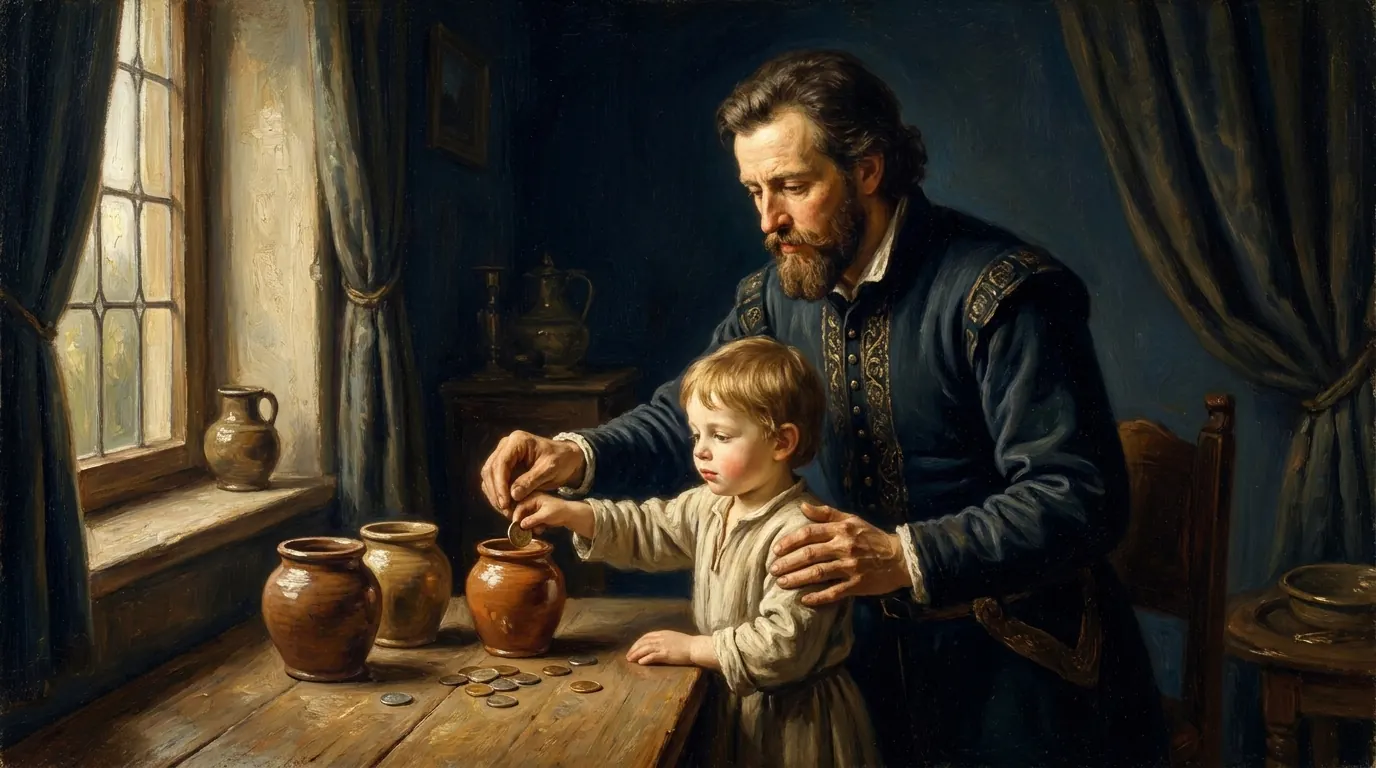
"Train up a child in the way he should go; even when he is old he will not depart from it." (Proverbs 22:6, ESV)
Proverbs 22:6 is the most-quoted parenting verse in the Bible. And one of the most disputed. Read as a promise, it has crushed faithful parents whose adult children walked away.
Taken as a probability, it has comforted some and angered others. Read as a warning, it inverts almost every wall plaque on which it is printed.
The disputed phrase is Hebrew al-pi darko. Literally "according to the mouth of his way." Whose way is "his way". The child's, or God's? The translation choice changes the entire verse.
This study walks the Hebrew, the four leading readings, why most English translations soften the original. What Solomon's most-quoted parenting line actually demands of Christian fathers and mothers.
Put it into practice
Money is one of the clearest classrooms a parent has. Start with our guide to teaching kids about money biblically, then use the Tithe Calculator to set the example and the Net Worth Calculator to see what you have to steward. Christian estate planning covers the long horizon.
The Hebrew verb: chanak
The verb translated "train up" is Hebrew chanak. It is rare. Only five occurrences in the Hebrew Bible. And its core meaning is "to dedicate, to initiate, to inaugurate."
It is the verb used for the dedication of Solomon's temple (1 Kings 8:63), the altar (Numbers 7:10). A new house (Deuteronomy 20:5). The same root gives Hebrew Hanukkah — "dedication."
The verb is not the ordinary word for "teach" (lamad) or "instruct" (yarah). It carries the weight of a formal, intentional, ceremonial setting-apart of something for its intended purpose.
Applied to a child, chanak suggests something more than passive religious upbringing. It is the deliberate dedication of a child to the path on which they are meant to walk. Beginning at the threshold of their life and aimed at the destination of their adulthood. The word implies intentionality, ceremony. Direction.
The disputed phrase: al-pi darko
The second half hinges on three Hebrew words: al-pi darko. Al-pi literally means "according to the mouth of". Idiomatically, "according to the measure of," "in keeping with." Darko is "his way." The grammatical question is: whose way is "his way"?
Two main options:
- "In the way he should go" (most English translations). "His way" is taken as the right way for the child — the path God has appointed. The verse becomes a command to train the child in objective righteousness.
- "According to his way" — i.e., the child's own bent. "His way" is the individual child's nature, temperament, and gifting. The verse becomes a command to train each child in keeping with how God has individually wired that child.
Hebrew grammar slightly favors the second reading. The possessive suffix -o ("his") most naturally refers back to the child who is the verse's subject.
If Solomon had meant "the way [generic, objective] he should go," Hebrew has clearer ways to say it.
This is the reading favored by classical Jewish commentators (Rashi, Ibn Ezra, Malbim) and by many modern evangelicals (Bruce Waltke, Tremper Longman, Derek Kidner).
Four readings of the verse as a whole
1. The Promise reading. "Train them right and they will turn out right." Treats the verse as an absolute guarantee. Pastoral consequence: faithful parents of prodigal children carry crushing guilt. Problem: Proverbs describe observed regularities of the moral universe and offer no absolute guarantees. Proverbs 26:4 and 26:5 contradict each other if you read them as promises, and they fit together as situational wisdom.
2. The Probability reading. "Generally, intentional Christian upbringing produces children who walk with God." Honest about exceptions, takes the proverb as a wisdom-tendency and drops the formula. Most evangelical commentaries land here.
3. The Individual-Bent reading. "Dedicate each child according to his own way. His temperament, his gifting, his learning style. And the dedication will stick." Discipleship is not one-size-fits-all.
The eight-year-old who learns by doing and the eight-year-old who learns by reading need different paths to the same Christ. Strongly supported by the Hebrew grammar above and by classical Jewish exegesis.
4. The Warning reading. "Indulge a child in his own way. Letting his sinful nature set the direction. And even when he is old he will not depart from it."
On this reading the proverb is the inverse of what wall plaques claim: a sober warning that a child raised without discipline will be ruined for life by the very tendencies the parents tolerated.
Defended by Charles Bridges in his classic 19th-century Proverbs commentary, and revived by Garrett, Hubbard, and others. The Hebrew grammar fits this reading equally well.
Why most English translations smooth it over
The KJV, ESV, NIV, NASB, and CSB all render the line "in the way he should go" — supplying "should" where the Hebrew has no such word.
The translation choice reflects the long-standing Promise reading and is not technically wrong. It does obscure the ambiguity Solomon left in the text. The NET Bible footnotes the dispute openly. Most others do not.
Christian parents who only ever read the smooth English have inherited a confident Promise reading that the underlying Hebrew does not actually demand.
How the readings fit together
The four readings are not mutually exclusive. The most faithful synthesis treats Proverbs as observed regularities.
Solomon is saying that dedicated, individually-tailored discipleship of a child. Beginning at the threshold of life and aimed at the destination of God-shaped maturity. Generally produces a path the child will keep.
Inverted: a child indulged in his own untrained appetites generally becomes the adult those appetites predicted.
Two pastoral consequences. (1) Parents of prodigal children should not be crushed by Proverbs 22:6 as if it were broken legislation. It is wisdom about tendencies. Contract law has no place here.
(2) Parents currently raising children should not coast on it either. The verse is a call to chanak. Deliberate, ceremonial, individualized dedication. Careless parenting will not work out fine on its own.
Proverbs 22:6 and teaching your children about money
Proverbs 22 opens with money. Verse 1 says a good name is better than great riches, the borrower is the slave of the lender in verse 7, and verse 9 blesses the generous person. Verse 6 sits in the middle of a chapter that keeps returning to wealth, debt and giving, so a parent reading it has good reason to apply it to the family budget.
If chanak means deliberate dedication, money habits belong in it. Children learn from what they see: whether the tithe goes out first, whether the card gets paid, whether Dad says “we can’t afford it” or “we chose something else.” Instruction with words alone rarely sticks. Instruction with a jar, a chore and a Sunday offering does.
A simple starting tool is three jars: Give, Save, Spend. Every coin a child earns or receives gets divided among them. The child learns that giving comes first (Proverbs 3:9), that saving takes patience (Proverbs 21:20), and that spending is allowed once the first two are done.
| Age | What to teach | A practical step |
|---|---|---|
| 3-5 | Coins have names; giving is normal | Three jars; let the child drop a coin in the offering plate |
| 6-8 | Earning, waiting, choosing | A small allowance for chores; split it 10% give, some save, the rest spend; save toward one goal |
| 9-12 | Budgeting and comparing prices | Let the child plan a purchase, compare two prices and live with the choice |
| 13-15 | Debt, interest, honest work | Show a real pay stub and a real card statement; talk through Proverbs 22:7; open a savings account |
| 16-18 | Independence and generosity | Give the teen a monthly budget for clothes or gas; tithe on a first job; walk through a simple budget |
These ages are a rough guide, and every child has his own bent, which is the point of al-pi darko. A saver and a spender need different training toward the same end. Our full guide to teaching kids about money biblically gives more scripts, chores and family conversations for each stage.
Applications for the Christian household
- Dedicate the household. The verb is chanak, the same verb used for consecrating the temple. The household is meant to be a place where children are formally and deliberately set apart for God's purposes — family worship, catechism, Scripture memory, Sabbath rhythms — not a holding pen between activities.
- Know each child's way. If al-pi darko includes the child's own bent, faithful discipleship requires that you actually know your children — their temperament, what their consciences respond to, what their gifting points toward. Generic parenting will not get a specific child to Christ.
- Take the warning reading seriously. Tolerated sin patterns in childhood often become the adult's ruinous habits. Parental discipline (Hebrew musar) is itself an act of love (Proverbs 13:24, Hebrews 12:6).
- Disciple money. Money is one of the clearest training environments. Children who never see giving will not give as adults, and children who never see budgeting will not budget. Start with the three jars above and read our guide to teaching kids about money and our biblical tithing guide.
- Pray, do not despair. The God who promised Israel "I will be God to you and to your offspring after you" (Gen 17:7) is still the God to whom every faithful parent prays. Proverbs 22:6 is a path. Walk it.
Continue your study
Read our 40 Proverbs on money, our good steward meaning, and our biblical financial planning pillar.
All Scripture quotations from the English Standard Version unless otherwise noted.