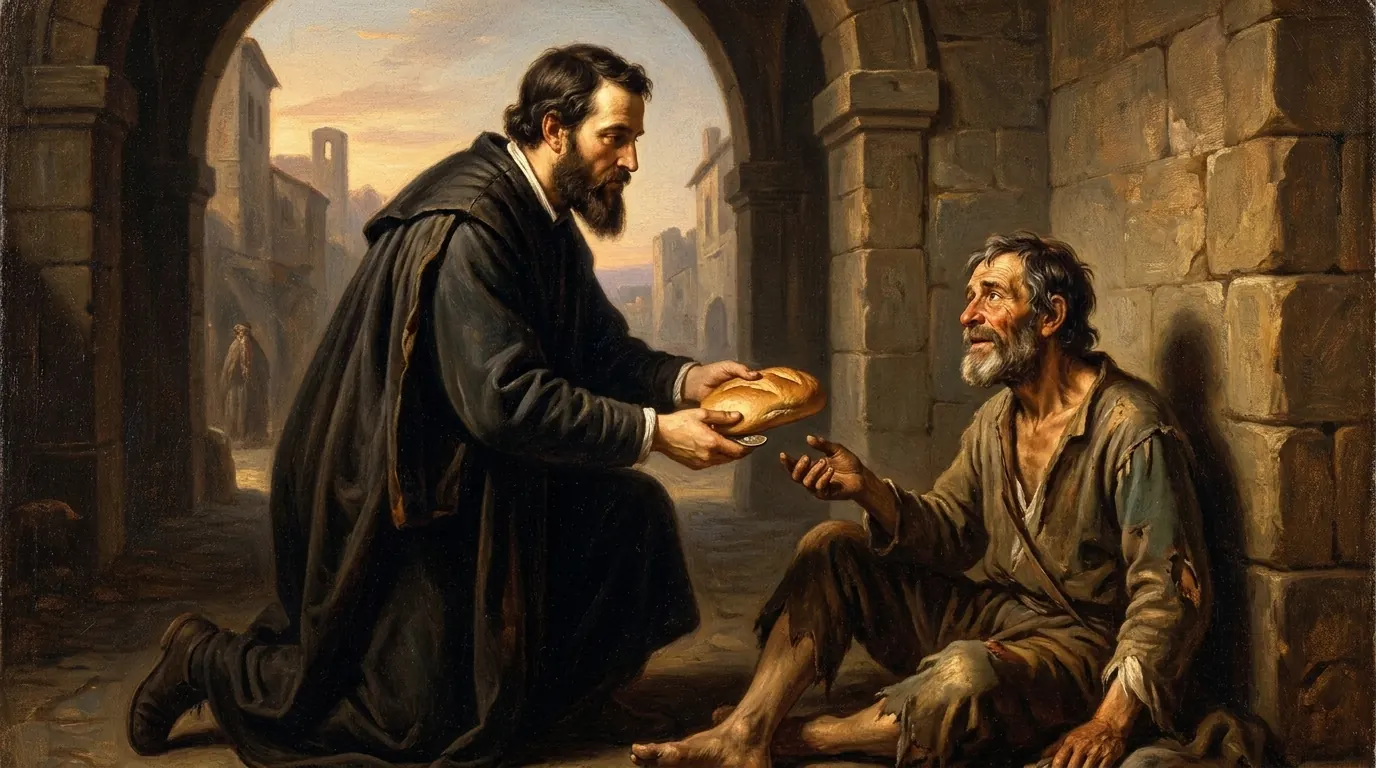
Proverbs 19:17 says, “Whoever is generous to the poor lends to the Lord, and he will repay him for his deed” (ESV). It means that God counts help given to a poor person as a loan made to him, and he promises to repay it. The Hebrew uses the language of finance on purpose, and the promise is one of the strongest motives for generosity in the Bible.
This guide walks through the key words, the idea of God as borrower, who counts as “the poor,” and a practical table of ways to give this month.
Put it into practice
Give the poor a line in your budget before the month begins. Use our Budget Calculator to place it, and the Tithe Calculator to keep it separate from the tithe. Open them now →
The Hebrew word: malveh
Hebrew malveh (מַלְוֵה), translated “lends,” comes from the same root that gives us the words for lender and borrower in Proverbs 22:7 (“the borrower is the slave of the lender”). Solomon deliberately echoes the language of finance. When you give to the poor, you extend credit to Yahweh, and he becomes the borrower.
The verb shalam (“repay”) in the second half shares its root with shalom. God’s repayment is wide: it can touch material need, relationships and the soul.
Lending to the Lord: God as borrower
The image is staggering. The God who owns the cattle on a thousand hills (Psalm 50:10), who needs nothing (Acts 17:25), and who upholds the universe by his word (Hebrews 1:3) treats your kindness to a poor person as a personal loan. Two other verses stand beside this one.
- Proverbs 14:31: “Whoever oppresses a poor man insults his Maker, but he who is generous to the needy honors him.”
- Matthew 25:40: “As you did it to one of the least of these my brothers, you did it to me.”
The three verses agree. The Lord identifies with the poor, so what reaches them reaches him.
What “he will repay” promises, and what it leaves open
- The repayment is certain. The verse says “he will repay,” and the promise rests on God’s character.
- God chooses the currency and the timing. Scripture names no amount and no date. The return may be provision, peace, friendships or reward beyond this life.
- The verse gives no formula. Reading it as a way to buy money from God turns a promise into a transaction, and the giver’s motive matters. Jesus says to give without expecting anything back from the person you help (Luke 14:13-14) and promises repayment “at the resurrection of the just.”
- The debtor is good for it. As one old saying puts it, God is no man’s debtor.
Who are “the poor”?
Hebrew dal (דַּל) means weak, low, poor, helpless. It describes people without economic, social or political power. In ancient Israel that meant widows, orphans, foreigners, the disabled and the chronically ill. Today it includes people who are homeless, unemployed, refugees, single parents in poverty and persecuted Christians overseas.
The verse sets no means test. It asks a simple question: is this person poor and in need? Wisdom still applies. Give in ways that help, and where you can, give through trusted organizations that know the community. Proverbs 3:27-28 adds a warning against delay: do not withhold good when it is in your power to do it, and do not say “come back tomorrow” when you can give today.
Practical ways to give to the poor
Scripture names no percentage for giving to the poor. A workable starting range is 2-5% of income on top of the tithe, and you should adjust it to your household and your season. The table shows six ways to give and how to check each one.
| Way to give | Example | Best when | How to check it |
|---|---|---|---|
| Church benevolence fund | A gift marked for benevolence or a deacons’ fund | You want local, known needs met | Ask leadership how requests are reviewed |
| Food pantry or meal ministry | Food, or a monthly gift to a pantry | You want to feed people directly | Ask what is needed most |
| Direct help to a neighbor | A grocery card, a rent gap, a ride | You know the person and the need | Ask, then give with dignity and privacy |
| Homeless or crisis ministry | A shelter or mission serving your city | You want a steady local partner | Visit, and read the annual report |
| Persecuted-church or relief work | A relief or missions organization | You want to serve believers overseas | Look up its rating on Charity Navigator and its membership in ECFA |
| Microloans and job training | A ministry that trains or lends to people in poverty | You want to build lasting income | Ask for measured outcomes |
Charity Navigator publishes ratings of U.S. charities, ECFA (the Evangelical Council for Financial Accountability) accredits Christian ministries that meet its standards, and the IRS Tax Exempt Organization Search confirms a group’s status. Check the current rating yourself before you give, since ratings change.
How to apply Proverbs 19:17 in five steps
- Separate it from the tithe. The tithe supports your local church (Malachi 3:10), and poor-giving is an additional line. Use the Tithe Calculator for the first.
- Choose a percentage. Start with 2-5% of income and write it in your budget with the Budget Calculator.
- Pick two channels. One local (a church fund or pantry) and one wider (relief or missions).
- Give with dignity. See Bible verses about giving to the poor. You can also give anonymously.
- Give and leave the return to God. He is the one who repays, and the recipient owes you nothing. Second Corinthians 9:6 says “whoever sows bountifully will also reap bountifully”; our 2 Corinthians 9:7 study develops the heart behind the gift.
Why this verse changes the question
Most people ask whether they can afford to give. Proverbs 19:17 asks who is on the receiving end of the loan. If the borrower is God himself, a gift to a poor person carries the safest promise in Scripture. The only open question is whether you believe it enough to act.
Two mistakes to avoid
- Treating the verse as an investment strategy. Giving in order to be paid back shrinks the promise into a transaction. Jesus told his hearers to give to those who cannot repay (Luke 14:13-14), and the verse works best when the giver has already let go of the return.
- Waiting for a perfect recipient. Proverbs 3:27-28 says not to withhold good from those to whom it is due when it is in your power to give. Use discernment about how you help, and keep helping.
Here is what a plan looks like on a $4,000 monthly income. Three percent for the poor is $120 a month and five percent is $200. Split the amount between one local channel and one wider channel, automate it on payday and review the choice once a year.
Internal study path
- Bible verses about giving to the poor
- Proverbs 11:25 meaning
- 2 Corinthians 9:7 meaning
- Luke 6:38 meaning
- Biblical tithing guide
- Generosity Calculator
Lend to the Lord
Build poor-giving into your budget
Turn the verse into a plan. Use our free Budget Calculator with biblical priorities.
Open Budget Calculator →