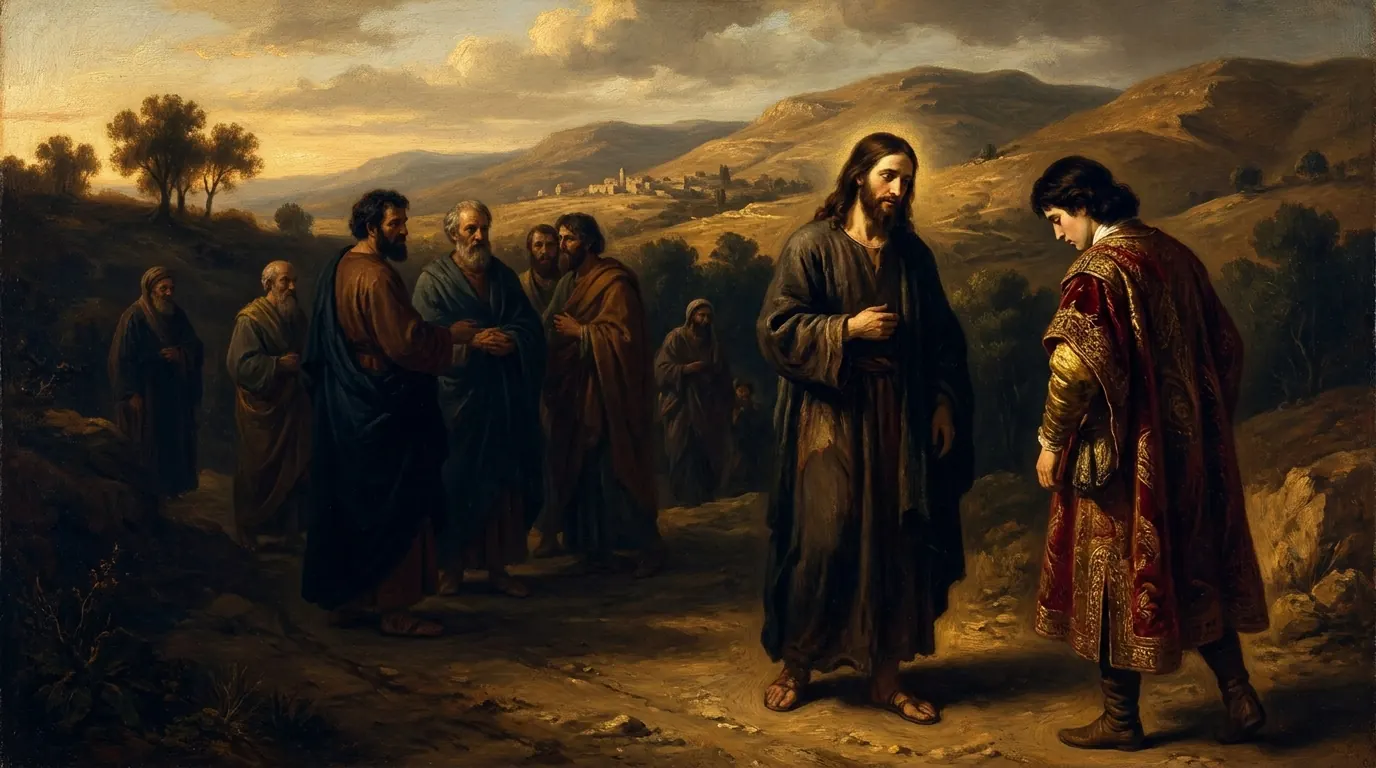
The Rich Young Ruler (Matthew 19:16-30; Mark 10:17-31; Luke 18:18-30) is one of the saddest scenes in the Gospels. A wealthy, young, religious leader sprints to Jesus, kneels, asks the right question. And walks away grieved when Jesus answers honestly.
Mark tells us Jesus looked at him and loved him before delivering the hardest sentence: "Go, sell all that you have and give to the poor… and come, follow me." This guide walks the Greek, the heart-diagnosis. What the passage actually requires of every Christian today.
Apply this study
Apply this study with our Budget Calculator and Tithe Calculator. Open them now →
Who was the rich young ruler?
- Wealthy — Mark 10:22: "he had great possessions" (Greek ktēmata polla).
- Young — Matthew 19:20-22.
- Ruler — Luke 18:18 calls him an archōn (a leader, possibly synagogue official).
- Religious — claimed to have kept the commandments from his youth (Mark 10:20).
- Earnest — ran to Jesus and knelt (Mark 10:17).
- Asking the right question — "What must I do to inherit eternal life?"
Jesus' two answers
Answer 1 (the easy one): "You know the commandments…" (v.19). Jesus lists Sinai's second-table commands. The man claims he has kept them all.
Answer 2 (the diagnostic one): "You lack one thing: go, sell all that you have and give to the poor. You will have treasure in heaven. And come, follow me" (v.21).
Jesus' second answer is not a universal command to all Christians. It is a spiritual diagnosis tailored to this man's specific idol. Money was his god. Until he could let it go, he could not follow Christ.
The Greek words: lupoumenos and stugnasas
Mark 10:22: stugnasas… apēlthen lupoumenos — "his face fell… he went away grieved."
Greek stugnazō means "to grow gloomy, to become overcast" (the verb is also used of the sky becoming dark). His face turned dark.
Greek lupoumenos ("grieving") is the same verb used of Jesus in Gethsemane (Matt 26:37). The man went away with the kind of grief Jesus knew.
The text does not say he refused outright; it says he went away grieving — perhaps the saddest verb in the Gospels.
The diagnostic principle
Jesus did not tell every disciple to sell everything. Peter and the apostles still had homes and boats. Joseph of Arimathea remained wealthy. Lydia kept her business. Jesus' command to this man exposed his particular idol.
The principle is universal even though the specific command was personal: whatever competes with Christ in your heart must be surrendered. For one person it is money. For another fame. For another security. For another a relationship. Jesus' love-driven diagnosis names the one thing standing between you and following him.
The disciples' shock — and Jesus' explanation
"It is easier for a camel to go through the eye of a needle than for a rich person to enter the kingdom of God" (Mark 10:25).
The disciples — themselves not wealthy — were astounded. Their question: "Then who can be saved?"
Jesus' answer: "With man it is impossible. Not with God. For all things are possible with God" (v.27). Salvation is always God's miracle. Wealth makes the miracle harder, not impossible.
The promise to those who do leave everything
Peter's response (v.28): "We have left everything and followed you." Jesus' answer: "Truly, I say to you, there is no one who has left house or brothers… or lands, for my sake and for the gospel, who will not receive a hundredfold now in this time… and in the age to come eternal life" (Mark 10:29-30).
The 100x return includes "with persecutions" — the cost is real, the reward is greater.
Application: the diagnosis question
- What is the "one thing" Jesus would name in you? Money? Career? Comfort? Reputation? A relationship? Pray honestly.
- Are you willing to release it if asked? Even hypothetically?
- What does your bank statement reveal about your god? See Matthew 6:24 Meaning.
- Are you investing eternally? Treasure in heaven (Matt 6:19-21) requires action now.
- Is your tithe and giving sacrificial? Use our Tithe Calculator. The widow's two coins outweighed the rich man's overflow.
- Are you discipling money or being discipled by it? Use our Budget Calculator to take control.
How to avoid the rich young ruler's exit
Tithe and give beyond the tithe. Practice contentment. Hold possessions loosely. Build for eternity. Confess when money has captured your heart. And when Jesus puts his finger on the one thing. Surrender it. The grief of the rich young ruler is the grief of every soul who chose possessions over the only treasure that lasts.
LET GO OF YOUR "ONE THING"
Build the budget of someone who follows Christ
Translate biblical wisdom into a real plan with our free Budget Calculator with biblical priorities.
Open Budget Calculator →