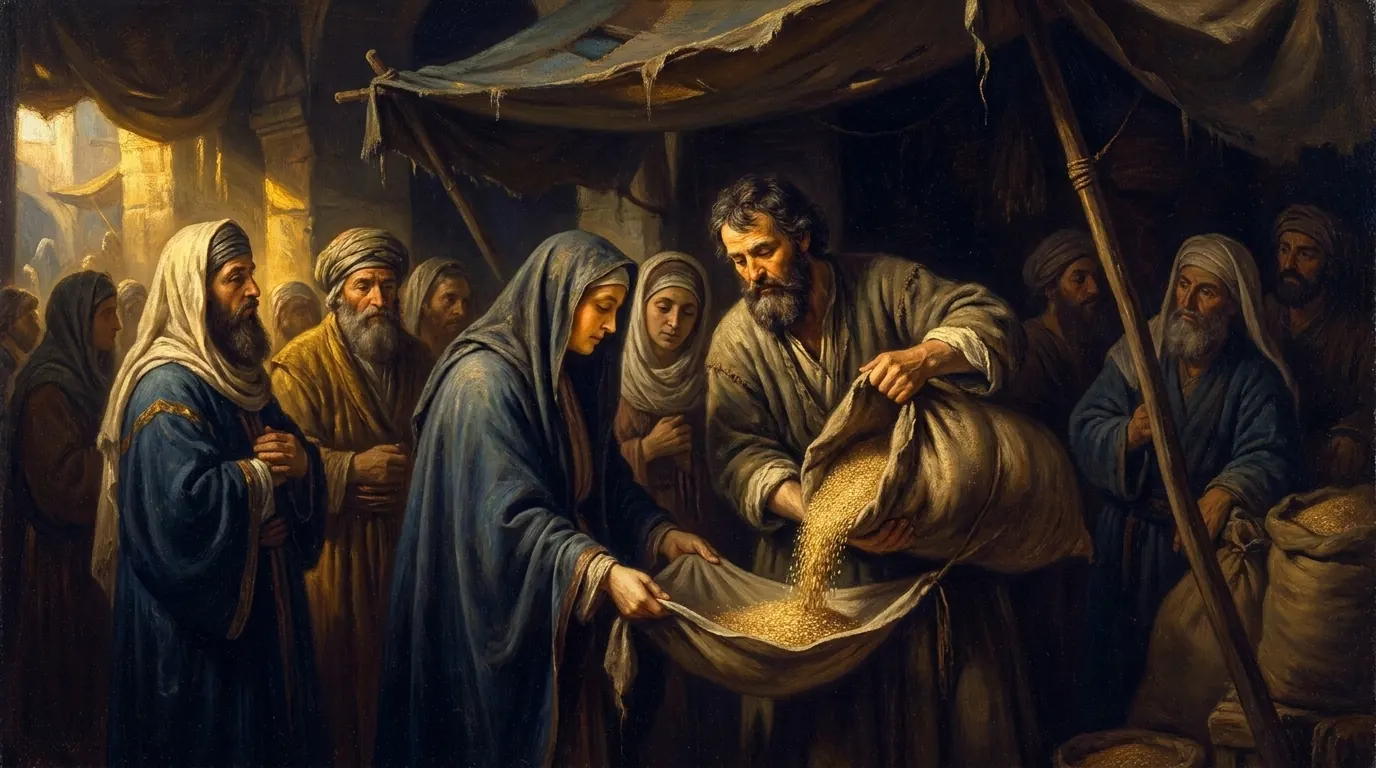
Luke 6:38 — “Give, and it will be given to you. Good measure, pressed down, shaken together, running over, will be put into your lap. For with the measure you use it will be measured back to you.” Does Luke 6:38 refer to money? It can include money, and the surrounding passage is about something wider: judging, forgiving and showing mercy, with generosity as one part of that. The picture is grain poured into a buyer’s lap, and the promise is that God’s return is generous.
The verse is one of the most loved generosity texts in Scripture, and one of the most misused by prosperity preachers. Read with its neighbors, it says something more careful and more useful. This study walks the Greek image, the context in Luke 6:27-38, and what the verse asks of your wallet and your heart.
Put it into practice
Live the verse by making giving a line in the budget. Set the first tenth with the Tithe Calculator, see what steady giving adds up to in the Generosity Calculator, and build room for it in the Budget Calculator. Open the Tithe Calculator →
Does Luke 6:38 refer to money?
Partly. Read the verses around it and the subject widens. Jesus has just said, “Judge not, and you will not be judged; condemn not, and you will not be condemned; forgive, and you will be forgiven” (v.37). Then comes “Give.” The command sits at the end of a run of instructions about how we treat people: enemies, borrowers, the ungrateful, the guilty.
So “give” covers forgiveness, mercy, time, patience and encouragement, and it covers money too. Verse 30 says, “Give to everyone who begs from you,” and verse 35 says, “lend, expecting nothing in return.” The money is there. What matters most is the measure God uses with the person who gives in every one of these ways.
The Greek image: grain in the lap
| Greek | Meaning | The market scene |
|---|---|---|
| metron kalon | a good measure | The seller fills the measuring vessel honestly |
| pepiesmenon | pressed down | He packs the grain down to fit more in |
| sesaleumenon | shaken together | He shakes the vessel so the grain settles and leaves room for more |
| hyperekchynnomenon | running over | He heaps it until it spills over the top |
| kolpos | lap, fold, bosom | The buyer holds out the fold of his robe to catch the grain |
A buyer in a first-century market carried grain home in the fold of his outer garment, the kolpos. Jesus’ seller is a generous one. He packs the vessel, shakes it, and keeps pouring after it is full. The buyer leaves with more than he paid for.
The passive verb “will be given” points to God as the giver. Jesus says God will deal generously with the generous, in a measure that overflows.
The context: Luke 6:27-38
Verse 38 closes Jesus’ teaching on radical love. “Love your enemies, do good to those who hate you, bless those who curse you” (vv.27-28). “Be merciful, even as your Father is merciful” (v.36). Then judging, condemning, forgiving and giving.
The last line is the key: “For with the measure you use it will be measured back to you.” The same standard you apply to others comes back to you. A person who judges harshly is measured harshly. A person who gives mercy and money freely is met with generosity. The verse reads as a warning and a promise in one sentence.
Luke 6:27-38 at a glance
| Verses | Jesus says | Where money comes in |
|---|---|---|
| 27-31 | Love enemies, bless, give to everyone who begs | Open-handed giving to people in need (v.30) |
| 32-35 | Love without a return; lend expecting nothing back | Loans made as gifts (v.35) |
| 36 | Be merciful as your Father is merciful | Mercy sets the pattern for money decisions |
| 37 | Do not judge or condemn; forgive | None directly |
| 38 | Give; the measure returns to you | Generosity is one kind of giving among several |
Read straight down the middle column and verse 38 arrives as the last line of a longer argument. Jesus asks his hearers to treat other people the way the Father treats them, and then says the measure they use comes back.
A scenario: a coworker asks to borrow $200
A coworker asks for $200 until payday. Verse 35 says to lend expecting nothing back. That leaves you two sensible paths: give the $200 outright if you can spare it, or lend it and release the debt in your own mind, so that a late repayment costs you no resentment. Proverbs 22:26-27 still warns you against pledging money you cannot lose, so give only what your budget can afford to lose. The same passage tells you to forgive if the money never returns.
Notice how much of Luke 6:38 happened before any return arrived. You gave, you released, and you forgave. The overflowing measure belongs to God, and it arrives in whatever form he chooses.
What “it will be given to you” can include
- Sometimes material. Proverbs 11:24-25 observes that the generous often flourish. Our study of Proverbs 11:25 explains how.
- Relational. Generous people are trusted, helped and loved.
- Spiritual. Joy, peace and closeness with God.
- Eternal. Matthew 6:19-21 speaks of treasure in heaven.
- Often slow. Galatians 6:9 promises a harvest “in due season.”
- From God, through any channel. The return rarely arrives from the person you gave to.
What the verse does not promise
Luke 6:38 offers no exchange rate. Nothing in it says “give $1,000 to this ministry and receive $10,000.” Jesus makes no guarantee of immediate financial return, and the passage gives no license for prosperity-gospel appeals. Jesus himself warns about greed in Luke 12:15, and our study of Luke 12:15 shows how that fits. Paul says in 2 Corinthians 9:7 that God loves a cheerful giver, and a person who gives to get a return is doing arithmetic. See 2 Corinthians 9:7.
How to live Luke 6:38
- Tithe as firstfruits (Proverbs 3:9-10) with a set percentage.
- Add freewill giving beyond the tithe.
- Support specific people: a missionary, a widow, a family in need.
- Give non-money things: time, hospitality, encouragement.
- Forgive quickly. Verse 37 sits right beside verse 38.
- Give quietly when you can (Matthew 6:1-4).
- Expect God to be generous and leave the timing and the channel to him.
For more verses on the subject, read Bible verses about giving and Bible verses about generosity.
The warning inside the promise
The measure cuts both ways. A stingy giver meets a small measure, and a harsh judge meets a harsh one. The principle covers money, mercy, words and presence. Live generously and you meet a generous God. That is the heart of the verse, and it reaches well beyond the offering plate.
Sow generously
Make giving the first line of your budget
Luke 6:38 pictures an overflowing measure for those who give freely. Use the free Tithe Calculator and Budget Calculator to make giving steady and planned.
Open the Tithe Calculator →