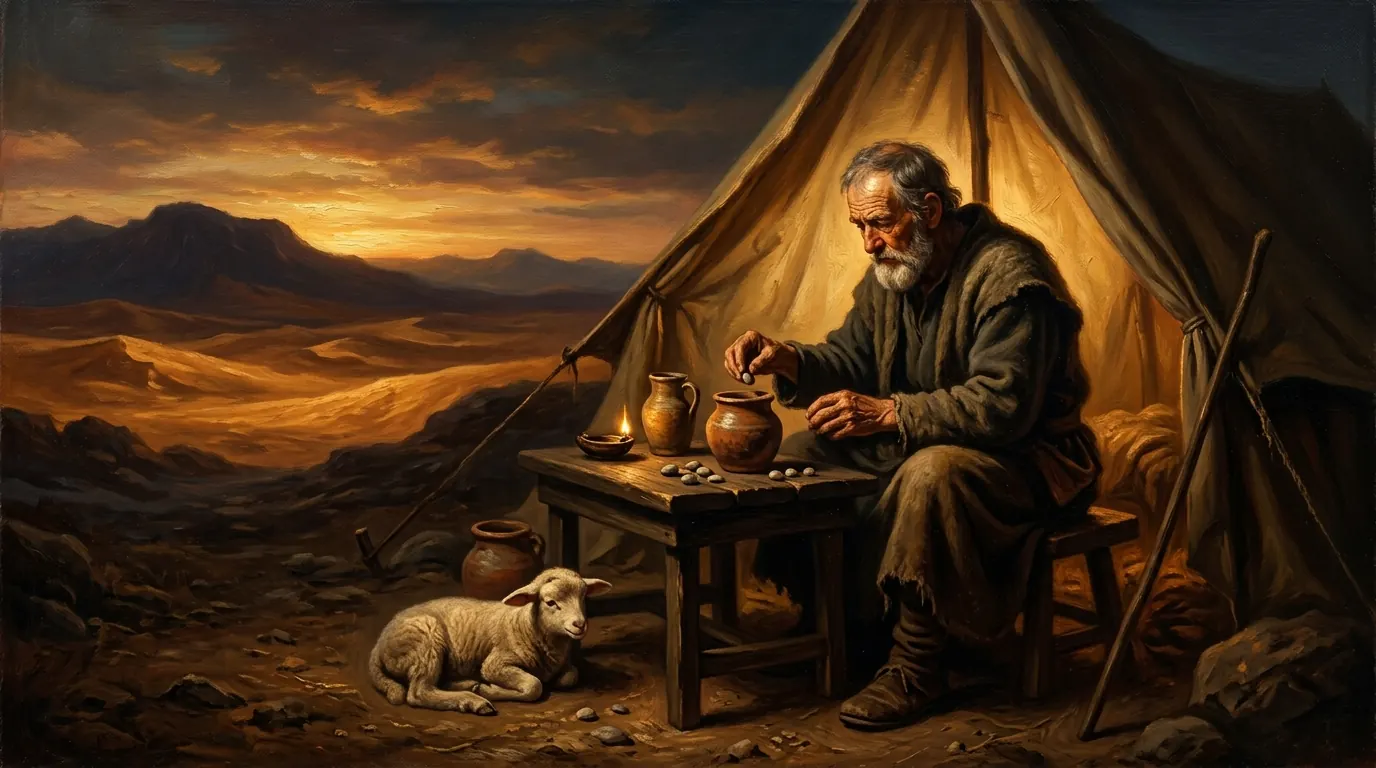
Psalm 90:12 asks God to teach us to number our days so that we gain a heart of wisdom. For money, that means measuring your finances against a limited lifetime: how many earning years you have, what your household needs if you die early or live long, and what you leave behind. Counting days makes saving, insuring, giving and estate planning acts of stewardship.
"So teach us to number our days that we may get a heart of wisdom" (Psalm 90:12, ESV). It is the only psalm Scripture attributes to Moses. The oldest in the Psalter.
The setting is the wilderness. Almost certainly after the death-sentence of Numbers 14, when an entire generation was told they would not enter the promised land.
Verse 12 is the petition that emerges from forty years of literally counting funerals.
Apply this study
Numbering days reframes every financial decision. Walk the math with our Net Worth Calculator, Budget Calculator, and Emergency Fund Calculator.
What Psalm 90:12 means for your money
Numbering your days puts a boundary around the money conversation. You have a limited number of working years, a limited window to save, and an unknown number of years to fund after work slows down. Psalm 90:10 gives the ordinary span as seventy years, or eighty for those with strength. Moses asks God to teach the arithmetic because we miscount so easily.
Four money habits follow from a numbered life. First, start early, because early dollars have the most years to grow. Our study of compound interest in Scripture shows why patient saving works. Second, protect the people who depend on you. A will, named beneficiaries and adequate life insurance answer the question “what if my days end sooner than I planned?” Third, spend time deliberately. Paul urges believers to make the best use of the time (Ephesians 5:16), and the same care applies to the hours you trade for income. Fourth, hold plans loosely. Jesus told of a farmer who planned for many years and heard, “This night your soul is required of you” (Luke 12:20). Our guide to the rich fool looks at that warning.
Wisdom in this psalm is practical skill. A heart of wisdom writes the will, funds the emergency account and decides on a giving percentage while there is still time to do it.
| Situation | What the psalm asks | Practical step |
|---|---|---|
| Early career (20s to 30s) | Count the many days ahead and use them | Automate a small monthly saving and try the Compound Interest Calculator |
| Midlife with a mortgage or debt | Weigh the working years that remain | Build reserves with the emergency fund guide, then clear debt using the Debt Snowball Calculator |
| Parents of children at home | Count the days they depend on you | Write a will, name guardians and beneficiaries, and ask a licensed insurance professional about coverage |
| Within ten years of retirement | Number the days you must fund | Draft a spending plan and a giving plan; see Christian retirement planning |
| Any age | Accept that days may end early | Keep documents where family can find them; read Christian estate planning |
A simple yearly exercise puts this into practice. On your birthday, write three numbers: the years you expect to keep earning, the monthly amount you save, and the percentage you give. Adjust one of them. Moses asks for a heart that grows wiser each time it counts, and a family that has been told where the papers are will feel the benefit long after the counting is done.
The Hebrew vocabulary
"Number" is manah. The verb of counting, assigning, allocating. It is the same root that gives min'yan (the count, as in the prayer-quorum), mana (a portion). The New Testament mammon (allotted wealth). To "number our days" is concrete arithmetic, the same kind of counting one does over inventory.
"Heart of wisdom" is levav chokmah. The Hebrew levav is the inner orientation. Mind, will, affection together. And chokmah is practical, lived-out skill (the same word used of the artisans who built the tabernacle, Exodus 31:3). The result of counting days is not melancholy but skill. Numbering produces craftsmanship in living.
The phrase "teach us" is hodaʿ. Make us know. A strong causative. The petition assumes that without divine instruction, humans cannot number their days. Left to ourselves, we miscount badly.
The Mosaic context
Psalm 90 is bracketed by mortality.
Verses 3–10 read like a meditation written by a man burying his contemporaries in batches: "You return man to dust… you sweep them away as with a flood. They are like a dream… The years of our life are seventy, or even by reason of strength eighty. Yet their span is but toil and trouble."
The view is from inside the wilderness death-camp.
Moses is therefore not philosophizing. He has watched a generation perish for unbelief (Num 14:29 — "your dead bodies shall fall in this wilderness"). His petition in v.12 is the response of a leader who has counted too many graves and now asks for the wisdom that should have come from the counting.
What numbering days produces
The text gives the result inline: levav chokmah, a heart of practical skill. Specifically, four reorderings follow naturally:
- Reordered priorities. What survives the count moves up; what doesn't survive it moves down. Activities that would not register on a deathbed lose claim on the living calendar.
- Reordered urgency. Numbered days dissolve the illusion of unlimited time for repentance, reconciliation, generosity, and witness.
- Reordered finances. The temporal frame for money shifts from "indefinite future" to "limited window." Investment horizons, estate planning, generosity decisions, and accumulation patterns all change.
- Reordered worship. The numbered life looks up. The opening of the psalm — "Lord, you have been our dwelling place in all generations" — anchors the petition.
The arithmetic, made literal
Practically, the petition can be made concrete. A 40-year-old with a life expectancy of 80 has roughly 14,600 days remaining. Subtract sleep. About 4,800 days. And the active hours total about 9,800 days, or 235,000 waking hours. Subtract work and routine maintenance. "discretionary kingdom hours" shrink to perhaps 60,000–80,000 hours total over a remaining lifespan.
Translated to weekly cadence: about 17,000 hours of corporate worship and prayer over the rest of life if attended weekly. Perhaps 8,000 hours of meaningful conversation with a spouse; 4,000–5,000 hours of fathering or mothering a child still in the home. The numbers are the literal counting Moses asks God to teach.
What the verse does not teach
- It does not authorize despair. Moses ends the psalm with petition — "establish the work of our hands upon us" (90:17). Numbered days are urgent and still hopeful.
- It does not require asceticism. Wisdom is skill in living, and skill adds to a life. A wise life can be full and joyful.
- It does not justify presumption about the count. The number is God's to know; we steward the unknown remainder.
Application: numbering as a discipline
Three concrete practices translate the verse:
- Annual review on the birthday. Once a year, on the date that marks a literal subtraction, walk through priorities, finances, and relationships against the diminished count.
- A running estate plan. Will, beneficiaries, life insurance, and instructions for those left behind are the financial expression of a numbered life. Update yearly.
- Visible memento mori. The Christian tradition has long used skulls, hourglasses, ashes — physical reminders of the count. A modern equivalent: a calendar marked with a realistic life-expectancy date.
For continued study, see our exegesis of Luke 12:15 (the rich fool), our Ecclesiastes 3:1 study, our walkthrough of James 4:13-15, our Proverbs 13:22 study. Our Bible verses about time. Translate the count into structure with our Budget Calculator and Net Worth Calculator.
Moses, mortality, and the prayer's setting
Psalm 90 is the only psalm attributed to Moses. The attribution is exegetically substantive. The psalm reads as a meditation on mortality from the perspective of a man who watched an entire generation die in the wilderness (Num 14:26-35).
The famous "seventy years, or even by reason of strength eighty" of verse 10 is the lived observation of forty years of funerals.
By the time Moses wrote Psalm 90, every adult who had left Egypt with him — except Joshua, Caleb, and himself — was dead.
Verse 12 sits at the hinge of the psalm. Verses 1-11 develop the contrast between God's eternity ("from everlasting to everlasting you are God," v. 2) and human transience ("you sweep them away as with a flood. They are like a dream," v. 5).
Verse 12 turns from observation to petition: "So teach us to number our days that we may get a heart of wisdom."
Verses 13-17 then ask for God's favor on the work of human hands. The only labor in the psalm that has any chance of lasting beyond the seventy years.
The Hebrew of verse 12 is sharper than most translations. "Teach us" is limnot yamenu hodaʿ — literally "to number our days, make us know."
The verb manah (to count, to number) is the same root that names the idol Meni in Isaiah 65:11 (the god of fate or apportionment) and that gives us the Hebrew word for portion or allotment.
Moses is asking God to do what only God can do: tell us the count. We can live inside it, knowing it is limited.
Numbering days as financial discipline
Numbering days is the precondition of wisdom. The Hebrew chokmah ("wisdom") in verse 12 is the same word Proverbs uses throughout. The practical skill of life under God.
Moses' point is exact: a person who lives as though his days were unlimited will not develop wisdom,.. Because wisdom is the management of finite resources for purposes that outlast the manager.
A person who knows his days are counted — and roughly how many — will allocate them differently.
Modern application: the average believer in his thirties has roughly 15,000 productive days remaining at most. Of those, sleep claims one third, work claims another third. Basic logistics another sixth, leaving perhaps 2,500 days of discretionary time across forty years.
A budget of money without a budget of days is a half-budget. A budget of days without a budget of money is the same. The two are reciprocal. Moses' prayer asks for the wisdom to make both at once.
This is what gives the verse its financial bite. Compound interest, retirement planning, debt repayment, generosity over a lifetime, inheritance for the next generation. All of them are disciplines that only matter when the believer has accepted the count of his days.
The believer who suppresses the count will spend money on the present and time on the inconsequential. The believer who accepts it will plant trees whose shade he will not sit under.
Our Proverbs 13:22 study develops the multigenerational frame. Our Proverbs 21:5 study develops the long-horizon plans. Our Net Worth Calculator and Budget Calculator structure both the day-budget and the dollar-budget under the same discipline of numbering.
Compounding, mortality, and the wisdom of long horizons
Numbering days reframes the financial decisions that look small in any single month and compound into the largest outcomes of a lifetime.
A 1% improvement in savings rate, sustained over the seventy years Moses names, becomes the difference between a comfortable retirement and dependence on others.
A 2% reduction in lifetime investment fees, applied to the same horizon, is worth more than most readers earn in a decade of work. None of these decisions is dramatic in the day. All of them are decisive across the count of days.
Moses' prayer is the precondition of taking such horizons seriously.
The believer who suppresses the count will not save now for a retirement that feels theoretical, will not buy term insurance against a death that feels distant, will not build the inheritance Proverbs 13:22 commands for grandchildren he has not yet met.
The believer who accepts the count plants what he will not see mature,.. Because he knows the planting and the maturity belong to the same brief life he has been given.
The pastoral inverse also matters. The believer who has accepted his own mortality also stops over-spending now in dread of a future he cannot control.
Anxious accumulation. The rich fool's "soul, you have ample goods laid up for many years" (Luke 12:19). Is the opposite error from anxious consumption. Both arise from a refusal to number days.
Moses' prayer is for the wisdom that lives between the two: building diligently for what may be, giving generously now, sleeping soundly.. Because the count is not in the believer's hands.
Our Luke 12:15 study develops the rich-fool warning. Our Matthew 6:19-21 study develops the heart-treasure rebalancing. Our Budget Calculator structures the accept-the-count discipline.
A pastoral close: numbering days as worship
Moses ends Psalm 90 with a petition that the LORD "establish the work of our hands" (v. 17). The verb is repeated for emphasis. The work of human hands matters to God. Only God can give it lasting weight.
Numbering days is therefore not despair; it is the doorway to consecrated work.
The believer who knows his days are counted offers each one as a unit of worship, builds patiently for outcomes he may not see. Rests at night in the knowledge that the establishing belongs to God.
Our Proverbs 16:3 study develops this committing-the-work theme; the discipline of numbering days is what makes the committing honest.
All Scripture quotations from the English Standard Version unless otherwise noted.