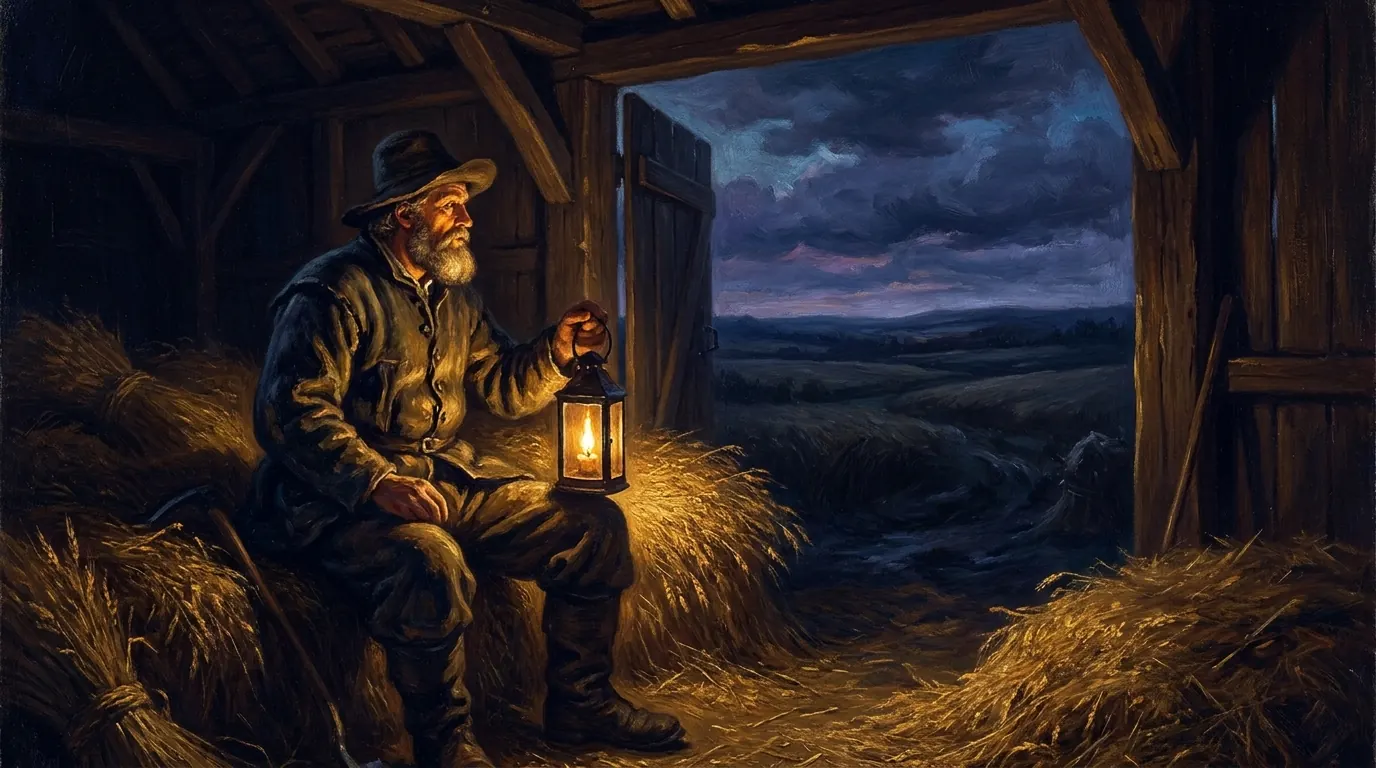
The Parable of the Rich Fool (Luke 12:13-21) is the shortest of Jesus' parables and one of the most surgical. Six verses. Six first-person pronouns. One verdict from God: aphrōn — "fool."
It is the parable a comfortable Christian needs and rarely hears preached. Not against wealth. Against the inner monologue that converts wealth into ultimate security.
Don't be the rich fool
The man's sin was not saving; it was treating savings as soul-insurance. Build margin without enthroning it — use our Budget Calculator and Generosity Calculator to keep wealth in motion toward God and neighbor.
The text — Luke 12:13-21
"Someone in the crowd said to him, 'Teacher, tell my brother to divide the inheritance with me.' But he said to him, 'Man, who made me a judge or arbitrator over you?' And he said to them, 'Take care, and be on your guard against all covetousness, for one's life does not consist in the abundance of his possessions.'
And he told them a parable, saying, 'The land of a rich man produced plentifully, and he thought to himself, "What shall I do, for I have nowhere to store my crops?" And he said, "I will do this: I will tear down my barns and build larger ones, and there I will store all my grain and my goods. And I will say to my soul, Soul, you have ample goods laid up for many years; relax, eat, drink, be merry."
But God said to him, "Fool! This night your soul is required of you, and the things you have prepared, whose will they be?"
So is the one who lays up treasure for himself and is not rich toward God.'" (ESV)
The setup — an inheritance fight
The parable is occasioned by a man asking Jesus to arbitrate a family inheritance dispute (v. 13). Jesus refuses the role (v. 14) and uses the moment to diagnose the deeper disease: pleonexia (πλεονεξία) — "covetousness," literally "the desire to have more." Paul will later call it "idolatry" (Col 3:5).
Jesus' premise is metaphysical: "ouk en tō perisseuein tini hē zōē autou estin ek tōn hyparchontōn autō" — "life does not consist in the abundance of possessions." The Greek zōē is life-as-substance, not bios (life-span). The claim is that the ontological category called life is not built out of stuff. The man in the crowd disagrees, and the parable is the proof.
The six first-person pronouns
The rich man's interior monologue (vv. 17-19) contains a stunning grammatical feature in Greek: six first-person references in three short verses — poiēsō ("I will do"), mou tous karpous ("my crops"), kathelō mou tas apothēkas ("I will tear down my barns"), oikodomēsō ("I will build"), synaxō ("I will gather"), erō tē psychē mou ("I will say to my soul").
God is not consulted. Neighbor is not mentioned. The poor at the gate (cf. Luke 16:20) are invisible. The soul is addressed as one would address a wealthy patron — "Soul, you have ample goods laid up for many years; relax (anapauou), eat, drink, be merry (euphrainou)."
The rich man has constructed a closed economy with himself as god, his soul as worshipper, his barns as temple, his grain as sacrament.
"Fool" — the Greek aphrōn
God's verdict is one word: aphrōn (ἄφρων) — literally "mindless," "without phrēn" (the seat of reasoning). It is the Septuagint word for the nabal of Psalm 14:1 ("the fool has said in his heart, there is no God") and Psalm 53:1.
The fool in biblical wisdom is not the unintelligent person. The Rich Fool is plainly a competent agriculturalist and financial planner. The fool is the person who plans as if God did not exist and death were not appointed.
The verdict is followed by the demand: "tautē tē nykti tēn psychēn sou apaitousin apo sou" — "this night your soul is required of you." The verb apaitousin is third-person plural ("they require"), an impersonal/divine passive: the appointment cannot be argued with. The soul the man was congratulating is the soul being repossessed.
"Whose will they be?" — the inheritance question turned inside out
The closing question — "the things you have prepared, whose will they be?" — is the parable's masterstroke. It returns to the opening inheritance dispute and reveals that every earthly accumulation is on its way to becoming someone else's inheritance dispute.
Ecclesiastes had said it first: "I hated all my toil in which I toil under the sun, seeing that I must leave it to the man who will come after me. And who knows whether he will be wise or a fool?" (Eccl 2:18-19). The Rich Fool is a man who has not read Qoheleth, or who has read him and refused to believe him.
What the parable is NOT condemning
The parable is not condemning planning. Joseph stored seven years' grain (Gen 41) and was praised. It is not condemning saving. Proverbs 21:20 commends "precious treasure and oil in a wise man's dwelling." It is not condemning a good harvest. The land's productivity is described neutrally.
It is condemning three things specifically: (1) self-referential storage — bigger barns with no thought of distribution; (2) soul-mistake — addressing the immortal soul as if grain could feed it; (3) presumption on time — "many years" assumed without God's permission.
"Rich toward God" — the antidote
Jesus closes (v. 21) with the diagnostic phrase: "plōutōn eis theon" — "being rich toward God." The preposition eis (toward, into, with reference to) is directional. The Rich Fool's wealth flowed toward himself; the wise person's wealth flows toward God.
Jesus immediately unpacks what this means in the next paragraph (vv. 22-34): do not be anxious about food and clothing (v. 22), seek the kingdom (v. 31), sell your possessions and give to the needy (v. 33), "for where your treasure is, there your heart will be also" (v. 34).
"Rich toward God" is not pious feeling; it is treasure deliberately redirected toward kingdom causes, generosity to the poor, and trust-based reduction of self-protective accumulation.
Five disciplines from the parable
- Audit your interior monologue. When you receive a windfall, raise, or good year, count the first-person pronouns in your first three thoughts. If God and neighbor are absent, you are rehearsing the Rich Fool's script.
- Set a barn-ceiling. Decide in advance the level of accumulation at which additional surplus converts automatically to giving. The Rich Fool's failure was unbounded barn-building.
- Speak to your soul truly. The soul cannot be addressed as a stockholder. Replace "Soul, you have ample goods" with "Soul, hope in God" (Ps 42:11). The soul is fed by God, not grain.
- Plan as a steward, not an owner. Saving (Prov 21:20), investing (Matt 25), planning (Prov 16:9) are commanded — but always in the recognition that the assets and the days are God's loan.
- Pre-distribute through giving. The Rich Fool's problem became his heirs' problem. Generous lifetime giving (and a written estate plan) prevents the deathbed accumulation that becomes inheritance war.
Continue your study
Continue with our survey of Jesus' teachings on money, our study on corrupting wealth, and our contentment in the Bible. The full Scripture hub.
All Scripture quotations from the English Standard Version.