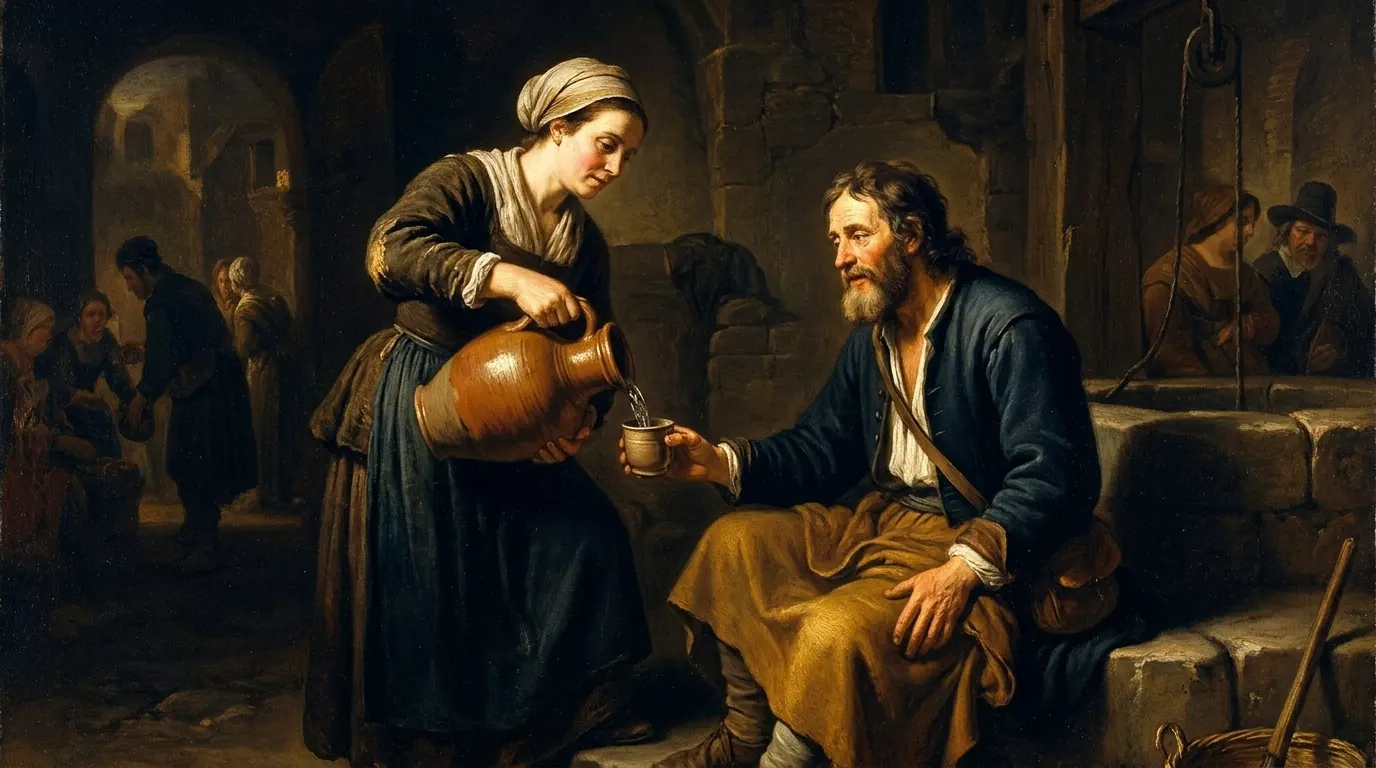
"The generous soul will be made rich. He who waters will himself be watered" (Proverbs 11:25, NKJV). It is one of the most-quoted verses in stewardship sermons, and one of the most easily abused. The Hebrew says a person shaped for blessing will flourish, and that giver and receiver share the same water. It describes the long arc of a generous life. It makes no promise of a dollar-for-dollar return.
Read carelessly, the verse sounds like prosperity-gospel arithmetic: give a dollar, get back ten. Read in its Hebrew vocabulary and inside the larger argument of Proverbs 11, it teaches something deeper and more honest about how God designed the generous life.
Put it into practice
Turn generosity into a written habit. Our free Generosity Calculator shows what a giving percentage looks like over the years, the Tithe Calculator sets the first tenth, and the Budget Calculator builds margin for gifts beyond it. Open the Generosity Calculator →
The Hebrew: nephesh berakah
The phrase "generous soul" is Hebrew nephesh berakah — literally a soul of blessing.
Nephesh is one of the deepest words in the Old Testament, and it means more than "soul" in the Greek sense. It names the whole self, the living person, the breath-and-life integrity of a human being.
Berakah is the standard word for blessing — used of God's blessings to Abraham, the priestly blessing in Numbers 6, and gifts given between people.
A nephesh berakah is someone whose whole self is shaped to be a conduit of blessing, and giving is the steady habit of that life.
"Will be made rich" is the Hebrew verb dashen. Literally to be made fat. It is the language of agricultural abundance, the picture of soil so rich it shines with oil. The verb is used of the burnt offerings made fat with sacrifice and of crops abundant on well-watered land. The image is flourishing fullness.
Take the second clause: "he who waters will himself be watered". Uses the Hebrew marveh from ravah, to be saturated. The verbal play in Hebrew is striking: the irrigator (marveh) is also irrigated (yorah). Water given becomes water received.
The key Hebrew words at a glance
| Hebrew | Literal sense | What the generous life looks like |
|---|---|---|
| nephesh berakah | a soul of blessing | A whole person shaped to pass blessing on |
| dashen (“made rich”) | made fat, made fruitful | Flourishing fullness, like well-watered soil |
| marveh (“he who waters”) | the one who saturates | The giver who refreshes others |
| yorah (“will be watered”) | to be watered in return | The giver is refreshed in turn |
The literary context: Proverbs 11
The verse does not stand alone.
Proverbs 11 is a chapter of antitheses: "Dishonest scales are an abomination to the Lord. A just weight is his delight" (v.1); "When pride comes, then comes disgrace. With the humble is wisdom" (v.2); "The integrity of the upright guides them" (v.3).
The chapter is a sustained meditation on the difference between two ways of using money and influence in a community.
Verses 24–26 form a tight unit on generosity: "One gives freely. Grows all the richer. Another withholds what he should give. Only suffers want. Whoever brings blessing will be enriched. One who waters will himself be watered.
The people curse him who holds back grain. A blessing is on the head of him who sells it." Three verses, one sustained argument: generosity multiplies. Withholding shrinks.
This is the literary frame for verse 25, and it reads as a wisdom observation about how a community functions and how a generous soul is shaped over time. A vending machine has no place in it.
| Verse | The generous person | The one who holds back |
|---|---|---|
| 11:24 | Gives freely and grows richer | Withholds what is due and only comes to want |
| 11:25 | Is made rich; the one who waters is watered | (implied) stays dry |
| 11:26 | Sells grain and is blessed by the people | Hoards grain and is cursed by the people |
Three ways the verse is fulfilled
Scripture and centuries of Christian observation suggest at least three ways generous souls are "made rich":
- Material reciprocity in community. In an honor-shame agricultural economy, the generous farmer was the one who got help when his roof fell in. Generosity built a web of social capital that translated into material help in crisis. The same dynamic operates in any healthy church — the generous family is rarely the family without help when help is needed.
- Inner enlargement. Generosity expands the soul. The miser's nephesh shrinks; the giver's nephesh grows. Jesus said it bluntly: "It is more blessed to give than to receive" (Acts 20:35). The blessing is the giving itself — a capacity for joy that the hoarder never tastes.
- God's direct provision. 2 Corinthians 9:8 — "And God is able to make all grace abound to you, so that having all sufficiency in all things at all times, you may abound in every good work." Paul makes the wisdom proverb explicitly Christian: God provisions the generous specifically so the generous can keep being generous.
Why this is not prosperity gospel
Prosperity preaching extracts verses like this and turns them into transactional formulas: give X to get Y. But Proverbs 11:25 is a wisdom proverb. Wisdom proverbs describe the general grain of God's universe, and they hold as broad truths with no mechanical guarantee attached.
Job was generous and lost everything. Lazarus was righteous and died poor. Faithful missionaries die in poverty. Wisdom literature itself flatly admits these exceptions in Ecclesiastes and in the book of Job.
The proverb's truth is real. Its scope is the long arc of a generous life across decades, which leaves no room for a quarterly return on a giving "investment." A Christian who gives in order to get has not yet understood the verse.
A Christian who gives because Christ gave will, more often than not, find the verse fulfilled in ways money cannot measure.
A practical framework: building a nephesh berakah
- Give first. Tithe and give on the day income arrives, ahead of expenses. Firstfruits-shaped giving is what builds the soul muscle the proverb describes.
- Give on a percentage. Mood-based giving fluctuates with mood, and percentage giving compounds across decades.
- Give locally and globally. A healthy generous portfolio includes the local church, the poor in your city, and gospel work overseas. The watered field has more than one stream.
- Give time and counsel, not only money. A nephesh berakah blesses with the whole self — financial advice to a young couple, a casserole to a sick neighbor, a job referral to an unemployed friend.
- Give without record-keeping for praise. Jesus' instruction in Matthew 6:3 — let not your left hand know what your right hand does — guards generosity from corrupting the soul that gives.
Theological balance
The proverb is a sober promise. It calls Christians to a generosity that is structural (built into the budget), spiritual (built into the soul) and patient (built across years).
The reward language exists to encourage generosity, and nobody is meant to use it as a lever. A Christian who needs the reward to give has missed the gospel. A Christian who gives because of the gospel will not miss the reward.
For continued study, see our exegesis of 2 Corinthians 9:7 (the cheerful giver), our Luke 6:38 study, our walkthrough of 40 Bible verses on generosity, our complete giving guide. Our Proverbs 10:22 study. Translate the proverb into a habit with our Tithe Calculator and Budget Calculator.
All Scripture quotations from the English Standard Version unless otherwise noted.