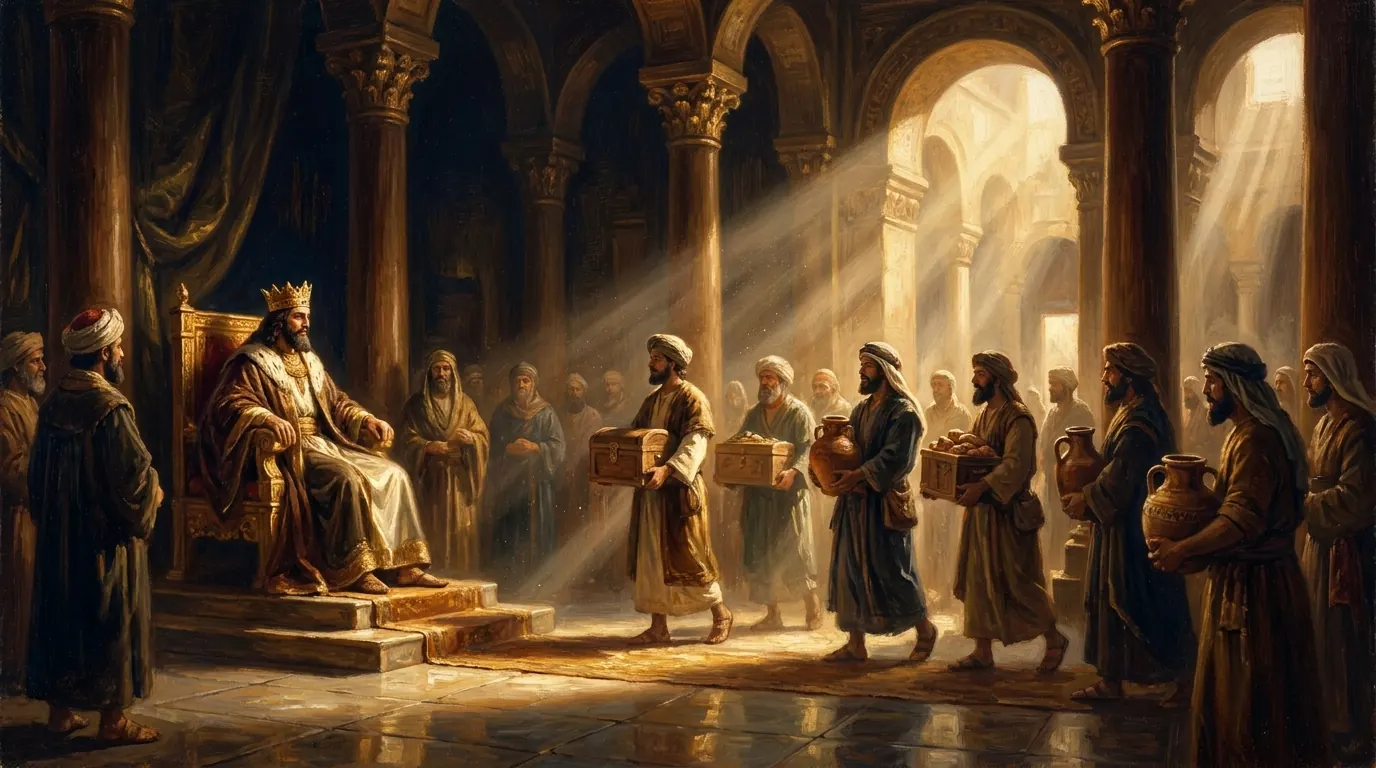
What did King Solomon say about money? Solomon — author of Proverbs and Ecclesiastes, the wealthiest king in Israel's history (666 talents of gold annually, 1 Kings 10:14) — produced the densest body of financial wisdom in all Scripture. His quotes cover wealth, work, debt, generosity and the vanity of riches with a sobriety only a rich man can write with credibility.
These 25 quotes are drawn from Proverbs and Ecclesiastes — the two books traditionally attributed to Solomon. Each is the original Hebrew compressed into a single line, then unpacked.
Apply Solomon's wisdom
For the full thematic study, see our deep-dive on Proverbs about money and the Solomon principles of wealth.
25 King Solomon quotes on money — quick reference
| Reference | Theme | The quote, compressed |
|---|---|---|
| Proverbs 10:4 | Work | Lazy hands make poverty; diligent hands bring wealth. |
| Proverbs 13:11 | Saving | Wealth gained hastily dwindles; gathered little by little, it grows. |
| Proverbs 21:5 | Planning | Diligent plans lead to profit; haste leads to poverty. |
| Proverbs 22:7 | Debt | The borrower is slave to the lender. |
| Proverbs 11:25 | Generosity | A generous person prospers; whoever refreshes others is refreshed. |
| Proverbs 11:24 | Generosity | One gives freely and gains more; another withholds and comes to poverty. |
| Proverbs 3:9-10 | Firstfruits | Honor the LORD with your firstfruits; your barns will overflow. |
| Proverbs 22:9 | Generosity | The generous will themselves be blessed. |
| Proverbs 28:22 | Greed | The stingy are eager to get rich and unaware that poverty awaits. |
| Proverbs 23:4-5 | Greed | Do not toil to acquire wealth; it sprouts wings and flies away. |
| Proverbs 11:28 | Trust | Whoever trusts in riches will fall; the righteous flourish. |
| Proverbs 30:8-9 | Contentment | Give me neither poverty nor riches; feed me with the food I need. |
| Proverbs 22:1 | Priorities | A good name is more desirable than great riches. |
| Proverbs 15:16 | Contentment | Better a little with the fear of the LORD than great wealth with turmoil. |
| Proverbs 16:8 | Integrity | Better a little with righteousness than much gain with injustice. |
| Proverbs 13:22 | Inheritance | A good man leaves an inheritance to his children's children. |
| Proverbs 27:23-24 | Stewardship | Know the condition of your flocks; riches do not endure forever. |
| Proverbs 6:6-8 | Work | Go to the ant; she stores provision in summer. |
| Proverbs 24:30-34 | Diligence | A little sleep, a little folding of the hands — poverty comes like a robber. |
| Proverbs 14:23 | Work | All hard work brings profit; mere talk leads to poverty. |
| Proverbs 22:26-27 | Surety | Do not be one who shakes hands in pledge or puts up security for debts. |
| Ecclesiastes 5:10 | Greed | Whoever loves money never has enough. |
| Ecclesiastes 5:12 | Anxiety | The abundance of a rich man permits him no sleep. |
| Ecclesiastes 5:15 | Mortality | Naked he came; naked he will depart. He takes nothing from his toil. |
| Ecclesiastes 11:1-2 | Diversification | Cast your bread upon the waters; give portions to seven, even to eight. |
The five quotes that define Solomon's financial worldview
1. "The borrower is slave to the lender" (Proverbs 22:7)
Hebrew: 'eved la'ish malveh — "slave to the man lending." The word 'eved is the same word used for actual chattel slavery in the Old Testament. Solomon is not softening the metaphor. Debt is structural bondage even when no chains are visible. See the full Proverbs 22:7 exegesis.
2. "Wealth gained hastily will dwindle" (Proverbs 13:11)
Hebrew: hon me'hevel yim'at — literally "wealth from vapor diminishes." The contrast is to wealth gathered 'al-yad — "by hand," methodically, in small increments. Solomon was the wisest man alive and he tells us compounding beats schemes. The lottery winner who is broke in five years is fulfilling Proverbs 13:11.
3. "Give me neither poverty nor riches" (Proverbs 30:8-9)
Technically Agur's prayer, included in the Solomonic collection. The argument: poverty tempts to theft and dishonoring God's name; riches tempt to forgetting God and asking "Who is the LORD?" The middle path — lechem chuqqi, "the bread of my portion" — is the safer place spiritually. The richest man in the ancient world preserved this prayer because he had personally tested both ends.
4. "Whoever loves money never has enough" (Ecclesiastes 5:10)
Hebrew: ohev kesef lo-yisba kesef — "lover of silver will not be satisfied by silver." The verb saba is the satiety word, used for food. Money cannot satisfy a hunger it did not create. Solomon writes this after building palaces, importing exotic animals, and accumulating 700 wives. He earned the right to say it.
5. "Honor the LORD with your firstfruits" (Proverbs 3:9-10)
Hebrew: kabbed et-YHWH me'honecha. The verb kabbed means "give weight to" — the same root as kavod, "glory." How you handle the first slice of income is a glory question, not a math question. The promised result (asamim — granaries — overflowing) is not a prosperity-gospel formula; it is the agrarian way of saying "God provides for the generous."
Why a man with 666 talents of gold warns against riches
666 talents per year is roughly 25 tons of gold annually — worth approximately $1.5 billion in 2026 prices. Solomon was the Jeff Bezos of the ancient Near East. And yet Ecclesiastes is the most disillusioned book in the Bible about wealth: "Vanity of vanities, all is vanity" (hevel havalim, "breath of breaths").
This is the credibility no other biblical author has. Moses warns against riches from the wilderness; Jesus warns against them from the carpenter's bench; Paul warns from a tentmaker's table. Solomon warns from the throne. He is the only biblical voice you cannot dismiss with "well, you would say that — you don't have anything."
How to apply Solomon's wisdom in 2026
- Build slowly. Proverbs 13:11 in a single sentence: index funds beat lottery tickets.
- Stay out of debt. Proverbs 22:7 in a single sentence: borrow only what you can extinguish quickly. Use our debt snowball calculator to put a date on it.
- Give first. Proverbs 3:9 in a single sentence: tithe before allocation. Our tithe calculator shows your firstfruits in seconds.
- Plan, don't rush. Proverbs 21:5 in a single sentence: write a budget. The biblical budget calculator is the modern version of "diligent plans."
- Hold loosely. Ecclesiastes 5:15 in a single sentence: you brought nothing in and you take nothing out.