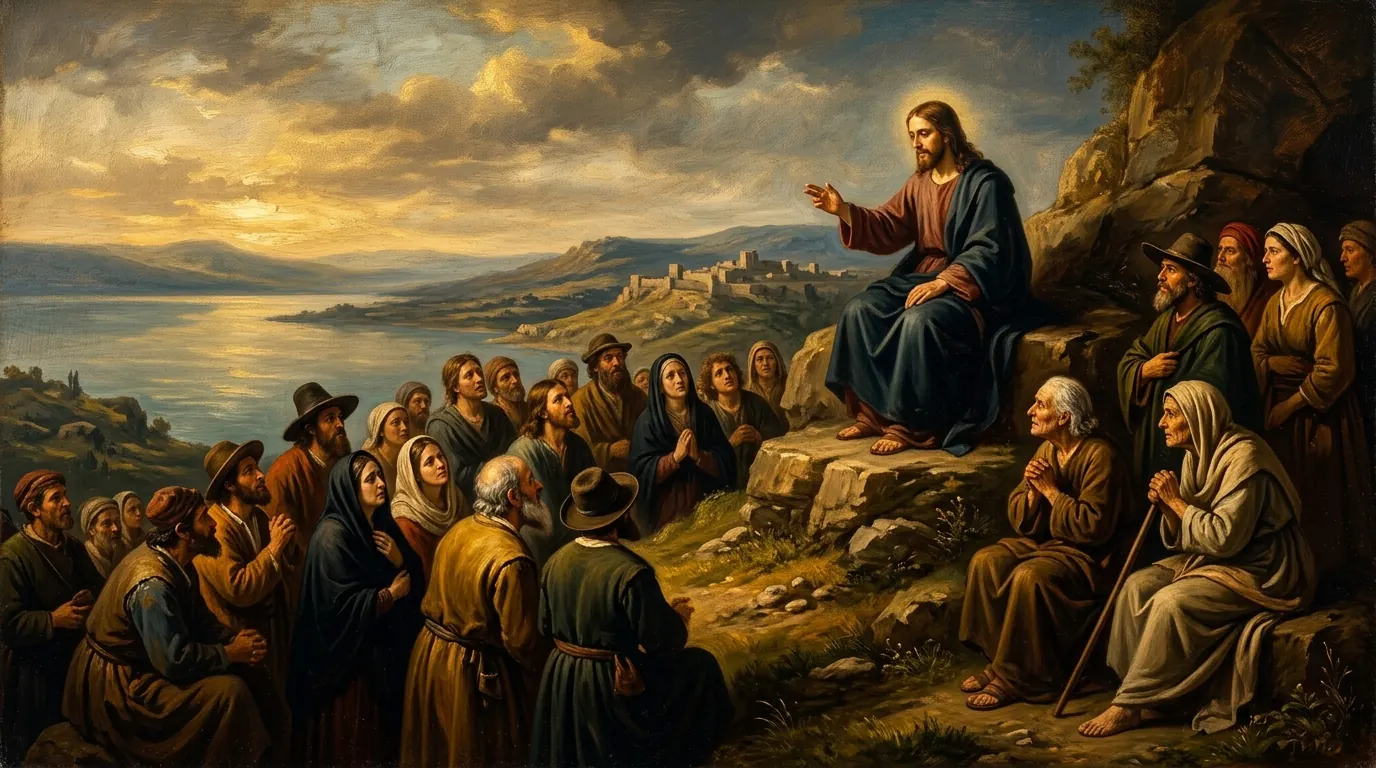
The Beatitudes (Matthew 5:3–12) open the Sermon on the Mount, and they shape a Christian view of money more than most readers expect. Jesus blesses the poor in spirit, the meek, the merciful and the pure in heart, and the same sermon goes on to teach treasure in heaven and the impossibility of serving God and money (Matthew 6:19-24). The Beatitudes describe people who depend on God, share what they have and hold wealth loosely. They are the most quoted, least understood paragraph in the New Testament. Eight (or nine) sentences, each beginning with the Greek makarios, each pronouncing a state of blessedness on a category of person the surrounding world considered cursed: the poor in spirit, the mourning, the meek, the hungry, the merciful, the pure, the peacemakers, the persecuted.
This guide walks the Greek makarios, the rabbinic backdrop, the structure of the eight sayings, the genitive/dative pattern in the second clauses, the Lukan parallel with its woes, and the pastoral application that follows from reading them as the portrait of the citizen of the kingdom Jesus is announcing.
Apply this study
Read alongside our exegeses of the rest of the Sermon on the Mount, the Fruit of the Spirit (the character the Beatitudes describe), and Psalm 46:10.
What the Beatitudes mean for your money
The Sermon on the Mount puts the Beatitudes and Jesus' teaching on money in the same speech. That placement invites a reading that connects the two. Luke's version says “Blessed are you who are poor” (Luke 6:20) and follows with woes to the rich (Luke 6:24), and Matthew's “poor in spirit” names a person who knows they need God. Neither version teaches that poverty is holy or that wealth is evil. Both warn the comfortable to hold their comfort loosely.
Each beatitude has a practical edge for a household.
| Beatitude | Money application | Practical step |
|---|---|---|
| Poor in spirit (Matthew 5:3) | Depend on God for every provision | Begin each budget review with prayer |
| Those who mourn (5:4) | Grieve losses honestly, then rebuild | Set aside time to reset the plan after a setback |
| The meek (5:5) | Use power over money with restraint | Negotiate fairly and skip the pressure tactics |
| Hunger for righteousness (5:6) | Seek honest gain | Refuse shortcuts, and keep clean records |
| The merciful (5:7) | Lend and forgive with mercy | Decide in advance which help you will give |
| Pure in heart (5:8) | One master for your money | Read Matthew 6:24 and audit your priorities |
| Peacemakers (5:9) | End money quarrels | Settle disputes early in the household or at work |
| Persecuted for righteousness (5:10) | Accept a cost for integrity | Turn down dishonest profit even when it hurts |
Put the Beatitudes to work in one household conversation. Read Matthew 5:3-10 aloud with your spouse or family, then ask which beatitude your money habits fit least. A family that tends to hoard may need mercy, and a family that spends freely may need the hunger for righteousness that chooses honest, lasting things. Pick one action for the month, such as a set gift, a debt forgiven to a relative or a plain conversation about a shared bill. The Beatitudes describe a whole way of life, and money is one of the places where it becomes visible.
Mercy deserves a closer look. Jesus tells the story of the servant forgiven a huge debt who then chokes a fellow servant over a small one (Matthew 18:23-35). Believers who have received mercy carry a duty to show it in lending, in collections and in family loans. Mercy does not require reckless generosity, and Proverbs also counsels prudence, so wise mercy sets limits you can keep.
For more on how Jesus handled wealth, read Matthew 6:24, the rich young ruler, contentment in the Bible, giving to the poor and Jesus and money.
The Greek word: makarios
Makarios (μακάριος) is not the word for "happy." Classical Greek reserved makarios for the gods themselves — the blessedness of the immortals whose flourishing was secured by their nature, untouched by fortune. Aristotle in the Nicomachean Ethics uses makarios of the person whose eudaimonia is so complete it cannot be disturbed by external circumstance. The Septuagint then absorbs the word for the righteous in Psalm 1:1 (makarios anēr, "blessed is the man") — the same opening Jesus is echoing.
Jesus is therefore not saying "the poor in spirit will be happy" (a feeling about a future event). He is pronouncing — present tense, indicative mood — that they already stand in a state of divinely-secured well-being. The blessedness is not earned by the condition; it is announced over the person in the condition by the king inaugurating his kingdom.
The structure: eight beatitudes, then a ninth
Matthew gives eight third-person beatitudes (vv. 3–10) and then a ninth in the second person (vv. 11–12, "blessed are you"). The eight form a literary unit: they open and close with the same second clause — "for theirs is the kingdom of heaven" (vv. 3 and 10) — an inclusio that bookends the unit and tells the reader the whole paragraph is a kingdom description. Everything between is unpacking what kind of person the citizen of that kingdom is.
The middle six (vv. 4–9) all have future-tense second clauses ("they shall be comforted… they shall inherit the earth… they shall be satisfied… they shall receive mercy… they shall see God… they shall be called sons of God"). The first and last have present-tense second clauses ("for theirs is the kingdom"). The structure is deliberate: the kingdom is already present in those who match the description, and the consummation of the kingdom is still future.
The eight, walked one by one
1. Poor in spirit (v. 3): ptōchoi tō pneumati
The Greek ptōchos is the strongest poverty word in the language. The word points past the working poor (penēs) to the destitute beggar — the one with literally nothing, who has to crouch and hold out a hand. "Poor in spirit" is the dative of reference: poor with respect to the spirit. The person who knows they bring nothing to God. Spiritually destitute and aware of it. This is the opposite of the Pharisee's self-sufficiency. The kingdom belongs (present tense) to such people because they alone are emptied enough to receive it.
2. Those who mourn (v. 4): penthountes
Pentheō is funeral-grade mourning, the deepest grief word in the Greek New Testament. Isaiah 61:2–3 (the passage Jesus reads in Luke 4) is the background: "to comfort all who mourn… to give them a beautiful headdress instead of ashes." The mourners are not the generally sad; they are those who grieve sin (their own and the world's). Promise: paraklēthēsontai (future passive) — "they shall be comforted" by God himself, the divine passive identifying the agent without naming him.
3. The meek (v. 5): praeis
Praus is not weakness. Aristotle defined it as the mean between excessive anger and inability to feel anger — strength under control. The same word describes Moses (Num 12:3 LXX, "the man Moses was very meek") and Jesus himself (Matt 11:29, "I am gentle [praus] and lowly in heart"). Promise: "they shall inherit the earth" — a direct citation of Psalm 37:11, reversing the assumption that the violent inherit by force.
4. Those who hunger and thirst for righteousness (v. 6)
The participles peinōntes and dipsōntes are present-active — continuous, ongoing hunger. Dikaiosynē ("righteousness") covers both personal moral uprightness and social justice. The promise is chortasthēsontai — they shall be filled, gorged, the verb used of cattle fattened on grain. The promise is a feast.
5. The merciful (v. 7): eleēmones
The wordplay is striking: eleēmones eleēthēsontai — "the merciful shall be mercied." Not karma; covenant. The Lord's Prayer two chapters later (Matt 6:12, 14–15) makes the same connection explicit. The merciful know they have already received mercy and therefore extend it; the unmerciful demonstrate by their refusal that they have never received it (cf. the unforgiving servant, Matt 18:23–35).
6. The pure in heart (v. 8): katharoi tē kardia
Psalm 24:3–4 stands behind this: "Who shall ascend the hill of the LORD?… He who has clean hands and a pure heart." The Greek katharos means undivided, unmixed — single-minded loyalty. The word means undivided allegiance, with sinless perfection left out. Promise: "they shall see God" — the beatific vision Israel was denied (Ex 33:20) is restored to the kingdom citizen at the end.
7. The peacemakers (v. 9): eirēnopoioi
Peacemakers step into conflict on purpose. Eirēnopoios is a compound of eirēnē (peace, the Hebrew shalom) and poieō (to make, do). Active peace-construction that goes beyond passive peace-keeping. Promise: "they shall be called sons of God" — the divine passive again, with God himself doing the calling. They will be recognised as the family of the God who is himself the peacemaker (Col 1:20).
8. The persecuted for righteousness' sake (v. 10): dediōgmenoi
Perfect passive participle — they have been persecuted and the effect persists. Not generically persecuted; heneken dikaiosynēs, "on account of righteousness." Suffering as a Christian and never as a fool. The second clause repeats v. 3 verbatim — "for theirs is the kingdom of heaven" — closing the inclusio.
9. The expansion (vv. 11–12) — "blessed are you"
The pronoun shifts from third person ("blessed are they") to second person ("blessed are you"). Jesus turns from describing a class to addressing his hearers directly. The persecution is now spelled out: reviled, persecuted, slandered "on my account" — and the appropriate response is chairete kai agalliasthe, "rejoice and exult." The reason: the same treatment was given the prophets.
The Lukan parallel — beatitudes and woes
Luke 6:20–26 gives a shorter Beatitude set (four blessings, four woes) on a "level place," in the second person throughout, and concrete where Matthew is spiritual: "blessed are you who are poor" (not "poor in spirit") and "blessed are you who hunger now" (not "for righteousness"). The Lukan version is followed by symmetrical woes — "woe to you who are rich… woe to you who are full now." Matthew interiorises and spiritualises; Luke socialises and materialises. The two complement each other, and the kingdom Jesus is announcing is both a spiritual reordering and a material reversal.
Three readings to avoid, one to adopt
- A portrait and no entrance test. The Beatitudes describe the kingdom-citizen Jesus is creating, and no set of virtues earns entry. Read as requirements they crush; read as portrait they comfort.
- Not generic ethical maxims. They are not the Christian equivalent of Stoic aphorisms. Each is a kingdom announcement that depends on Jesus' presence and authority to inaugurate.
- Promises for now and for later. The bookend "is" clauses (vv. 3, 10) keep the kingdom present-tense. The future-tense middle clauses point to the consummation, but the kingdom has already arrived in Jesus.
- Read them as the portrait of the disciple Jesus is forming. The character described is the character the Spirit produces (cf. the Fruit of the Spirit). The Beatitudes are not the prerequisite for grace; they are the shape grace takes in a human life.
Application — six things the Beatitudes ask of the modern Christian
- Start with v. 3. Spiritual destitution is the doorway. If you cannot say "I bring nothing," you cannot enter. Tithe weekly as a confession of dependence — see our Tithe Calculator.
- Permit yourself to mourn. Christianity has room for grief that secular optimism does not. Pair with our prayer for financial help for the practice.
- Cultivate meekness as strength under control. Moses was meek and still confronted Pharaoh.
- Let hunger for righteousness drive vocation. The hungry are filled — not the satisfied.
- Practice mercy as the diagnostic. The unmerciful prove they have never received mercy. See the parable of the talents for the fear that produces hardness.
- Expect persecution and rejoice in it. The Beatitudes close where the modern church refuses to live — in the strange joy of being slandered for Christ.
LIVE THE BEATITUDES IN MONEY
The first beatitude is the doorway to biblical stewardship
"Poor in spirit" begins where every honest budget begins — admitting you own nothing. Use our free tools to put that confession into practice.
Open Budget Calculator →All Scripture quotations from the English Standard Version. Greek transliterations follow standard SBL conventions.