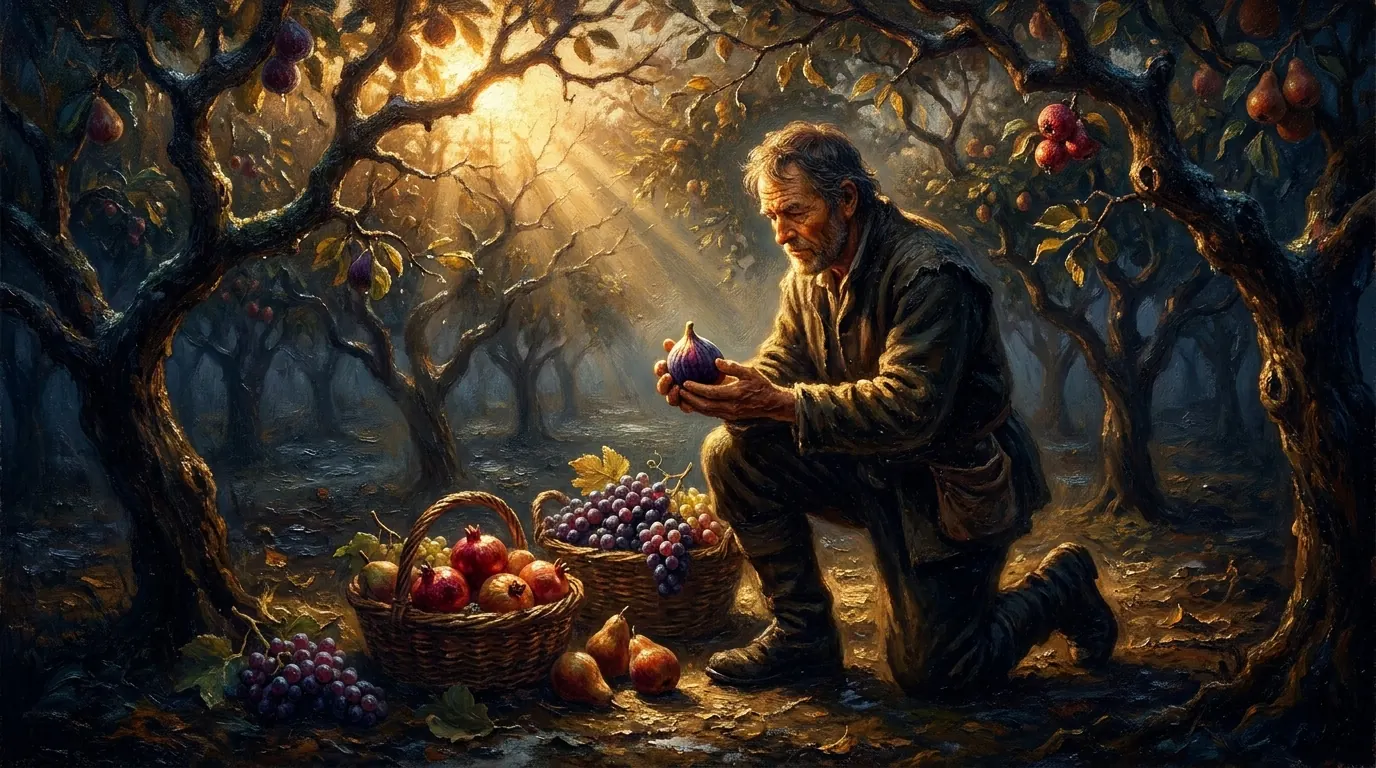
"But the fruit of the Spirit is love, joy, peace, patience, kindness, goodness, faithfulness, gentleness, self-control; against such things there is no law." — Galatians 5:22–23. Paul describes the character the Holy Spirit grows in a believer, and each quality has a money test: peace when the account runs low, patience while saving, self-control at the register, kindness toward people in need, faithfulness in work and debts.
This guide walks the Greek (karpos, singular not plural), the polemical context of Galatians 5, the works-of-the-flesh contrast that frames the list, each of the nine virtues with its Greek root and biblical background, the throwaway final clause ("against such things there is no law") that is doing more theological work than English readers notice, and the application that distinguishes Spirit-produced fruit from human imitation.
Apply this study
Pair with our exegeses of the Beatitudes (the character the Spirit forms), contentment (the fruit of peace applied to money), and the biblical work ethic (faithfulness applied to vocation).
Fruit is singular
The Greek noun is karpos — singular, and the plural karpoi never appears. Paul writes "the fruit of the Spirit is…" in the singular, so a believer cannot pick some qualities and skip others, and then he lists nine qualities. They are nine facets of one fruit. You do not get to choose love without joy, or patience without self-control. The Spirit produces all nine simultaneously in the believer who walks by the Spirit (5:16, 25). Maturity is the deepening of all nine together.
The contrast clarifies the point. In v. 19 Paul writes "the works (erga, plural) of the flesh are evident" — the flesh produces a scatter of disconnected sins, each one a separate work. The Spirit produces a single integrated fruit. The grammar enacts the theology: sin fragments; the Spirit integrates.
The Galatians 5 context — flesh vs Spirit
Galatians is Paul's hottest letter. He is fighting the Judaisers, who were teaching the Galatian Gentile believers that faith in Christ was necessary but not sufficient — they also needed circumcision and Torah-observance to be fully right with God. Paul's response is the doctrine of justification by faith alone (chs. 2–3) and the resulting freedom from the law (chs. 4–5:1).
But chapter 5 then asks the obvious question: if Christians are not under the law, what stops the new freedom from collapsing into libertinism? Paul's answer is the Spirit. Verses 5:16–26 are the answer: "walk by the Spirit, and you will not gratify the desires of the flesh" (v. 16). The works of the flesh (vv. 19–21) catalogue what unaided human nature produces — sexual immorality, idolatry, sorcery, enmity, strife, jealousy, fits of anger, rivalries, dissensions, divisions, envy, drunkenness, orgies. Against that list Paul sets the fruit of the Spirit (vv. 22–23). The list is the alternative to flesh-living, produced by the Spirit in the disciple.
The nine, one by one
1. Love — agapē
Agapē is the New Testament's most theologically loaded love-word. It names covenant, self-giving, sacrificial love, a step beyond erōs (desire), philia (affection-friendship) and storgē (family-bond). The love God shows in the cross (Rom 5:8) and demands of the disciple (1 Cor 13). It heads the list because it is the foundation; the eight that follow are facets of it.
2. Joy — chara
Happiness depends on hap (chance, circumstance — the same root as "happen"). Chara is joy that is settled, theological, anchored in God's character and steady through the day's events. James 1:2 commands Christians to "count it all joy" (pasan charan hēgēsasthe) when they meet trials — which is unintelligible unless joy is independent of circumstance.
3. Peace — eirēnē
The Greek eirēnē translates the Hebrew shalom — wholeness, integrated flourishing, the right ordering of relationships with God, self, others, and creation. The presence of right order. Justification by faith (Rom 5:1) produces peace with God; the Spirit then produces peace as fruit in the believer's experience and relationships.
4. Patience — makrothymia
A compound: makros (long) + thymos (anger, passion). Literally "long-anger" — the temperament that takes a long time to get angry. The Septuagint uses it of God himself (Ex 34:6, "slow to anger" — makrothymos). Patience is a participation in God's own forbearance with sinners.
5. Kindness — chrēstotēs
Chrēstotēs is moral excellence expressed as benevolence. Romans 2:4 says God's chrēstotēs leads people to repentance. Kindness as fruit is the active extension of God's own benevolence through the disciple to the people around them.
6. Goodness — agathōsynē
A specifically biblical noun — it does not appear in classical Greek. Agathōsynē is moral integrity expressed in concrete action. Kindness is the disposition; goodness is the deed.
7. Faithfulness — pistis
The same Greek noun usually translated "faith." Here it carries its active sense — faithfulness, trustworthiness, reliability. The disciple in whom the Spirit produces pistis is the one whose word can be relied on, whose commitments hold, whose loyalty does not shift with circumstance.
8. Gentleness — prautēs
The noun form of the adjective praus in the third Beatitude. Strength under control. Restrained power. The same word describes Christ (Matt 11:29) and is the temperament the disciple should bring to restoring a fallen brother (Gal 6:1).
9. Self-control — egkrateia
A compound: en (in) + kratos (power, mastery). The mastery one has over oneself. Pagan moral philosophy prized egkrateia; Paul places it last as the bookend. The list begins with love (the most God-ward virtue) and ends with self-control (the most self-ward), framing the whole as the Spirit's reshaping of the disciple from the inside out.
"Against such things there is no law" — what Paul means
The throwaway last clause is doing serious theological work. Paul has been arguing the whole letter that the Christian is not under the Mosaic law. Now he turns the corner: the law was never against virtues like these — the law never condemned them, though it could never produce them. The Christian who walks by the Spirit produces by grace what the law could only demand. The conflict between gospel-freedom and ethical seriousness is therefore resolved: the Spirit produces in the freed believer the character the law was always trying to enforce on the unwilling slave.
Fruit vs imitation — how to tell the difference
- Source. Fruit grows; imitation is manufactured. The believer "walks by the Spirit" (v. 16) and "keeps in step with the Spirit" (v. 25). The work is the Spirit's; the disciple's job is to walk.
- Integration. Fruit is singular — the nine come together. The person with great patience but no self-control, or great kindness with no faithfulness, is producing imitation.
- Durability. Manufactured virtue collapses under pressure; fruit deepens under it. Romans 5:3–5 says suffering produces endurance, character, hope — the Spirit's pressure-test of the fruit.
- Direction. Fruit is given away. Love, kindness, gentleness are inherently outward-facing. The believer who hoards "fruit" privately has not understood what is being grown.
What the fruit of the Spirit means for your money
You cannot manufacture the fruit. You can arrange your finances so it has room to grow, and you can use each quality as a test of your money habits. The table pairs the qualities with a question and a step.
| Fruit | Money question | Practical step |
|---|---|---|
| Love | Does my plan provide for my household and my neighbor? (1 Timothy 5:8; 1 John 3:17) | List the people your money must cover, then add a giving line |
| Joy and peace | Where does worry about money keep me awake? (Philippians 4:6-7) | Build an emergency fund with small, steady deposits |
| Patience | Am I buying today what I could save for? | Add a 30-day wait for non-essential purchases |
| Kindness and goodness | Who near me has a need I could meet? | Set aside a monthly amount for quiet generosity |
| Faithfulness | Do I keep promises, pay debts and work honestly? (Luke 16:10) | Automate minimum payments and give a full day’s work |
| Gentleness | How do I talk about money with my spouse? | Hold a weekly money meeting with no blame |
| Self-control | Where does my spending outrun my plan? | Give each category a limit and track it weekly |
Paul places these qualities in a church that had trouble with biting and devouring one another (Galatians 5:15). Money is one of the fastest ways to bite. A family that talks about the budget with gentleness and patience shows the fruit in the place where it is tested.
Prayer belongs in this work. Ask the Spirit for self-control before you shop and for peace before you open the bills. Then take a practical step the same day, so the prayer has something to work with.
Pick one quality for the month. If peace is thin, focus on the emergency fund. If self-control is thin, focus on spending limits. One quality at a time gives you a clear target and a clear sign of growth, and your family can see the change without a speech.
Build the structure with our Budget Calculator and Emergency Fund Calculator. Then study Luke 16:11 on faithfulness, the biblical emergency fund, money and marriage and Bible verses about generosity.
Application — six ways to walk by the Spirit this week
- Stop trying to manufacture the fruit; start walking by the Spirit. Read the Word, pray honestly, confess sin, gather with the church. The Spirit produces fruit through ordinary means of grace.
- Diagnose the missing fruit. Pick the one of the nine you are weakest in this season and let that diagnosis push you to repentance.
- Connect fruit to money. Self-control in giving (see our Tithe Calculator), patience in saving, faithfulness in budgeting (use the Budget Calculator) are concrete tests of the Spirit's work.
- Refuse the works-of-the-flesh shortcuts. Anger, rivalries, dissensions — Paul's list (vv. 19–21) — are the alternative the flesh always offers.
- Cultivate chara independent of circumstance. Joy that depends on the week's events is happiness.
- Treat suffering as the fruit's incubator. Patience, gentleness, and faithfulness all grow under pressure.
FRUIT IN YOUR FINANCES
Self-control, faithfulness, and patience are the Spirit's stewardship fruit
A budget is one of the most concrete places the fruit of the Spirit shows up — or fails to. Our free tools turn the principle into practice.
Open Budget Calculator →All Scripture quotations from the English Standard Version. Greek transliterations follow standard SBL conventions.