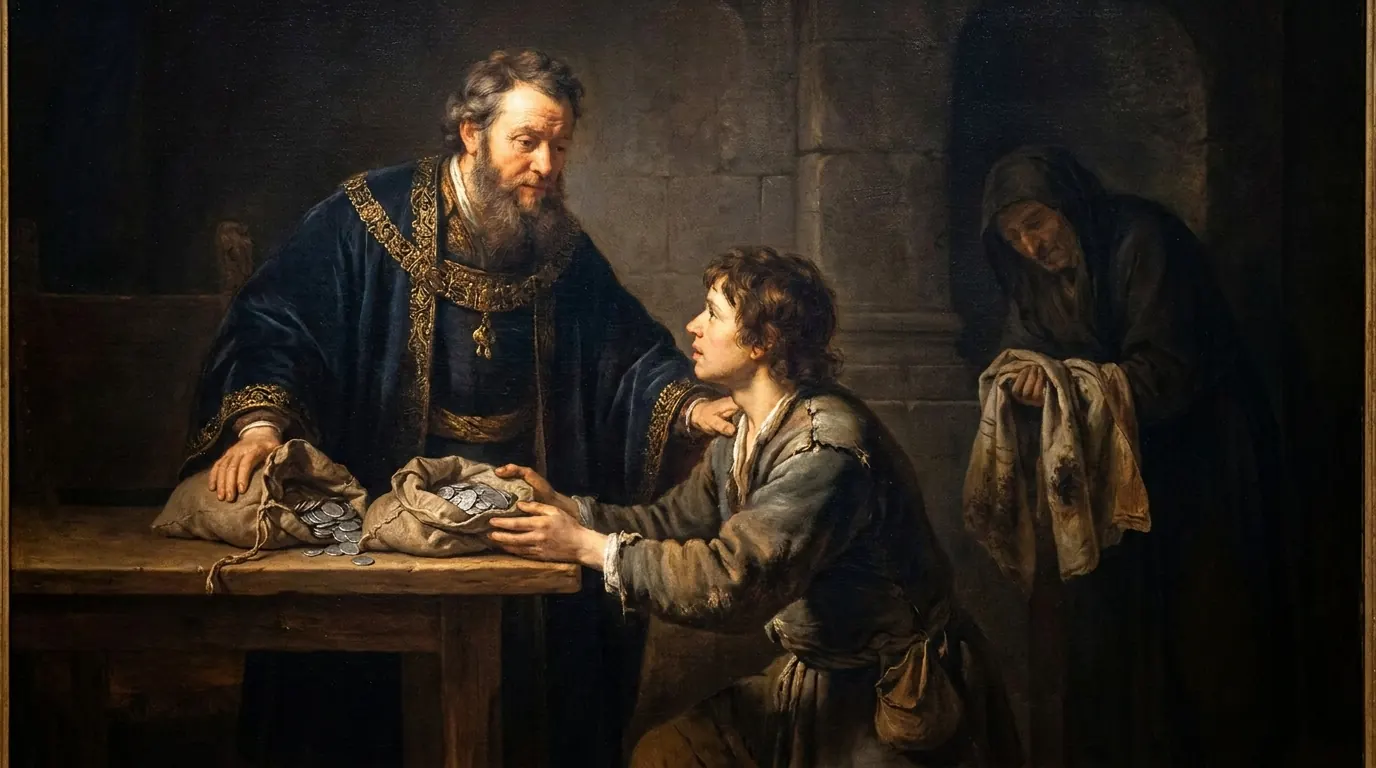
“Well done, good and faithful servant” means the master is pleased with a steward who managed faithfully what he was given. In Matthew 25:21 Jesus says these words in the parable of the talents, and the reward that follows is more responsibility and a place in the master's own joy: “You have been faithful over a little; I will set you over much. Enter into the joy of your master.”
The verse comes from Jesus' most explicit teaching on stewardship, given in His final week before the crucifixion as part of the Olivet Discourse on the end of the age. Read in context, Matthew 25:21 is a comforting promise and also a sober announcement: every dollar, hour and gift entrusted to a Christian will be evaluated. This study walks through the whole parable, Matthew 25:14-30, from the value of a talent to the fate of the third servant, and ends with what it means for your money.
The setting: Jesus' final teaching before the cross
Matthew 24-25 is the Olivet Discourse, Jesus' extended answer to the disciples' question, “What will be the sign of your coming and of the end of the age?” (Matthew 24:3).
The discourse moves from the destruction of the temple, to the great tribulation, to the return of the Son of Man, to three parables about being ready: the wise and foolish virgins (25:1-13), the talents (25:14-30) and the sheep and the goats (25:31-46).
The parable of the talents sits in the middle. The point of all three is the same. Christ will return, and how you live in His absence determines what you hear when He arrives. The talents parable is the one that speaks about resources: what to do with the master's property while the master is away.
How much is a talent worth?
The word is talanton (τάλαντον). In the first century it was a unit of weight, roughly 75 to 80 pounds of silver, and in money it equaled about 6,000 denarii. A denarius was a laborer's day wage (Matthew 20:2). One talent therefore matched roughly twenty years of a laborer's pay. Our English word “talent” for a skill comes from this parable, and the Greek word never meant ability.
| Servant | Received | Roughly in day-laborer wages |
|---|---|---|
| First | 5 talents | 100 years |
| Second | 2 talents | 40 years |
| Third | 1 talent | 20 years |
These are estimates from the standard Greek and Roman weights and the day-wage in Matthew 20. Jesus is telling a story about vast sums. Even the servant with one talent held more than a laborer could earn in two decades. The size of the trust matters, because God gives His stewards control of resources they could never have produced on their own.
The parable: a master, three servants and unequal capital
A master leaving on a long trip entrusts his property to three servants: five talents to one, two to another, one to the third, “each according to his ability” (verse 15). The Greek is kata tēn idian dynamin. The distribution is unequal and calibrated to what each servant could handle.
The first two go at once and put the money to work. Both double it (verses 16-17). The third digs a hole in the ground and hides his master's money (verse 18).
“After a long time” the master returns and settles accounts (verse 19). The two faithful servants receive identical words: “Well done, good and faithful servant. You have been faithful over a little; I will set you over much. Enter into the joy of your master” (verses 21, 23).
The third servant returns the original talent and blames his master: “I was afraid, and I went and hid your talent in the ground” (verse 25), after calling his master a hard man (verse 24). The master calls him “wicked and slothful,” says he should at least have put the money with the bankers to earn interest (verses 26-27), takes the talent and gives it to the servant who has ten (verse 28). The parable closes with the servant thrown “into the outer darkness. In that place there will be weeping and gnashing of teeth” (verse 30).
The three servants at a glance
| Servant | Talents | What he did | Result | Money lesson |
|---|---|---|---|---|
| First | 5 | Traded at once and gained 5 more | “Well done” and more responsibility | Put capital to work in the real economy |
| Second | 2 | Traded and gained 2 more | The same words as the first | You answer for your own assignment |
| Third | 1 | Buried it and returned it unchanged | Rebuked, stripped and cast out | Hoarding out of fear counts as failure |
“Well done”: the Greek eu and the master's pleasure
The Greek behind “well done” is the simple word eu, “good” or “well.” It is a word of pleasure, a verbal smile. The master is pleased. The whole accounting scene, with all its sober weight, is meant to be heard against this backdrop: the master genuinely wants to say “well done” to His servants.
“Good and faithful servant” is doule agathe kai piste (δοῦλε ἀγαθὲ καὶ πιστέ). Agathos points to intrinsic moral quality. Pistos points to reliability in execution. The master praises a life that was good and dependable over time. He does not praise spectacular results.
“Faithful over a little; I will set you over much”
Notice what the master rewards. Both servants doubled their entrustment, one from five and one from two, and both hear the same words. He rewards the faithfulness of the management. He does not compare the size of the two returns.
This is one of the most freeing principles in Scripture. God measures stewardship against the entrustment given. Luke 12:48 says the same thing: “Everyone to whom much was given, of him much will be required.” The Christian with $40,000 of income and the Christian with $400,000 are each measured against what they were given. The single mom faithfully tithing $200 a month and the executive faithfully tithing $200,000 a month hear the same words from the same Master.
“I will set you over much” (epi pollōn se katastēsō) tells us the reward for faithful stewardship is more responsibility. Heaven includes work, and the servant is promoted. Joy in the Master's presence comes through sharing His work.
“Enter into the joy of your master”
The Greek chara means joy, gladness, delight. The phrase chara tou kyriou sou is the joy that belongs to the master, His own gladness shared with the servant. Whatever heaven is, it includes being invited into the gladness of God Himself. The faithful servant does not stand at the gate and receive a paycheck. He walks into the house.
Steward your “talents”
Faithful stewardship begins with knowing what you actually hold. Try our free Net Worth Calculator, Budget Calculator and Tithe Calculator: three tools for managing what the Master has entrusted to you.
The third servant: what the parable says about doing nothing
The third servant did not lose the master's money. He did not embezzle, gamble or squander. He buried it and returned the exact amount. First-century readers would have found that defensible: rabbinic teaching in the Mishnah (Bava Metzia 3:10-11) treats burying entrusted money as the safest way to keep it. By the master's standard he was still wicked and slothful (ponēre kai oknēre).
Stewardship failure in Scripture is often quiet. The Christian who never tithes because he is “saving up.” The Christian with marketable skills who refuses to use them while “waiting for direction.” The Christian with capital that sits idle while the Kingdom has needs. The buried talent draws the sharpest rebuke in the parable.
His stated reason is fear: “I was afraid” (ephobēthēn, verse 25). He held a picture of the master as a hard man, and that picture produced his paralysis. A distorted view of God will shape a person's use of money. The faithful servants risked because they trusted the one who had given them the capital.
“To everyone who has will more be given” (Matthew 25:29)
Verse 29 puzzles many readers: “For to everyone who has will more be given, and he will have an abundance. But from the one who has not, even what he has will be taken away.” Read inside the story, the “has” describes the servant who put the entrusted capital to work. Faithful use of a small trust leads to a larger trust. A talent that stays buried is lost to its holder. The verse states a principle of the Kingdom about responsibility and gives no license for greed.
What the talents represent
Christians read the talents in several ways, and each has some support.
- All God-given resources. Time, money, gifts, opportunities and the gospel itself. This is the most common reading.
- Spiritual gifts. The parallel in 1 Corinthians 12:7 says the manifestation of the Spirit is given “to each for the common good.”
- The gospel and apostolic ministry. Some Reformed readers see the third servant as Israel's leadership burying the message.
- Money itself. The parable is financial on its face, and Jesus tests faithfulness with money because money reveals the steward (Luke 16:11).
The parable's specifics are financial and its applications are wider. A steward who handles money faithfully has learned the habit that serves every other gift.
The financial implications of Matthew 25:21
Every dollar will be evaluated. The income, the inheritance, the windfall, the unexpected raise. All of it is the master's capital, on loan. You will give an account.
Faithfulness is measured against what you were given. You will answer for your specific entrustment and be compared to no one else.
Doing nothing is unsafe. The third servant thought he was minimizing risk. His master's response leaves no doubt that inaction was the greater risk.
Heaven includes promotion. The reward for faithful stewardship is more responsibility in the master's joy. The Christian life continues past death and grows.
Applying the parable to your money
- Stop burying. Keep an emergency fund, which Scripture commends (Proverbs 21:20). Money parked for years out of fear, far beyond prudence, resembles the buried talent.
- Invest with discernment. The faithful servants put capital at real risk in the marketplace. Scripture never commends speculation, and it never commends hoarding either. Read our study of biblical investing principles and whether Christians should invest.
- Give first and give steadily. Generosity acts on the belief that the reckoning is real. Our biblical tithing guide covers the practical side.
- Build the vocation you have. The two-talent servant did not resent the five-talent assignment. He doubled what he was given and received the same commendation.
- Check your decisions for fear. Ask where your money is sitting because you doubt God's goodness.
- Plan for the reckoning. The master returns after a long time, and he does return. Stewardship is custody until the audit, so beneficiary reviews and estate planning belong in the plan.
Live now in light of that future “well done.” The steward who hears it from Christ has lived the only life worth living. For the broader theology, see our study on the parable of the talents, our exegesis of Proverbs 19:17, and our overview of stewardship verses. Apply the principle this month with the Budget Calculator and the Generosity Calculator.
All Scripture quotations from the English Standard Version unless otherwise noted.