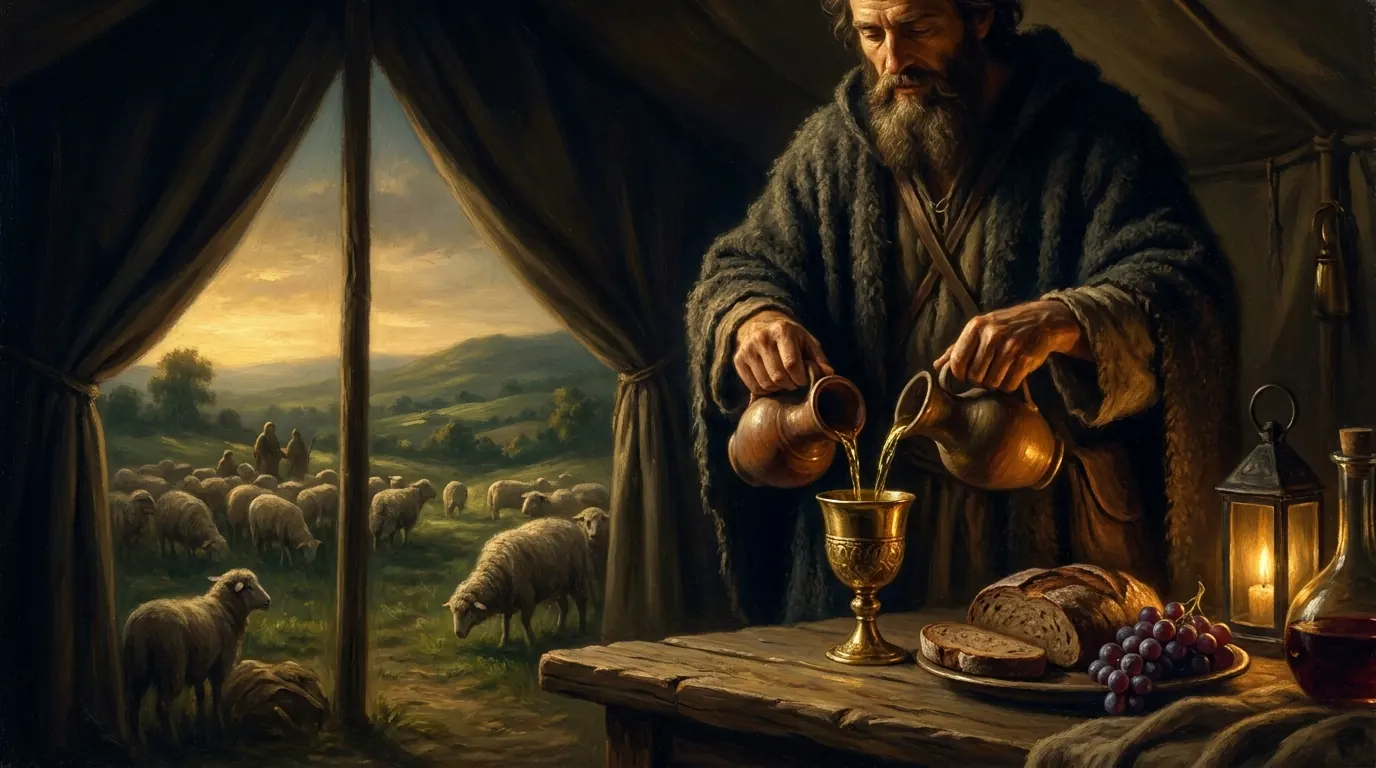
"My cup overflows" — Psalm 23:5. The Hebrew is kosi revayah, and the word revayah is not a verb at all; it is a noun meaning "saturation, abundance, drink to the point of fullness." Literally: "my cup [is] saturation." David's cup is not just full; it has become overflow itself.
The Bible has a whole vocabulary for overflow — Hebrew nouns, Greek verbs with stacked hyper- prefixes, agricultural images of bursting vats and rising rivers, marketplace pictures of grain pressed down and shaken together. This guide walks fifteen-plus passages and gives you the working framework for receiving overflow without turning it into hoarding.
Apply this study
Pair with our abundance prayer, our bible verses about finances, and our tithing guide.
Psalm 23:5 — the saturated cup
Taʿarokh le-fanai shulchan neged tsorerai, dishanta va-shemen roshi, kosi revayah. "You prepare a table before me in the presence of my enemies; you anoint my head with oil; my cup [is] saturation." The third clause is a noun-only sentence in Hebrew — no verb. The cup is the abundance.
The setting matters: neged tsorerai, "in the presence of my enemies." Overflow is not for the smooth-sailing season; it is for the table set in adversarial conditions. The shepherd is not just safe; he is feasting while surrounded. Overflow in Psalm 23 is testimony, not luxury.
Luke 6:38 — pressed down, shaken together, running over
Jesus' four-verb generosity formula: metron kalon pepiesmenon sesaleumenon hyperekchynnomenon dōsousin eis ton kolpon hymōn — "a good measure, pressed down, shaken together, running over, they will put into your lap."
The image is the grain merchant of the ancient Near Eastern marketplace. A buyer asked for a measure of grain; the seller would pour it in, press it down with the hand, shake the container to settle the grains tighter, then continue pouring until it overflowed into the fold of the buyer's outer garment (the kolpos, the lap-fold). The honest seller did all four. The principle: "for with the measure you use it will be measured back to you." Stingy measuring out yields stingy measuring back; overflowing measuring out yields overflowing measuring back. Overflow is reciprocal.
Malachi 3:10 — the windows of heaven until there is no more need
"Bring the full tithe into the storehouse… and thereby put me to the test, says the LORD of hosts, if I will not open the windows of heaven for you and pour down for you a blessing ʿad-beli-day." The Hebrew phrase ʿad-beli-day literally means "until there is no more sufficiency" — until your capacity to receive is exhausted, until you run out of barn.
The context is covenant Israel under the Mosaic law and the blessing language is agricultural-corporate (rain, harvest, vine). The principle remains for the Christian: God honours faithful giving, and his blessing can exceed the receiver's capacity to contain it. The application is not "tithe to get rich" but "tithe and prepare for blessing that may force you to enlarge your barn-of-generosity, not your barn-of-storage."
John 7:38 — rivers of living water flowing out
"Out of his heart will flow rivers of living water" — potamoi ek tēs koilias autou rheusousin hydatos zōntos. Jesus speaks at the Feast of Tabernacles when the priests poured water at the altar daily for seven days. The plural potamoi (rivers, not river) signals overflow; the verb rheusousin is future indicative — "shall flow."
The next verse identifies the rivers: "this he said about the Spirit, whom those who believed in him were to receive." Overflow in John 7 is pneumatological. The Christian becomes a conduit, not a reservoir.
Ephesians 3:20 — super-beyond-abundantly
Paul stacks prefixes to break the ceiling on prayer: tō de dynamenō hyper panta poiēsai hyperekperissou hōn aitoumetha ē nooumen — "to him who is able to do super-beyond-abundantly all that we ask or think." Hyperekperissou is built from hyper + ek + perissos — three intensifiers stacked. Paul has run out of normal Greek and is coining vocabulary.
The verse is bounded by "according to the power at work within us" (v. 20b) — overflow is for the Christian in whom the Spirit is working, not for any wish-list petitioner.
2 Corinthians 9:8 — the five-all verse
Paul packs five "all/every" words into one verse: dynatos de ho theos pasan charin perisseusai eis hymas, hina en panti pantote pasan autarkeian echontes perisseuēte eis pan ergon agathon. "God is able to make all grace abound to you, so that having all sufficiency in all things at all times, you may abound in every good work." The verb perisseuō appears twice — God abounds grace toward you, you abound generosity toward others. The construction makes the overflow's purpose explicit: eis pan ergon agathon, "for every good work." Overflow is given for the next person, not for the storehouse.
Other anchor passages on overflow
- Romans 5:20 — hou de epleonasen hē hamartia, hyperepe rosseusen hē charis ("where sin abounded, grace super-abounded"). The prefix hyper- on the second verb. Grace outruns sin.
- Joel 2:24 — "the threshing floors shall be full of grain; the vats shall overflow with wine and oil." Restoration prophecy, fulfilled in the eschaton.
- Proverbs 3:9-10 — "honour the LORD with your wealth… then your barns will be filled with plenty, and your vats will be bursting with new wine."
- Deuteronomy 28:11-12 — covenant blessing of overflow ("the LORD will open to you his good treasury, the heavens").
- Psalm 65:11 — "you crown the year with your bounty; your wagon tracks overflow with abundance."
- Psalm 36:8 — "they feast on the abundance of your house, and you give them drink from the river of your delights" (Hebrew nachal ʿadaneykha — "river of your Edens").
- Isaiah 66:11 — "that you may nurse and be satisfied from her consoling breast; that you may drink deeply with delight from her glorious abundance."
- 1 Timothy 6:17 — "God, who richly provides us with everything to enjoy" (plousiōs, "richly").
- John 10:10 — "that they may have life, and have it abundantly" (perissos).
- Philippians 4:18-19 — "I am well supplied… and my God will supply every need of yours according to his riches in glory in Christ Jesus."
The framework — overflow as conduit, not reservoir
Every biblical overflow text terminates in giving, not storing. The cup overflows so others may drink. The vats burst so the priest and the poor and the festival may be supplied. The grain runs over into the lap so the household has bread for the next guest. The rivers flow out of the believer for the world. Paul's perisseuō-twice in 2 Cor 9:8 is the structure: grace overflows toward you so that good works may overflow from you.
The Christian who receives overflow and stores it without giving has cancelled the biblical pattern. The rich fool (Luke 12) is the warning. The wise virgins (Matthew 25) — who had reserve oil — are not contradictions; their reserve had a purpose (to last through the bridegroom's delay), and they were ready to part with it for that purpose.
Three misreadings to avoid
- Overflow as luxury. Biblical overflow is for generosity-funding and adversarial-table testimony, not for a luxurious lifestyle.
- Overflow as formula. Malachi 3:10 is a covenant promise, not a deposit-slip. The tithe is the obedience; the overflow is God's prerogative.
- Overflow as guaranteed for every believer. The Macedonian Christians of 2 Cor 8 gave out of "extreme poverty" (kata bathous ptōcheia). Their overflow was generosity-overflow, not bank-account-overflow. Both are biblical.
RECEIVE OVERFLOW AS A CONDUIT
Steward overflow with a generosity-funded budget
The biblical pattern: overflow comes in so that giving goes out. Our budget tool puts giving first.
Open Budget Calculator →All Scripture quotations from the English Standard Version. Hebrew and Greek transliterations follow standard SBL conventions.
Three things that lead to an abundant life — what Jesus actually meant
Jesus' promise in John 10:10 — "I came that they may have life and have it abundantly (perisson)" — is the headwater verse for any biblical theology of the abundant life. The Greek perisson means "exceeding, beyond measure, more than enough" — but the context (John 10:1-18, the Good Shepherd discourse) defines the abundance theologically, not materially. Three things lead to the abundant life Jesus describes.
- Knowing the Shepherd's voice (John 10:3-4, 14, 27). The abundant life begins with relational recognition — sheep that know the shepherd's voice and follow. Abundance is a function of intimacy with Christ, not of circumstance. Without this, every other "abundance" is counterfeit.
- Abiding obedience (John 15:5, 10-11). "Abide in me, and I in you... that my joy may be in you, and that your joy may be full." The Greek plērōthē ("be made full") is the Johannine equivalent of perisson. Joy-fullness is the experiential signature of abundant life, and it is produced by abiding — sustained, dependent communion expressed in obedience.
- Generous self-giving (Acts 20:35, 2 Cor 9:6-11). The abundant life that Jesus models is poured out, not accumulated (John 10:11 — "the good shepherd lays down his life for the sheep"). Disciples enter into abundance by reproducing the giving-pattern. Hoarders never experience the perisson; the generous taste it weekly.
Note what is not on this list: wealth, status, perfect health, problem-free circumstances. Jesus promises zōē perisson — overflowing life — to disciples in any economic condition, and the promise has held for two thousand years of poor saints whose joy outran their bank accounts.