The Bible treats buying land as a normal, honorable act of stewardship. Abraham paid full price for a burial cave, Jeremiah bought a field while an army besieged the city, and the woman of Proverbs 31 “considers a field and buys it.” The guardrails are just as clear: build your income first, pay honestly, do not grab, and remember that the land belongs to God.
Scripture never says “buy a house” or “rent forever.” It gives principles, and this guide turns them into numbers you can test against your own budget.
Put it into practice
Before you look at a single listing, see what a payment does to your monthly plan with our Budget Calculator, then check that a repair fund exists with the Emergency Fund Calculator. Our free resources page has the printable worksheets.
Quick answer: what the Bible says about buying land
Five ideas carry the whole subject. Land can be bought and sold (Genesis 23, Jeremiah 32). Income comes before the house (Proverbs 24:27). Land belongs to God in the end (Leviticus 25:23). Property should be gained honestly and never by squeezing others (Isaiah 5:8, Deuteronomy 19:14). And a wise buyer counts the cost first (Luke 14:28).
The rest of this article walks through each one, then puts them on a table with real numbers.
Abraham buys Machpelah: pay the price, put it in writing
Sarah died in Hebron and Abraham owned no ground in the land God had promised him. Genesis 23 records what he did about it. He went to the city gate, where legal business was conducted, and asked the Hittite elders for a burial site.
Ephron offered the field and the cave as a gift. Abraham refused the gift and insisted on paying. Ephron named the price: four hundred shekels of silver. “Abraham listened to Ephron, and Abraham weighed out for Ephron the silver that he had named in the hearing of the sons of Heth” (Genesis 23:16).
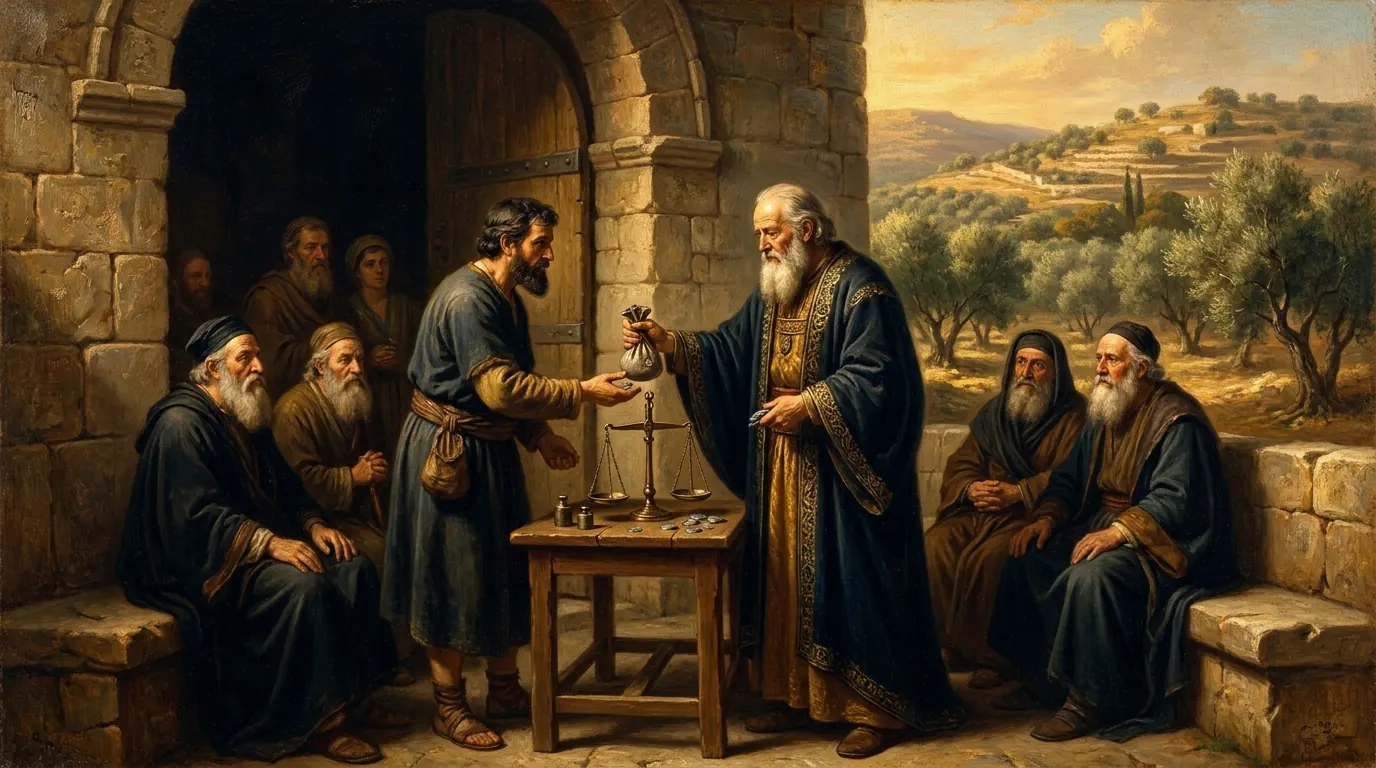
Notice four habits. He paid a clear price and did not haggle it into a bargain at someone else's cost. The sale happened in public, before witnesses. The seller's terms were recorded. And the purchase met a real need, a family burial place, with no guess about the market behind it. The chapter closes by saying the field “was made over to Abraham as a possession” (v. 20). Clean title still matters today.
Jeremiah buys a field at Anathoth: faith with paperwork
Jeremiah 32 is the strangest real estate deal in Scripture. Babylon's army surrounded Jerusalem, the prophet sat in the guard's court, and God told him his cousin Hanamel would offer him a field. Jeremiah bought it anyway.
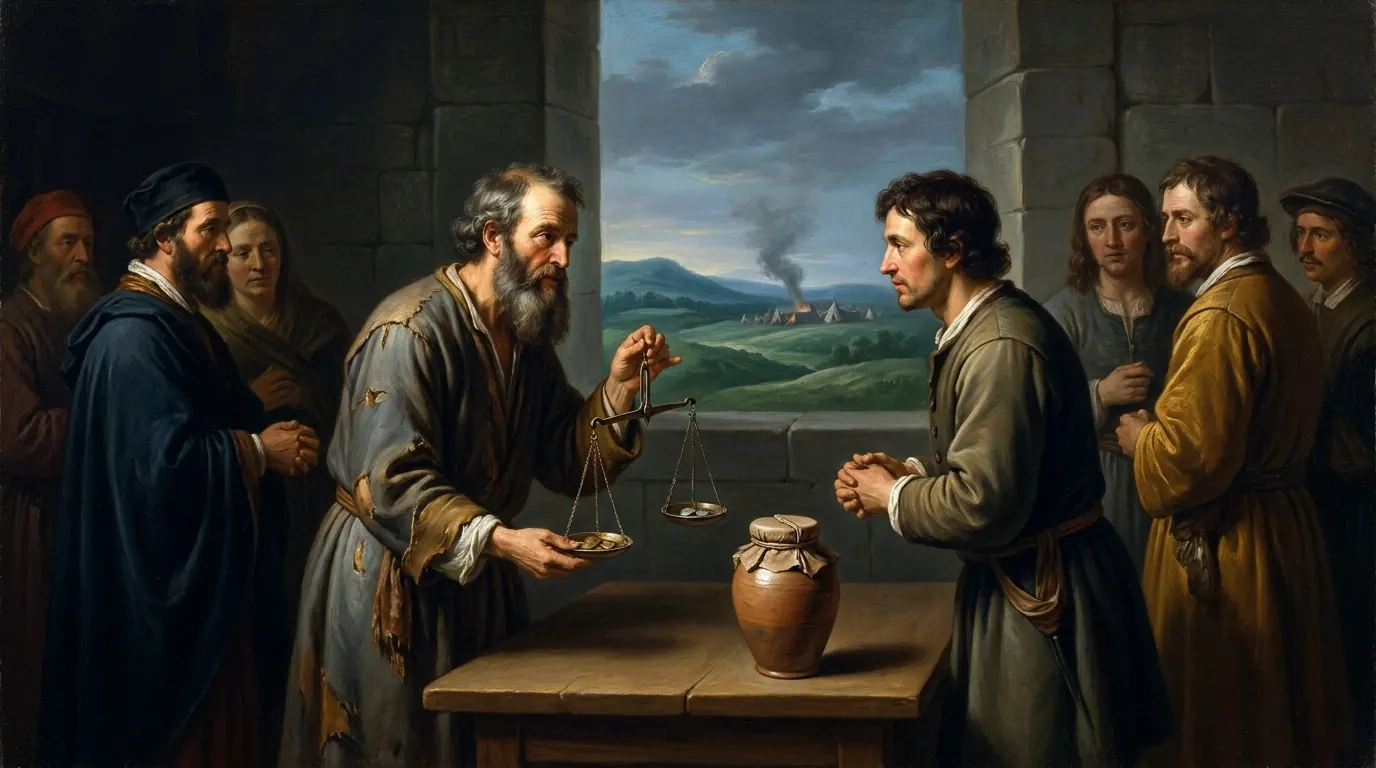
The details read like a closing table. He weighed out seventeen shekels of silver, signed the deed, had it sealed and witnessed, and put both copies in an earthen jar “that they may last for a long time” (Jeremiah 32:9-14). God's explanation follows: “Houses and fields and vineyards shall again be bought in this land” (v. 15).
The purchase was a sign of hope in a season of ruin. It was also careful. Jeremiah did not treat faith as permission to skip documents. Modern readers should not stretch this into a promise that any property purchase will prosper. The text ties this field to a specific promise of Israel's return. The lesson that transfers is the method: honest price, witnesses, sealed paper, patient timeline.
Proverbs 24:27: prepare your work, then build your house
“Prepare your work outside; get everything ready for yourself in the field, and after that build your house.”
Solomon puts the income engine ahead of the house. In an agrarian economy the field fed the family and paid for the roof. The order matters for anyone buying property today: stable income, savings and a working budget come first, and the purchase comes after.
The same book adds a warning about speed. “Wealth gained hastily will dwindle, but whoever gathers little by little will increase it” (Proverbs 13:11). Our study of Proverbs 13:11 covers that verse in more depth. Jesus applied the same logic to building projects: “Which of you, desiring to build a tower, does not first sit down and count the cost?” (Luke 14:28).
Proverbs 31:16: a field bought with earnings
“She considers a field and buys it; with the fruit of her hands she plants a vineyard.” The sequence is worth reading slowly. She considers first. She buys with money she has earned. Then she puts the land to work by planting.
Land here is a productive asset, paid for from income and put to work. If you want the full portrait, read our guide to the Proverbs 31 woman.
Leviticus 25:23: the land is God's
“The land shall not be sold in perpetuity, for the land is mine. For you are strangers and sojourners with me.” Israel's land laws rested on this sentence. Families received allotments, and in the Year of Jubilee land returned to the original family line (Leviticus 25:10-13). A sale was really a lease priced by the years remaining until Jubilee.
Christians differ on how much of that system carries into the present. All agree on the core idea: you hold property as a manager, and God stays the final owner. That view changes how you shop. It makes room for hospitality, for generosity from the property's income, and for a plain answer to the question “Is this purchase making me more dependent on God or less?” See our page on the Year of Jubilee for the historical detail.
The warnings: land grabs and moved boundary stones
Scripture is not naive about property. Isaiah 5:8 pronounces woe on “those who join house to house, who add field to field, until there is no more room, and you are made to dwell alone in the midst of the land.” The target is accumulation that crowds out neighbors. Deuteronomy 19:14 and Proverbs 22:28 forbid moving the ancient boundary stone. Micah 2:2 describes people who “covet fields and seize them.”
None of these condemn owning property. They condemn taking it by force, fraud or predatory pressure. Buying a home at a fair price from a willing seller sits far from anything on that list.
Rent or buy: a table of biblical and practical considerations
Neither renting nor owning is a sin. Each fits certain seasons. Use this table to test your own situation.
| Question | Renting tends to fit when | Buying tends to fit when |
|---|---|---|
| Time horizon | You may move within about five years | You expect to stay long enough for costs to pay off |
| Income (Prov 24:27) | Your income is new, seasonal or uncertain | Income has been steady for a couple of years |
| Down payment | Saving it would drain your emergency fund | You can put down 20% (this avoids private mortgage insurance on most conventional loans) and keep your reserve |
| Debt load | Consumer debt is still on the table | Only the mortgage remains |
| Repairs | You have no cushion for a roof or furnace | You keep a maintenance fund funded separately |
| Flexibility | Ministry, family or work may call you elsewhere | Your roots are settled and you plan to host and serve from the home |
Two guardrails from lenders and counselors help keep the purchase sane. Many mortgage lenders use a 28/36 guideline: housing costs near 28% of gross monthly income and total debt payments near 36%. Dave Ramsey teaches a tighter limit, keeping the payment at or under 25% of take-home pay, with a 15-year fixed mortgage and a 10-20% down payment. Both are guidelines that no verse requires. The point is that a payment you can carry through a job loss is wiser than the largest payment a bank will approve.
A practical example with $6,000 a month gross
Suppose a household earns $6,000 a month before taxes and $4,800 after taxes.
| Guideline | Calculation | Monthly housing ceiling |
|---|---|---|
| Lender front-end 28% | 28% of $6,000 | $1,680 |
| Ramsey 25% of take-home | 25% of $4,800 | $1,200 |
| Total debt at 36% | 36% of $6,000 = $2,160, minus a $300 car payment | $1,860 (the 28% line of $1,680 is tighter, so it governs) |
The gap between $1,200 and $1,680 is $480 a month. That difference is real money for a repair fund, giving and savings. Choose the lower number, and a surprise like a layoff, a new baby or a broken water heater stays a problem you can handle. Remember that the payment is not the whole cost: property tax, insurance and maintenance come on top of the loan payment.

A framework in seven steps
1. Settle your income first (Proverbs 24:27). Two years of steady work is a reasonable marker. If your income is irregular, rent longer and build reserves.
2. Clear the consumer debt (Proverbs 22:7). A mortgage on top of card balances stacks obligations. Our Debt Snowball Calculator shows how quickly the smaller debts can go.
3. Save the down payment and a reserve. Keep a full emergency fund intact after closing costs. Use the emergency fund guide to set the target.
4. Set a payment ceiling before you shop (Luke 14:28). Decide your number at the kitchen table before you ever open the lender's website.
5. Buy with clean title and a fair price (Genesis 23). Use a professional inspection, a title search and a reputable closing agent. Abraham's witnesses are your modern paperwork.
6. Keep giving steady (Proverbs 3:9). A mortgage calls for planning, and generosity stays in the plan. Test the payment with your giving line already in the budget.
7. Hold it open-handed (Leviticus 25:23). Plan to use the property for hospitality, and review the purchase yearly the way Proverbs 27:23 tells the shepherd to know his flocks.
Internal study path
Continue with is buying a house biblical, the Year of Jubilee, the Proverbs 31 woman, biblical investing principles, multiple income streams in Scripture, land trust vs living trust, and our stewardship hub.