“Seven streams of income” circulates widely as a biblical teaching, usually attached to Ecclesiastes 11:2. The verse is real. The number is being read too literally, and the passage it belongs to is more interesting than the slogan.
Solomon is not handing out a portfolio allocation. He is making an argument about acting wisely under conditions you cannot see. That argument is genuinely about diversification — and it comes with a guardrail that the “seven streams” version usually drops.
Put it into practice
Diversifying is meaningless without knowing your baseline. Map what you actually hold with our Net Worth Calculator, then work through the whole arc of Scripture on money in our free Biblical Blueprint for Money (41-page PDF, no signup).
What Ecclesiastes 11:1-2 actually says
“Cast your bread upon the waters, for you will find it after many days. Give a portion to seven, or even to eight, for you know not what disaster may happen on earth.”
Two readings of the first line have long standing in the commentary tradition, and both are defensible.
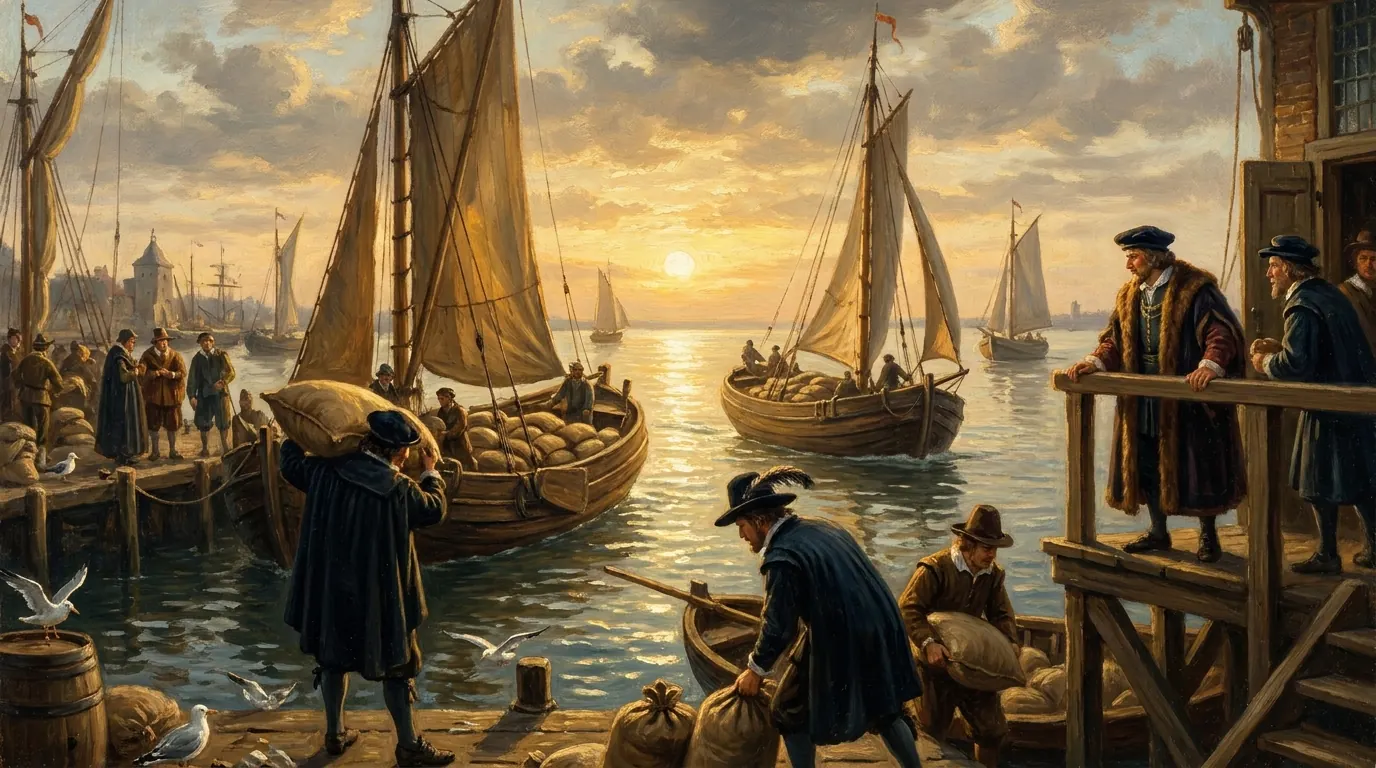
The commercial reading takes “cast your bread upon the waters” as maritime trade — grain sent out by ship, returning as profit “after many days.” Solomon's own kingdom ran exactly this: fleets sailing from Ezion-geber, voyages returning every three years (1 Kings 9:26-28; 10:22). The phrase would have been unremarkable commercial language.
The generosity reading takes it as open-handed giving that returns to the giver in God's timing, in the same key as Proverbs 11:24-25.
Verse 2 is where the diversification argument is unambiguous. “Give a portion to seven, or even to eight” uses a standard Hebrew numerical idiom — the x, or even x+1 pattern that appears throughout Proverbs (“six things the LORD hates, seven that are an abomination,” 6:16). The construction means “many, and then some”. It is emphatically not a count.
Anyone teaching that Scripture prescribes exactly seven income streams is turning a Hebrew idiom for “plenty” into a number. The verse says: spread it widely, and then wider.
The reason Solomon gives
The second half of verse 2 carries the whole argument: “for you know not what disaster may happen on earth.”
This is a statement about ignorance, not about ambition. Solomon does not say diversify because you will earn more. He says diversify because you cannot see what is coming.
He drives it home four verses later: “In the morning sow your seed, and at evening withhold not your hand, for you do not know which will prosper, this or that, or whether both alike will be good” (11:6). Sow twice, because you do not know which sowing survives.
The whole chapter is built on this: “you do not know the way the spirit comes to the bones in the womb of a woman with child, so you do not know the work of God who makes everything” (v. 5). Diversification, in Ecclesiastes, is what humility looks like when it touches money. It is an admission that you are not the one who knows.
Proverbs 27:23-24 — know what you actually hold
“Know well the condition of your flocks, and give attention to your herds, for riches do not last forever; and does a crown endure to all generations?”
The Hebrew is emphatic: yadoaʿ tedaʿ, an infinitive absolute doubling the verb — “knowing, know.” Know thoroughly. Know by inspection, repeatedly.
This is the passage that keeps diversification from becoming scattering. Multiple holdings you do not monitor are not diversification; they are multiplied exposure. The Hebrew shepherd counted the flock. The verse assumes you can say, today, what you own and what condition it is in.
The reason given is sobering: “riches do not last forever.” The Hebrew ḥosen names accumulated store — and even a crown, Solomon adds, does not endure across generations. He would know.
Joseph's granary: reserves against a known cycle
Genesis 41 is Scripture's fullest worked example. Joseph reads seven years of plenty followed by seven of famine, and builds policy around it: store one-fifth of the harvest during the surplus years (v. 34).
Three features are worth naming. The reserve is counter-cyclical — built when things are good, precisely because they will not stay good. It is proportional, a fixed fraction rather than whatever happens to be left over. And it is held against a foreseen event, not an emergency imagined after the fact.
Joseph is not diversifying revenue; he is building the reserve that lets you survive the year one stream fails. In practice these are the same discipline: refusing to let this year's abundance define next year's assumptions.
The Proverbs 31 household runs several ventures
The clearest picture of multiple income in Scripture is not a teaching passage but a portrait.
The woman of Proverbs 31 “considers a field and buys it; with the fruit of her hands she plants a vineyard” (v. 16) — real estate, then a productive asset on top of it. She “perceives that her merchandise is profitable” (v. 18), language of trade with margin. She “makes linen garments and sells them; she delivers sashes to the merchant” (v. 24) — manufacturing sold wholesale.
Land, agriculture, trade, manufacture, wholesale distribution. Four or five distinct activities, several of which fund the next. Notice the sequence in verse 16: the field is bought first, and the vineyard is planted “with the fruit of her hands” — earnings redeployed into an asset that produces later.
And the passage frames none of it as accumulation for its own sake. Verse 20: “She opens her hand to the poor and reaches out her hands to the needy.”
The guardrail: haste is the sin, not diversification
Here is what the “seven streams” teaching almost always omits. Scripture's warnings about money are aimed far more often at speed than at concentration.
Proverbs 28:20: “A faithful man will abound with blessings, but whoever hastens to be rich will not go unpunished.” Proverbs 13:11: “Wealth gained hastily will dwindle, but whoever gathers little by little will increase it.” Proverbs 23:4: “Do not toil to acquire wealth; be discerning enough to desist.”
The distinction is sharp and it is easy to blur. Adding income sources to reduce fragility is Ecclesiastes 11. Adding income sources to get rich faster is Proverbs 28:20 — the thing Solomon says will not go unpunished. The activity can look identical from the outside. The difference is whether you are buying resilience or chasing acceleration.
James 4:13-15 closes the door on the second motive by name: “Come now, you who say, 'Today or tomorrow we will go into such and such a town and spend a year there and trade and make a profit' — yet you do not know what tomorrow will bring.” That is the same ignorance Ecclesiastes 11:2 appeals to, turned into a rebuke of the confident planner.
The limit Scripture puts on the pursuit
Multiple income streams cost time, and Scripture treats time as bounded by something other than earning.
The Sabbath command (Exodus 20:8-11) sets a hard ceiling on productive activity, and Deuteronomy's version grounds it in the memory of slavery (5:15) — rest is what free people do. Psalm 127:2 is blunter: “It is in vain that you rise up early and go late to rest, eating the bread of anxious toil; for he gives to his beloved sleep.”
1 Timothy 6:17-19 supplies the disposition: the wealthy are told not to set their hope on “the uncertainty of riches” but on God, and to be “rich in good works, generous and ready to share.” The Greek adēlotēs — uncertainty, unreliability — is exactly the condition Ecclesiastes says to diversify against. Paul's answer to the same uncertainty is not a wider portfolio but a different foundation.
Both are true at once. Spread the risk, because you cannot see. Do not rest your hope on the spread, because it cannot hold your weight.
A working framework
1. Diversify against ignorance, not for acceleration (Eccl 11:2; Prov 28:20). The motive test is the whole thing. Are you reducing fragility or chasing speed? Same actions, opposite verdicts in Scripture.
2. Know what you hold, thoroughly and repeatedly (Prov 27:23). “Knowing, know” your flocks. Holdings you cannot describe are exposure, not diversification.
3. Build the reserve during the good years (Gen 41:34). A fixed proportion, set aside counter-cyclically, before you feel the need.
4. Redeploy earnings into producing assets (Prov 31:16). The field bought, then the vineyard planted with the fruit of her hands. Income converted into something that yields.
5. Sow twice, expect one to fail (Eccl 11:6). Morning and evening. You do not know which prospers, and Solomon assumes some will not.
6. Keep the Sabbath ceiling (Ex 20:8-11; Ps 127:2). If the additional stream requires the elimination of rest, Scripture has already ruled on it.
7. Give from every stream (Prov 3:9-10; 1 Tim 6:18). Firstfruits scales with the number of sources. So does the temptation to treat the newest one as exempt.
Internal study path
Continue with Ecclesiastes 5:10 on the love of money, Proverbs 13:11 on wealth gained hastily, the Proverbs 31 woman, what Scripture says about getting rich quick, biblical investing principles, and our stewardship hub.