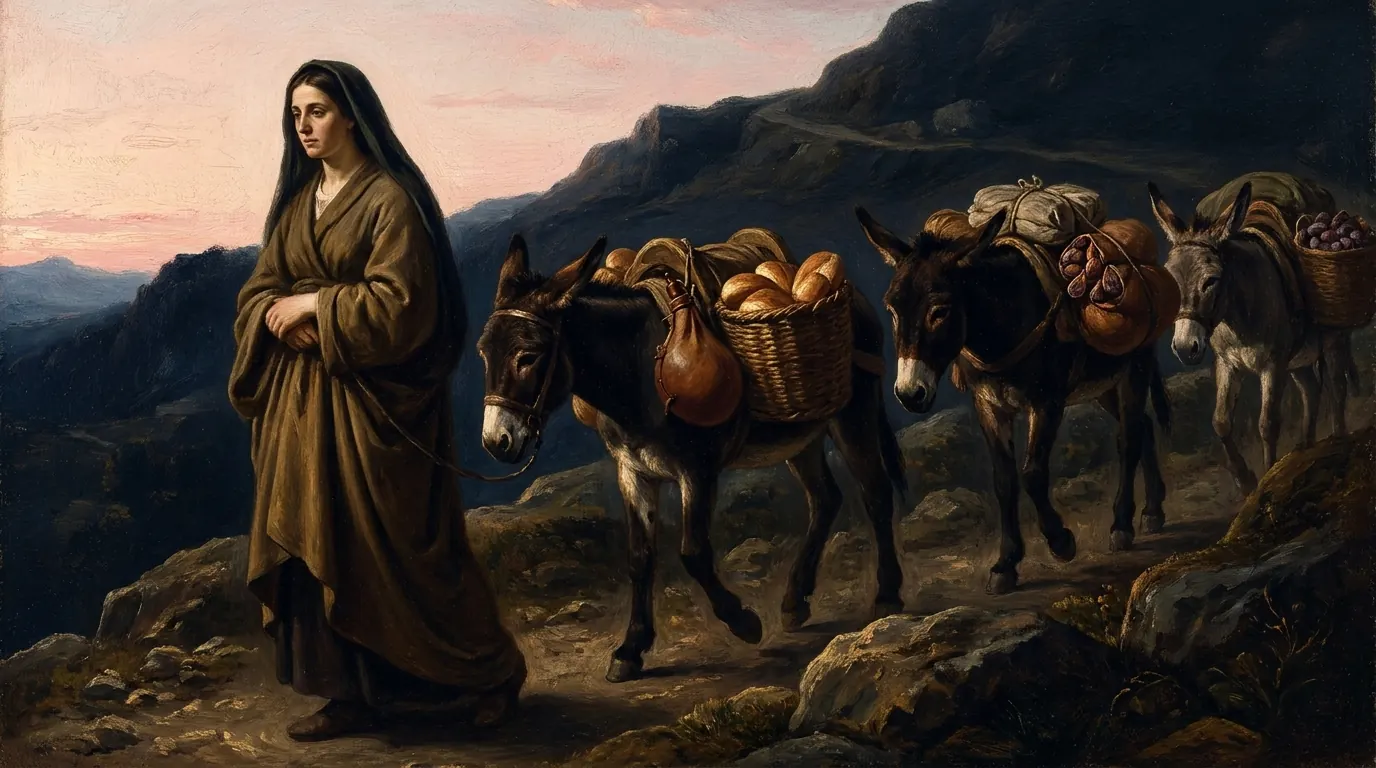
Abigail (1 Samuel 25) is the Bible’s clearest picture of wisdom under financial pressure. Her husband Nabal was very rich and very foolish, and his refusal to repay a debt of kindness put his whole household at risk. Abigail loaded donkeys with food and met David on the road within hours. The story offers a pattern for generosity, fast and calm decisions, and dealing with a spouse’s bad money choices.
Put it into practice
Couples who talk about money before a crisis handle crises better. Set up your shared plan in our Budget Calculator, plan your giving with the Generosity Calculator, and read how to budget as a Christian couple. The free Biblical Blueprint for Money (41-page PDF, no signup) is a good place to start together.
The story in brief
1 Samuel 25:2 introduces Nabal as a very rich man, with 3,000 sheep and 1,000 goats, at work shearing them in Carmel. His name means “fool,” and verse 3 calls him harsh and badly behaved. His wife Abigail is described as discerning and beautiful.
David, then a fugitive from King Saul, was camped in the wilderness nearby with his men. The shepherds later say those men were “a wall to us both by night and by day, all the while we were with them keeping the sheep” (25:16). At shearing time, a feast day, David sent ten young men to greet Nabal and ask for whatever he could spare (25:5-8). Nabal answered with contempt: “Who is David? Who is the son of Jesse?” (25:10). He would not share his bread and his water with men he did not know.
David told his men to strap on their swords, and about 400 went up with him (25:13). One of Nabal’s young men, however, told Abigail what had happened. He said of his master, “he is such a worthless man that one cannot speak to him” (25:17). She acted at once.
What Abigail did, step by step
Verse 18 begins, “Then Abigail made haste.” She gathered a gift, and the text lists it in exact quantities. The list shows a woman who knew what was in her household’s storerooms and who could load it in a hurry.
| Item (1 Samuel 25:18) | Quantity |
|---|---|
| Loaves of bread | 200 |
| Skins of wine | 2 |
| Sheep, already prepared | 5 |
| Measures of parched grain | 5 seahs |
| Clusters of raisins | 100 |
| Cakes of figs | 200 |
Against a flock of 4,000 animals, five sheep were a small fraction of the household’s wealth. The gift was sized to feed several hundred hungry men and settle a debt of honor. The donkeys were loaded, and her young men went ahead of her. Nabal heard nothing of it (25:19).
On the road she met David, got off her donkey, and bowed. Her speech (25:24-31) does four things. First, she took responsibility (“On me alone, my lord, be the guilt”), even though the offense was Nabal’s. Second, she spoke plainly about her husband: “as his name is, so is he” (25:25). Third, she handed over the gift as a blessing for David’s young men (25:27). Finally, she reminded David of who he was: God had appointed him, and unnecessary bloodshed would trouble his conscience later (25:28-31).
David’s answer is one of the warmest in Scripture: “Blessed be your discretion, and blessed be you, who have kept me this day from bloodguilt” (25:33). He accepted the gift and sent her home in peace.

Lesson 1: Generosity solves problems that argument cannot
Nabal treated his wealth as a private possession. He forgot the men who had guarded his shepherds, and he shrugged off a request made at a feast. Deuteronomy 8:17-18 warns against saying, “My power and the might of my hand have gotten me this wealth,” and reminds Israel that it is the Lord who gives the power to get wealth. Our page on Deuteronomy 8:18 takes that up. Luke 12:16-21 gives the New Testament version in the rich fool.
Abigail understood that a modest, timely gift could settle what a debate could not. Proverbs 18:16 says, “A man’s gift makes room for him and brings him before the great.” Proverbs 15:1 says a soft answer turns away wrath. Her gift and her words arrived together, and both were needed.
This has a modern shape. If a neighbor helped your family in a hard season, thank them with something real. Pay a small vendor’s invoice early after good work. When a relationship is close to breaking over money, a quiet act of generosity often does more than another round of arguments. Generosity of that kind should still be prudent. It comes from surplus, it is sized to the need, and it is not an attempt to buy someone off. Our page on Bible verses about generosity gathers more of the teaching.
Lesson 2: Wisdom under pressure means moving quickly and calmly
A servant brought bad news, and Abigail had to decide within hours. She did not panic and she did not wait. Proverbs 22:3 says the prudent sees danger and hides himself, while the simple go on and suffer for it. She listened, weighed the facts, prepared a response, and carried it out.
Financial emergencies arrive the same way: a layoff notice, a car repair, a call from a collector, a scam email. Panic makes the cost higher. Preparation is what lets you move fast. Abigail knew what was in the storerooms, which is why she could load donkeys at once. A household that knows its accounts and keeps an emergency fund can respond to a crisis at the speed she did. Our page on a biblical emergency fund explains how to build that readiness, and Proverbs 27:23-24 covers knowing the condition of your flock.
Lesson 3: When a spouse makes bad money decisions
Abigail lived with a man whose folly threatened everything. Christians handle that situation in different ways, and it deserves care. Some traditions teach that a wife submits to her husband’s leadership in the household (Ephesians 5:22-24), and others read Ephesians 5:21 as mutual submission that applies equally to both spouses. Nearly all agree that Scripture never asks anyone to join in sin or to stand aside while a household is destroyed. Proverbs 14:1 says, “The wisest of women builds her house, but folly with her own hands tears it down.”
The story does not offer a license for secret spending or for cutting a spouse out of decisions. Abigail acted in a real emergency to prevent bloodshed. When Nabal woke from his feast, she told him what she had done (25:36-37). The text approves of her honesty afterward, and it presents her as loyal to her household.
Use this checklist when a spouse’s money habit worries you:
1. Talk early and calmly. Choose a private time and open with facts. See our page on Proverbs 18:21 for the words that help.
2. Look at the real numbers together. Many disputes shrink when both see the same statement.
3. Bring in a trusted third party. A pastor, a Christian financial counselor, or a wise older couple can speak where a spouse cannot.
4. Agree on guardrails. A spending threshold, a joint account for shared bills, and a rule that neither spouse cosigns or borrows without the other.
5. Protect the household from irreversible moves. Suppose a spouse wants to withdraw $20,000 from a retirement account to fund a business. With the additional 10% tax the IRS generally applies to early withdrawals before age 59½, plus income tax at an assumed 22% bracket, roughly $2,000 plus $4,400 goes to taxes and about $13,600 remains. A conversation and a tax professional can save $6,400 in a single decision.
6. Seek help when control or fear is involved. If a spouse controls all the money, hides accounts, threatens, or frightens you, that is a different situation than foolishness. Talk to a pastor or counselor you trust, and contact the National Domestic Violence Hotline at 1-800-799-7233 for confidential help.
Our pages on marriage and money verses, money and marriage lessons, and separate finances in a Christian marriage go further.

How the story ends
Abigail came home and found Nabal holding a feast like a king, drunk and merry (25:36). She waited until morning. When she told him, his heart died within him and he became like a stone (25:37). About ten days later the Lord struck Nabal and he died (25:38). David praised God for keeping him from taking vengeance himself, and then he sent for Abigail and made her his wife (25:39-42).
The ending underlines a truth the book returns to often. Foolish wealth does not protect anyone, and Nabal’s flocks did nothing for him on the day he needed them. A wise person with modest resources, a clear head, and a generous heart changed the outcome of a whole household. The chapter also shows that God notices financial injustice and sees the person who acts with integrity. Read it alongside the parable of the talents and the parable of the rich fool.
A working framework
1. Know what you have. Abigail could load donkeys in an hour because she knew her storerooms. Keep an updated list of accounts, cash, and obligations.
2. Keep a reserve. A cash cushion gives you room to respond generously and quickly.
3. Listen to the messenger. Abigail heard the servant out. When someone brings you a warning about money, weigh it seriously.
4. Act before the crisis peaks. A phone call, a payment plan, or a small gift early costs less than repairs later.
5. Speak with humility and truth. Take responsibility where it is yours, describe the facts without cruelty, and offer a way forward.
6. Give from surplus, and size it to the need. Generosity should fit your means and your household’s duties (1 Timothy 5:8).
7. Tell your spouse. Be open afterward, as Abigail was, and rebuild the habit of deciding together.
Internal study path
Keep going with the Proverbs 31 woman, Bible verses about generosity, 1 Timothy 5:8, greed in the Bible, cosigning in the Bible, and our stewardship hub.