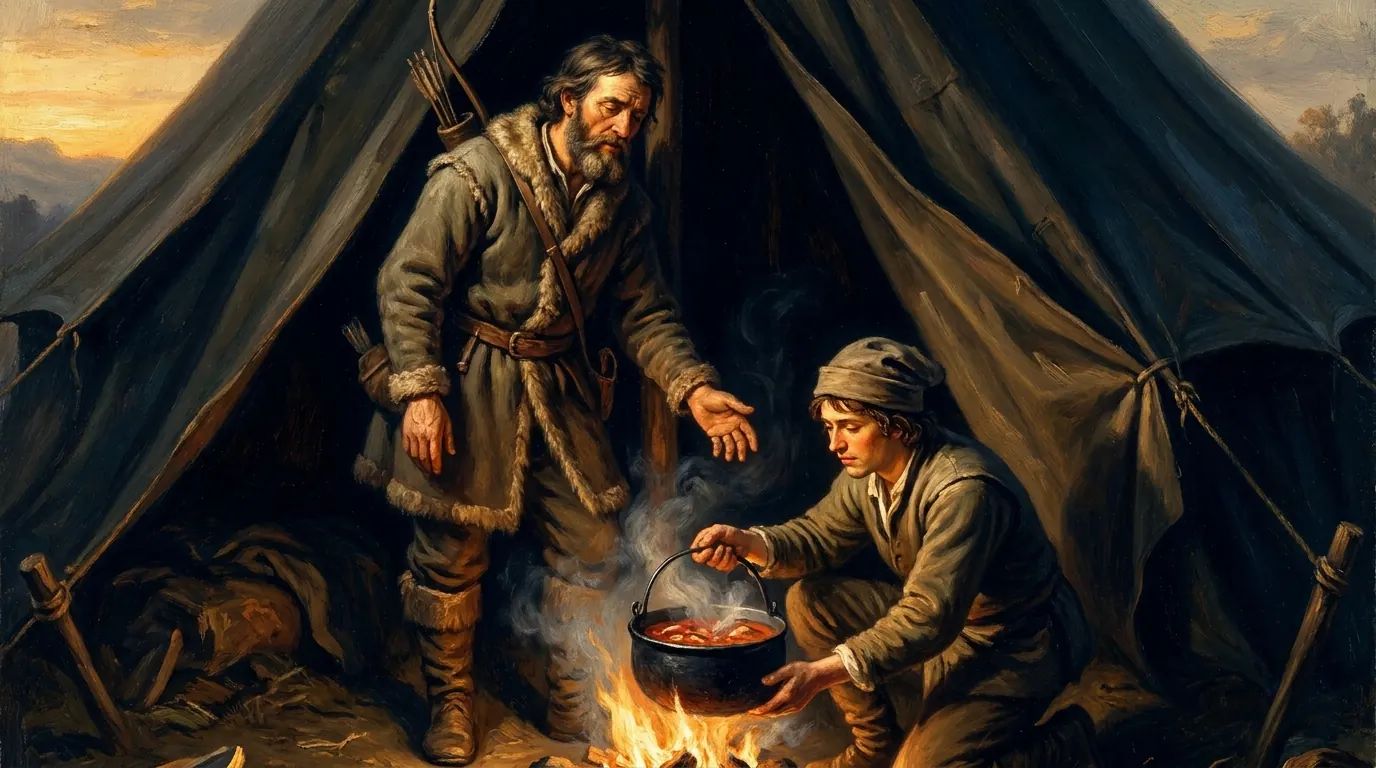
Esau sold his birthright, the double share of the family inheritance and the place of the firstborn, to his twin brother Jacob for a bowl of red lentil stew (Genesis 25:29-34). The text gives its own verdict in one sentence: “Thus Esau despised his birthright.” The money lesson is plain. Esau traded something large and lasting for something small and immediate, and people repeat that trade today with impulse purchases, financed wants, and savings that never get started.
Put it into practice
Find out where your own “stew” money goes with our Budget Calculator, then see what a small monthly amount becomes with the Compound Interest Calculator. For the whole biblical picture of money, grab the free Biblical Blueprint for Money (41-page PDF, no signup).
What happened in Genesis 25
Isaac and Rebekah had twin sons. Esau was born first, so the birthright was his. In that world the firstborn carried the family name, led the household after his father, and received a larger share of the estate. Later Israelite law states the double share directly: the firstborn gets “a double portion of all that he has” (Deuteronomy 21:17). In this particular family the birthright also sat inside the promise God made to Abraham, which made it worth far more than land and livestock.
One day Esau came in from the field and found Jacob cooking a red stew of lentils. Esau was hungry and said, “Let me eat some of that red stew, for I am exhausted” (Genesis 25:30). Jacob saw his chance and named a price: “Sell me your birthright now.” Esau answered, “I am about to die; of what use is a birthright to me?” He swore an oath, sold it, ate, drank, and left. Then comes the line that closes the scene: he despised his birthright.
Notice how ordinary the moment is. Nobody put a knife to Esau's throat. He was tired and hungry after a day of work, and the future felt abstract while the stew smelled real. Most bad money decisions arrive in exactly that costume.
Jacob does not come out of this looking noble. He took advantage of his brother's hunger, and the family paid for that scheming for years afterward. Scripture does not excuse either brother. The lesson for a buyer is about Esau's choice, and the lesson for a seller, employer, or lender is about Jacob's: do not profit from someone's weakest moment.
What the New Testament adds
Hebrews 12:16 uses Esau as a warning: “that no one is sexually immoral or unholy like Esau, who sold his birthright for a single meal.” The writer calls the whole exchange a single meal. The phrase points at scale. A meal lasts an evening, and a birthright shapes generations.
Hebrews 12:17 adds that afterward, when Esau wanted the blessing, he was rejected, “for he found no chance to repent, though he sought it with tears.” Some choices reopen. This one did not. A financial parallel is any decision that locks in a cost you cannot undo, such as a loan with a heavy exit penalty or a sale of an asset you can never buy back.
The Proverbs describe the same pattern without naming Esau. “Whoever loves pleasure will be a poor man” (Proverbs 21:17). “Precious treasure and oil are in a wise man's dwelling, but a foolish man devours it” (Proverbs 21:20). “The plans of the diligent lead surely to abundance, but everyone who is hasty comes only to poverty” (Proverbs 21:5). Each verse sets the immediate appetite against the plan that pays later.
Your birthright is bigger than you think
Few of us hold a literal family estate. Every household still holds a long-term inheritance of its own. It includes retirement savings, home equity, an emergency fund, the ability to give generously, and the financial freedom you hope to hand to your children. Any of these can be sold for stew.
| Esau's trade | The modern version | What the future loses |
|---|---|---|
| Lentil stew for the birthright | A new gadget or trip put on a card while the emergency fund sits empty | Security in the next job loss or repair |
| Hunger overrides the long view | A late-night online order, a sale that ends tonight | The margin that gives you choices |
| Sworn oath, no way back | Financing a want across several years | Future paychecks already spent |
| Contempt for what was inherited | Cashing out retirement early for a lifestyle upgrade | Decades of growth on the money you took out |
Debt deserves its own mention. Borrowing to buy a want moves tomorrow's income into today's cart, and Proverbs 22:7 says “the borrower is the slave of the lender.” Our page on buy now, pay later covers the specific question of installment plans. Here the point is wider: any purchase that spends your future to feed a present craving carries Esau's pattern.
Why smart people still sell their birthright
Esau was a capable man who knew the land and could feed a household. Intelligence does not protect anyone at the hungry hour, because the pressure works on the appetite before it reaches the reasoning. Three pressures show up again and again in money decisions.
Exhaustion. Esau came in from the field worn out, and tired people spend more. Decision fatigue at the end of a long day is one reason late-night shopping goes badly. Rest is a financial tool.
Immediacy. The stew was steaming in front of him, and the birthright was a promise about the future. Anything you can touch today beats a benefit that arrives in twenty years, unless you build habits that make the future visible. A savings goal written on the refrigerator door or a retirement balance checked once a quarter can do this.
A dramatic story. “I am about to die” was a large exaggeration for a man who was hungry. Money decisions get the same drama: “I deserve this,” “we have to have it,” “this will never come again.” When your inner voice starts talking like Esau, slow down. Ask whether the claim is true, or only loud.
Hunger is not a sin. Jesus fed crowds, and God provides food. The trouble starts when a real need is used to justify a permanent, costly trade, and one way to spot it is to ask whether a cheaper, smaller answer to the same need exists. Esau could have asked for a piece of bread.
What a small habit costs over time
The numbers are easier to see than to feel. Suppose a household spends $60 a week on small unplanned purchases, the kind nobody remembers by Friday. That is $3,120 a year. The next table shows what that amount becomes if it goes toward the future instead. The growth column is an illustration with a stated assumption, and no return is guaranteed. Investments can lose value.
| Time | Total set aside ($3,120 a year) | If it grew 6% a year (illustration) |
|---|---|---|
| 10 years | $31,200 | about $41,100 |
| 20 years | $62,400 | about $114,800 |
| 30 years | $93,600 | about $246,700 |
The point is not that every purchase is a sin. Enjoying a meal out or a small gift is fine. The point is that a hundred small decisions made in hunger add up to a very large sale. Run your own figures on the Compound Interest Calculator, and talk with a qualified financial professional before you choose specific investments.
Three real-life scenarios
The sale-day shopper. A couple with a $1,000 emergency goal sees a $900 discounted TV. They have $600 saved so far. The TV would take the savings to zero and leave a $300 gap. Applying Esau's lesson, they wait a week, finish the $1,000 fund first, and buy the TV from the next month's budget line for fun spending. They lose nothing except the hurry.
The early cash-out. A man in his forties changes jobs and can cash out a $35,000 retirement account. A new truck sits on the lot. Cashing out usually brings income tax and often an early-withdrawal penalty, and it removes decades of possible growth. Rolling the account into the new plan keeps the birthright intact. He should check the tax rules with a tax professional before he decides.
The exhausted parent. A mother works two jobs, comes home tired, and orders takeout most nights because she has no energy to cook. The fix is not shame. A slow cooker, a shared freezer meal swap, or a weekly prep hour turns the same tired evening into a cheaper one. Esau's hunger was real, and a wise person plans for the hungry hour before it arrives.

A framework: guard your birthright
1. Name your birthright. Write down the long-term things you are protecting: the emergency fund, retirement savings, a debt-free home, and the gifts you want to leave. A named goal is harder to trade for stew.
2. Know your hungry hours. Most people have predictable times when they overspend, such as late at night, after a hard day, or on a payday. Write yours down and plan around them.
3. Use a waiting rule. Wait 24 hours on any unplanned purchase over a small limit you set, and 30 days on anything big. Esau had no waiting period. You can build one.
4. Pay the future first. Set up automatic transfers to giving, savings, and retirement on payday, before any spending. Proverbs 3:9 speaks of honoring the Lord with the firstfruits, and the same order protects the rest of your plan.
5. Say no to financing wants. If you cannot pay cash from a savings line for a want within a few months, it can wait. Financed wants tie up future income.
6. Keep a fun line in the budget. A small, planned amount for enjoyment takes the pressure off. A budget with no room for treats tends to break at exactly the wrong moment.
7. Do not exploit anyone else's stew moment. If you sell, lend, or manage money for others, treat their weak moments with care. Jacob's price was a scheme.
Internal study path
Keep going with whether buy now, pay later is a sin, Proverbs 21:20, Proverbs 21:5, the biblical emergency fund, what the Bible says about debt, the Bible on get-rich-quick thinking, and our stewardship hub.