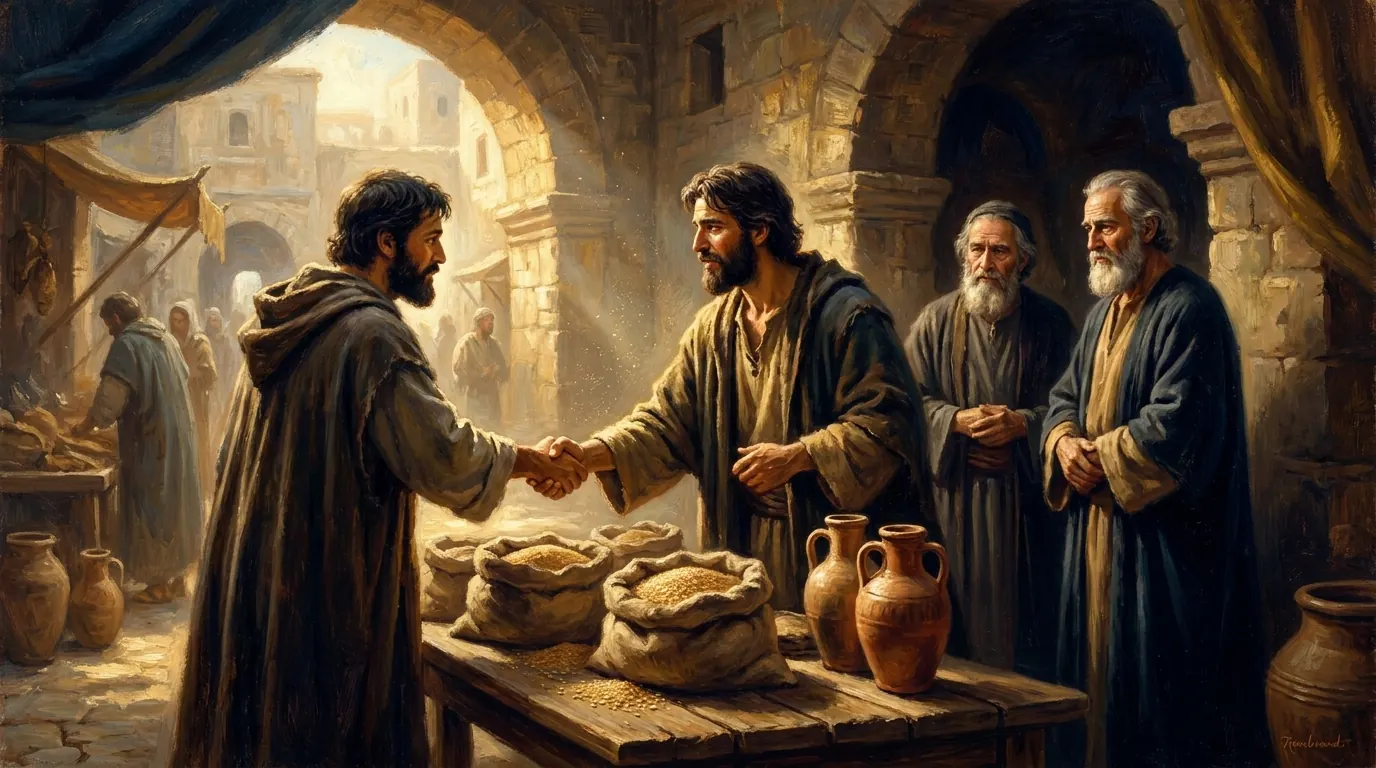
Proverbs 18:21 says, “Death and life are in the power of the tongue, and those who love it will eat its fruits” (ESV). Applied to money, the verse says that what you say in a negotiation, a contract, a promise to a lender, or a Saturday-morning talk with your spouse sets real dollars in motion. Words close deals, create debts, keep marriages steady, and break them.
Put it into practice
Give your next money conversation something concrete to talk about: build a plan together in our Budget Calculator, then read how to budget as a Christian couple. The free Biblical Blueprint for Money (41-page PDF, no signup) gives you a plan to bring to the table.
What Proverbs 18:21 means
The verse sits inside a short thought. Proverbs 18:20 says a man’s stomach is filled with the fruit of his mouth, and he is satisfied by the yield of his lips. Verse 21 then raises the stakes: the tongue holds power over death and life, and people eat what it grows. The picture is a farm. Words are seed, and the harvest comes back to the one who planted.
The Hebrew behind “power” is yad, the ordinary word for “hand.” Some translations keep that image: death and life are in the hand of the tongue. A hand grips, builds, throws, and heals. So does speech.
One caution matters for a money site. Proverbs 18:21 does not teach that you can speak wealth into existence. That claim belongs to the prosperity gospel, and Scripture never makes it (see our page on the prosperity gospel). The proverb describes cause and effect in ordinary life. Keep a promise and trust grows. Make a careless one and it costs money. A harsh word in a budget meeting can cost a week of peace in the house.
Where words touch your money
Most financial damage starts as a sentence. Here are the five places where speech and money meet, with illustrative dollar figures so you can see the stakes.
| Situation | Words that build | Words that damage | Illustrative dollars |
|---|---|---|---|
| Negotiating a purchase | “Can you put that quote in writing? I’ll compare it with one more.” | Bluffing, running the item down, or agreeing on the spot | A $3,200 repair quote drops to $2,600 after a second quote: $600 saved |
| Making a promise | “I will pay $150 on the 1st of each month.” | “I’ll get it to you soon.” | A vague loan of $1,500 to a relative can cost the money and the relationship |
| Talking to a lender | Calling early, asking for a payment plan | Dodging calls, excuses, silence | A plan at $250 a month against the original $400 frees $150 a month, or $1,800 a year |
| Talking with your spouse | “Here is what I’m worried about. What do you see?” | Accusing, hiding, sarcasm | A weekly 20-minute meeting keeps small errors from becoming $4,800 of card debt |
| Speaking about what you have | Thanks, specific and out loud | Constant complaint and comparison | No dollar cost on paper, and a large one in contentment |
The figures above are examples to show the size of the stakes, and your own numbers will differ. The pattern holds in every row: the sentence comes first, and the dollars follow.

Promises and contracts: say what you mean
Scripture treats a spoken commitment as weighty. Psalm 15:4 describes the person who may dwell with God as one who “swears to his own hurt and does not change.” That person keeps a promise even when it becomes expensive. Ecclesiastes 5:5 adds, “It is better that you should not vow than that you should vow and not pay.” Jesus puts the same standard in plain words: “Let what you say be simply ‘Yes’ or ‘No’” (Matthew 5:37).
Proverbs 20:25 warns about the rash promise: “It is a snare to say rashly, ‘It is holy,’ and to reflect only after making vows.” Think of the person who says “I’ll co-sign that” at a family dinner and finds out on Monday what it means. Proverbs 6:1-2 uses the same language of a trap for those who put up security for a neighbor: “you are snared in the words of your mouth.” Our page on what the Bible says about cosigning covers that case in detail.
Practical rules follow from these verses:
Wait a day before you commit. Any request for money, a signature, or a big purchase gets the answer, “Let me pray and talk with my spouse, and I’ll answer tomorrow.”
Put terms in writing. Amount, date, payment schedule, and what happens if a payment is late. Writing protects the friendship, because nobody has to guess later what was said.
Keep the small promises. Luke 16:10 says the person faithful in very little is faithful in much. Paying back the $20 on the day you said you would is training for the $2,000 promise.
Negotiating with honest words
Proverbs describes a bargaining scene that anyone who has bought a used car will recognize. In Proverbs 20:14 the buyer cries “Bad, bad” over the item, and once he has walked away he brags about the bargain. He ran the item down to get a lower price. Scripture notes the game and does not endorse it.
Christians can negotiate hard and stay honest. Proverbs 11:1 says, “A false balance is an abomination to the LORD, but a just weight is his delight.” Ephesians 4:25 tells believers to put away falsehood and speak the truth to their neighbor. In practice that sounds like this:
State your real budget range, and skip the invented competing offer. Ask questions. “What is the lowest price you can do today?” is honest. Give a real reason when you decline. “That is above what we planned” is true and leaves the seller free to answer. Accept the deal you agreed to. Walking back a handshake because you found a better offer later breaks Psalm 15:4.
The same goes for salary talks. State the value you bring, name the figure you want, and stay courteous if the answer is no. The person on the other side will remember your tone longer than your number.
Debt talk: speak early and pay what is due
Debt thrives in silence. People stop opening mail, stop taking calls, and let the balance grow. Romans 13:8 says, “Owe no one anything, except to love each other.” Where a debt already exists, honest words are the first payment.
Proverbs 3:27-28 speaks to the person who has the money and delays: “Do not withhold good from those to whom it is due, when it is in your power to do it. Do not say to your neighbor, ‘Go, and come again, tomorrow I will give it’—when you have it with you.” If the money is in your account and the bill is due, pay it.
If the money is not there, call before the due date. A soft answer turns away wrath (Proverbs 15:1), and lenders tend to answer a caller who says, “I can pay $250 a month starting the 1st. Can we set that up?” more kindly than one who says nothing. Ask for the terms in writing. Then keep them. Our pages on what the Bible says about debt and whether debt is a sin go further, and the Debt Snowball Calculator shows how long a plan will take.
Proverbs 14:23 finishes the thought: “In all toil there is profit, but mere talk tends only to poverty.” A promise to pay is worth what the next payment is worth. Words have to turn into deposits.

Marriage money talks: the tongue at the kitchen table
Couples argue about money more than almost anything else, and the argument usually turns on tone. Proverbs 12:18 says, “There is one whose rash words are like sword thrusts, but the tongue of the wise brings healing.” Ephesians 4:29 asks for speech “that is good for building up, as fits the occasion, that it may give grace to those who hear.” Both verses fit a conversation about an overdrawn account.
Proverbs 18:13 sits only a few lines before the famous verse: “If one gives an answer before he hears, it is his folly and shame.” Listening comes before advice. Try these habits:
Hold a weekly money meeting. Twenty minutes, same day, same place, snacks allowed. Review last week’s spending, the next bill due, and one decision to make together.
Open with a fact and a feeling. “We spent $640 on groceries, and I feel anxious about that” invites a discussion. “You always overspend” ends it.
Agree on a spending threshold. Many couples pick a number, often $100 to $250, above which both talk before buying. The right figure depends on your income.
Repeat back what you heard before you answer. It sounds slow and it prevents most fights.
Take a couple with $5,200 of monthly take-home pay and a $4,800 credit-card balance. If the weekly meeting produces an agreement to send an extra $300 a month to the card, the balance clears in about 16 months, before interest. Interest will stretch that timeline, so plan for a longer stretch. The plan starts with a conversation both people can speak in honestly. Our pages on marriage and money verses, money and marriage lessons, and separate finances in a Christian marriage take up the questions couples ask most.
Complaining and blessing
Israel in the wilderness shows what habitual complaint does. In Numbers 14:2 the whole congregation grumbled and said they wished they had died in Egypt. Paul refers to that generation in 1 Corinthians 10:10 as a warning. Philippians 2:14 gives the instruction for today: “Do all things without grumbling or disputing.”
Complaining about money has a practical cost. It trains the mind to see what is missing and to miss what is present. Paul writes in Philippians 4:11-12 that he has learned to be content in every circumstance, in plenty and in need. Contentment is learned by practice, and one of the practices is speaking thanks aloud. Proverbs 16:24 says that pleasant words are like a honeycomb, sweet to the soul and healing to the bones.
A simple habit helps. At each weekly money meeting, each spouse names one specific thing the household has been given that week: a paid bill, a full pantry, an unexpected $40 refund. This is a fact-based way to practice 1 Thessalonians 5:18. Complaint about real problems still has its place, because Scripture’s psalms are full of honest lament. Honest lament brings a problem to God and to your spouse for action. Chronic grumbling only repeats it. Our page on contentment in the Bible builds on this.
A working framework for your words about money
1. Pause before you commit. Use a 24-hour rule for signatures, loans, and large purchases.
2. Write the terms. Amount, dates, and consequences go on paper for every loan, gift with strings, or shared expense.
3. Say yes or no. Matthew 5:37 removes the need for vague answers.
4. Speak first to creditors. Call before the due date, offer a specific amount, and confirm it in writing.
5. Hold a weekly money meeting with your spouse. Listen before you respond. Open with a fact and a feeling.
6. Practice thanks out loud. Name one specific provision every week.
7. Turn talk into action. Proverbs 14:23 measures a conversation by what it produces. End every discussion with one task, an owner, and a date.
Internal study path
Keep going with Proverbs on money, a summary of the book of Proverbs, Bible verses about integrity, Proverbs 22:7, budgeting as a Christian couple, contentment in the Bible, and our stewardship hub.