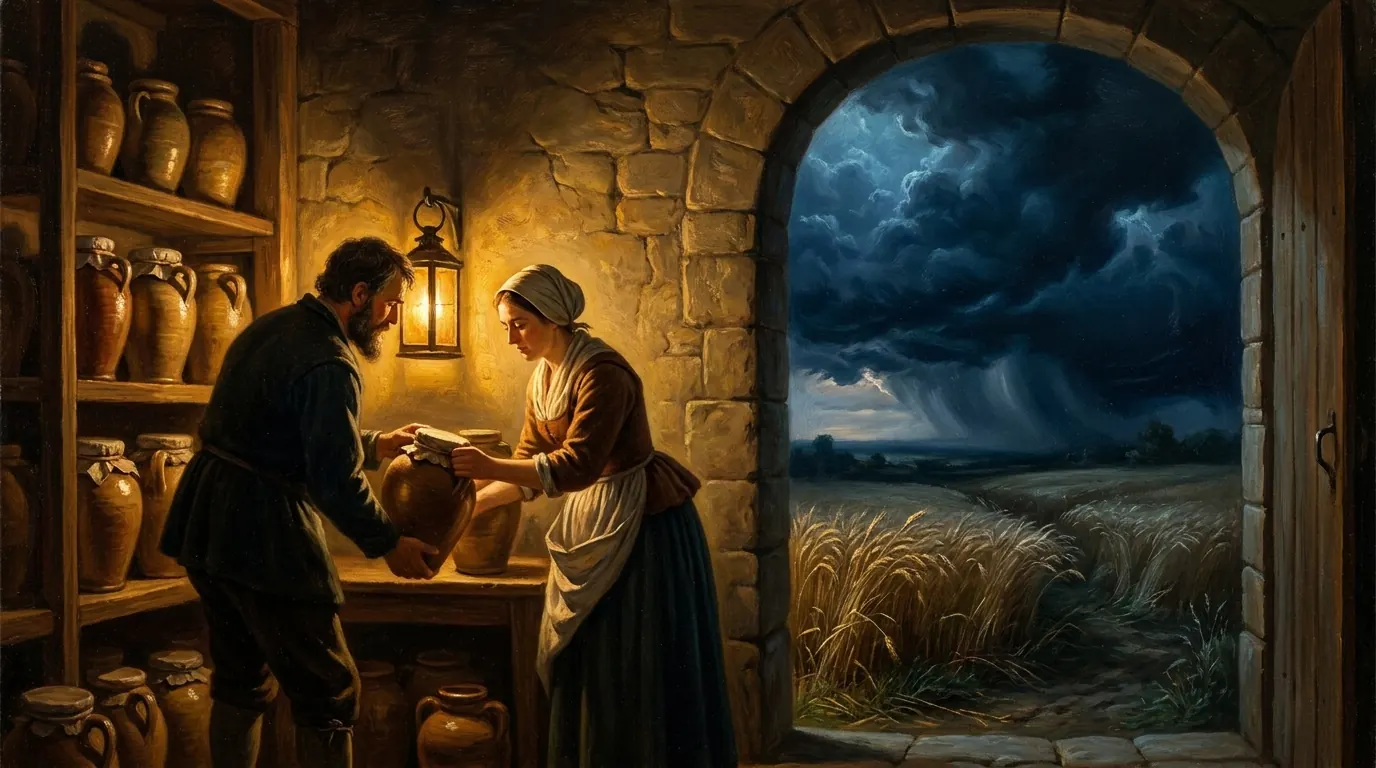
Yes, insurance fits what the Bible teaches about wise provision. Scripture praises the person who sees danger coming and prepares (Proverbs 22:3), commands a man to provide for his household (1 Timothy 5:8), and shows Joseph building a reserve for a known disaster (Genesis 41). A policy sits beside trust in God as one of the ordinary tools a prudent person uses while still trusting him.
The question comes up because two things feel true at once. Jesus tells his followers not to be anxious about tomorrow, and a family that skips coverage can be ruined by one bad day. This article sorts out what each passage asks of you, explains the basic difference between term and whole life coverage, and gives a short checklist for deciding how much protection your household needs. It does not recommend any company or product.
Put it into practice
Coverage works best on top of a cash cushion. Find your target with the Emergency Fund Calculator, then see where every dollar goes with the Budget Calculator before you add a new monthly premium.
Where the worry comes from
Some believers feel that insurance signals doubt. If God provides, why pay a company to catch you? The feeling usually leans on Matthew 6:34: “Therefore do not be anxious about tomorrow, for tomorrow will be anxious for itself. Sufficient for the day is its own trouble” (ESV).
Read the whole sermon, though. In the same chapter Jesus points to birds that are fed and lilies that are clothed, and the target of his teaching is anxiety, the gnawing fear that crowds out the kingdom. He never tells a farmer to leave the barn empty or a father to leave his children without a plan. The Bible condemns worry and praises planning in the same breath. The only open question is what planning looks like in a modern economy, where a long illness, a house fire or a lawsuit can wipe out savings that took years to build.
What Scripture says about preparing
Proverbs 22:3. “The prudent sees danger and hides himself, but the simple go on and suffer for it” (ESV). The wise person is defined here by foresight. Danger exists, the prudent man sees it, and he takes shelter. The simple one walks straight into it and pays. Insurance is a form of shelter that you build before the storm, when you can still afford the materials.
Proverbs 6:6-8. “Go to the ant, O sluggard; consider her ways, and be wise. Without having any chief, officer, or ruler, she prepares her bread in summer and gathers her food in harvest” (ESV). The ant stores up in the season of plenty. Nobody forces her, and the text calls this wisdom. For a deeper look, read our study of Proverbs 6:6-8.
Proverbs 21:20. “Precious treasure and oil are in a wise man's dwelling, but a foolish man devours it” (ESV). A wise household keeps reserves. A foolish one spends everything it receives.
Luke 14:28. “For which of you, desiring to build a tower, does not first sit down and count the cost, whether he has enough to complete it?” (ESV). Jesus himself uses a builder who counts costs as a model of good judgment. Counting the cost of an uninsured loss belongs to the same habit.
James 4:15. “Instead you ought to say, 'If the Lord wills, we will live and do this or that'” (ESV). James lets the merchant keep planning and asks him to plan with open hands. A policy fits that posture: you prepare, and you still admit the outcome is not yours to control.
1 Timothy 5:8 and the duty to provide
“But if anyone does not provide for his relatives, and especially for members of his household, he has denied the faith and is worse than an unbeliever” (ESV).
Paul is writing about care for widows and extended family, and the verse is blunt. Provision is a duty, and the duty has a long horizon. A father who earns well today and leaves his family with nothing if he dies tomorrow has provided for one season only. Life insurance is the most direct modern answer to this verse for a household that depends on one or two incomes. Our full study of 1 Timothy 5:8 covers the Greek and the context in more detail.
The same logic reaches other kinds of coverage. Disability insurance protects the paycheck that feeds the household. Auto and homeowner's coverage protect the people who might be hurt or displaced. Health coverage protects the family from a single illness consuming everything saved for the next ten years. Every one of these asks the same question: if the worst happens, who carries the weight?
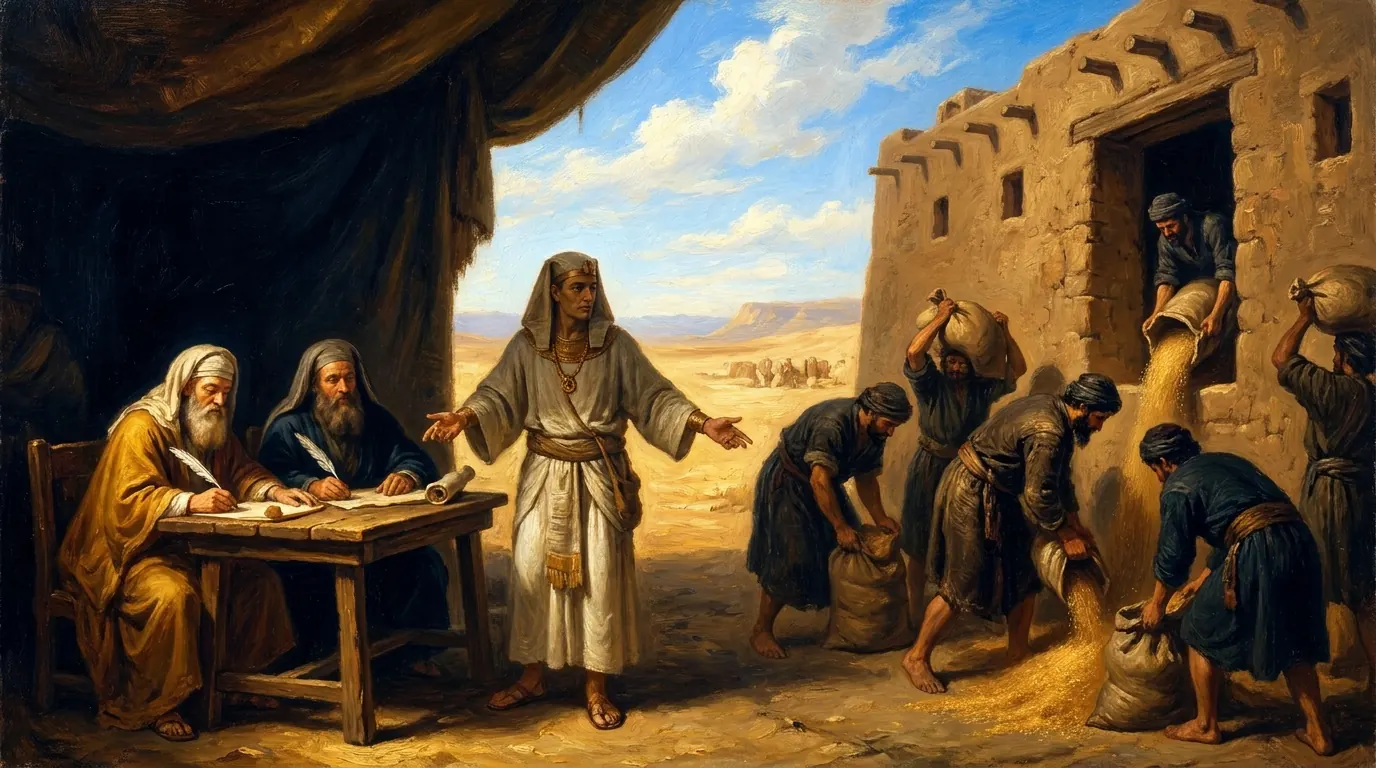
Joseph's storehouses: a reserve against a known disaster
Genesis 41 gives the clearest biblical case for planned protection. Pharaoh dreams of lean cows and thin grain, and Joseph advises a policy: “Let Pharaoh proceed to appoint overseers over the land and take one-fifth of the produce of the land of Egypt during the seven plentiful years” (Genesis 41:34, ESV).
Three features stand out. The reserve was built during abundance. It was a fixed share, one-fifth, so it did not depend on what happened to be left over. And it was held against a risk that was coming whether anyone liked it or not. God had revealed the famine, and the response he honored was to store grain and act on the warning.
Insurance pools this same instinct. Thousands of people pay small amounts during ordinary years so that the few who meet disaster can be rebuilt. It is a shared granary, with premiums as the one-fifth. Your own savings are your private storehouse, and the two work best together. For the savings side, see how to build a biblical emergency fund.
When insurance does become a spiritual problem
Honest answers admit the limits. A few attitudes do deserve a warning:
Treating coverage as a guarantee of safety. A policy repairs money loss. It does not repair grief, health or a marriage. Psalm 127:1 still stands: unless the LORD builds the house, the builders labor in vain.
Over-insuring out of fear. When the premium list grows because anxiety keeps asking “what if,” the plan has become a way to avoid trusting God with the unknown. A household can spend a fortune on small risks it could have absorbed with savings.
Using insurance as an investment you do not understand. Complex products that mix protection with an investment can carry heavy fees. Read the terms and ask hard questions before you sign anything. Our review of indexed universal life as an investment explains one example in plain language.
Neglecting generosity and giving to build a larger cushion. Protection should not squeeze out the firstfruits you owe God or the help your neighbor needs.
Term versus whole life: the basics
Life insurance comes in two broad families. The details differ by company and state, so treat the table as a general map and read any policy before you buy it.
| Feature | Term life | Whole life |
|---|---|---|
| How long it lasts | A set period, such as 10, 20 or 30 years | Your whole life, as long as premiums are paid |
| Cost per dollar of coverage | Generally much lower | Generally much higher |
| Cash value | None | Builds slowly inside the policy |
| Best fit | Replacing income while children are young and debts are large | Lifelong needs, such as a dependent with special needs or certain estate plans |
| Main risk | Coverage ends before your need does | Paying so much that other priorities go unfunded |
Many financial writers, Christian and secular, suggest that most families whose main need is replacing an income during the working years start by looking at term coverage, and many use it alongside savings and investing. Some advisors disagree for specific cases, so ask more than one source and ask how each is paid. Our guide to finding a Christian financial advisor lists questions worth asking. Check any policy's terms and exclusions directly with the insurer, and confirm rules that apply in your state.

A six-step checklist for your household
1. Start with who depends on you (1 Timothy 5:8). List every person who would lose support if your income stopped. A single adult with no dependents has a very different need than a parent of three.
2. Build the cash cushion first (Proverbs 21:20). Savings handle small and frequent losses. Insurance exists for the rare large ones. If one broken car makes you panic, fix that gap before adding premiums.
3. Cover the risks that could end your household's stability (Proverbs 22:3). Rank them by size. Typical heavy hitters are a death, a long disability, a major medical event, a house loss and a liability claim after an accident.
4. Choose plain products you can explain (Luke 14:28). If you cannot describe in two sentences how a policy pays out and what it costs, keep asking until you can.
5. Keep generosity in the budget (Proverbs 3:9). Premiums are a stewardship expense. They should not be the reason giving falls to zero.
6. Review every year or after a big life change. A new baby, a new mortgage, a raise or a paid-off debt changes the right amount of coverage. Joseph's reserve was reviewed against a calendar of seven years, and yours deserves a calendar too.
What about trusting God instead?
Trust and preparation appear side by side across Scripture. Nehemiah prayed and posted a guard (Nehemiah 4:9). Paul trusted God and still told the centurion that the sailors had to stay on the ship (Acts 27:31). The believer who buys coverage and prays over the family is doing both, and a Christian who skips coverage on principle should be able to say who would carry the cost if the worst arrived.
Some believers choose not to buy conventional coverage and instead rely on savings, family and church. That is a decision made before God, and honest people differ. What Scripture gives no support for is neglect described as faith. Ask yourself whether the choice protects the people who depend on you.
Internal study path
Continue with 1 Timothy 5:8 on providing for your household, the biblical emergency fund, Christian estate planning, Christian health sharing ministries compared, whether Christians should have savings, Proverbs 6:6-8 and the ant, and our stewardship hub.